

Are pay-by-the-minute booths the future of work?
Sure, there are advantages, but I find it isolating. I’m sick of sitting in my apartment. I prefer to interact with colleagues face-to-face.
I find the endless Zoom meetings draining. I’m tired of the lunch options nearby.
Also, construction noise is inescapable in Singapore, and I’m dreading the day when builders start tearing down the building across the street, or the neighbours start to renovate their kitchen.
In preparation for this, I tried out a new type of workspace. It’s a pay-by-the-minute desk in a booth at my nearest shopping centre.
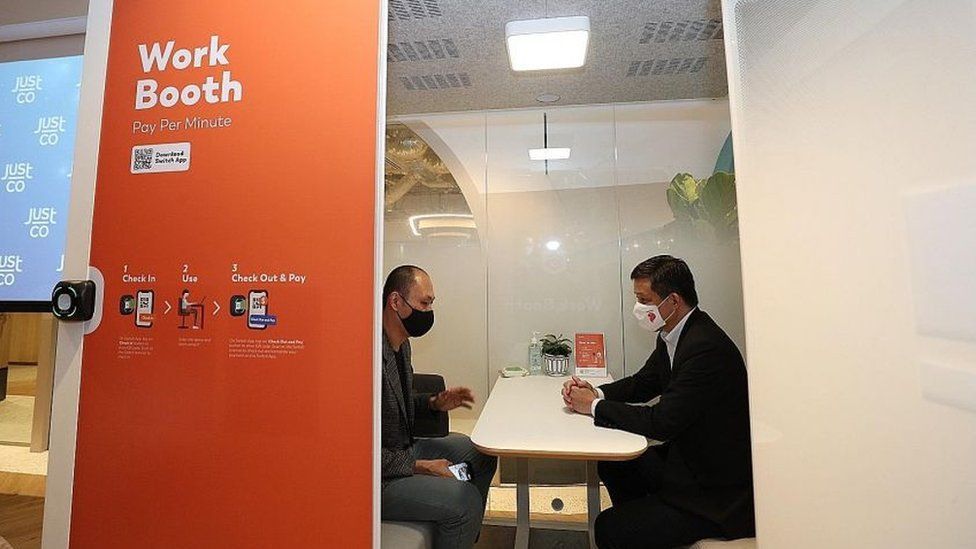
The pods, which cost less than four Singapore dollars ($3; £2.15) per hour, have been created by a Singaporean company called Switch.
They follow similar booths that have been around for a few years in Japan, where a handful of companies like Telecube and Cocodesk have placed them in metro stations, hotel lobbies and convenience stores.
However, Switch's main competition in Singapore appears to be Starbucks, or any other coffee shop with free wi-fi.
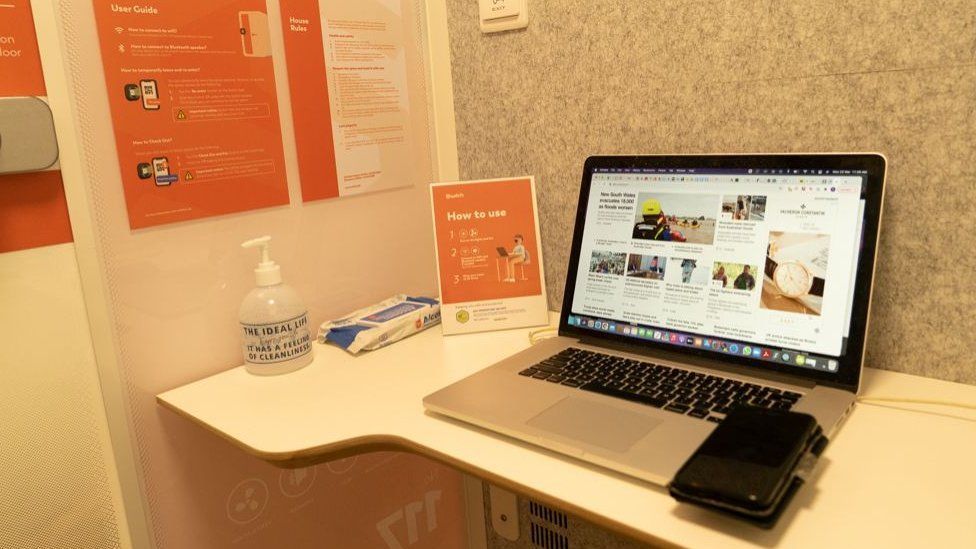 The booths come with hand sanitizer and wipes
The booth is a reasonable work space, if a little utilitarian, and very compact. The wi-fi works, and so does the fan. The chair is okay, but unremarkable. The overhead light isn’t overpowering. The grey and white colour scheme isn’t very exciting, but nor is it distracting.
But the main selling point for me is that it's not my living room. Switch's founder Dominic Penaloza agrees.
“I certainly would agree with the notion that part of the value proposition [of the booths] is that psychological separation that is created by a physical separation between work and home,” he says.
Then again, if I’m sick of my apartment, leaving it is also a hassle. Getting to the booth required a short train journey - and walking half way around a shopping centre in the tropical heat to find an entrance that opened before 10am.
Then I had to check in using a contact tracing app at the centre's entrance, and then at the booth itself, using both the Switch app and the contact tracing app. And once in the booth, wearing a mask was still compulsory.
These are not big problems, but they all require more effort than just walking from my bedroom to my living room.
Switch has now opened more than 60 of its booths in Singapore. They are in addition to its 3,500 hireable desks in shared co-working offices that are the more typical way of hiring somewhere to work.
Switch aims to place many more booths across the city-state. And overseas expansion is on the horizon too.
Mr Penaloza says its on-demand flexibility "means you pay only for what you use, and you can use them where and when you need it".
While he thinks the firm's booths would have existed without Covid-19, the pandemic made the business case for them more obvious.
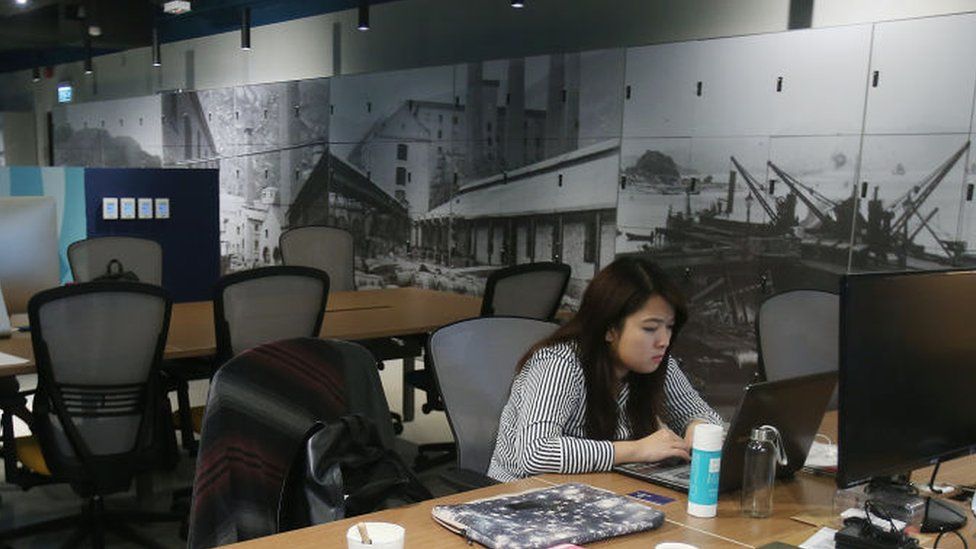
Recent surveys from around the world suggest that a majority of employers will permanently adopt a hybrid working model when the pandemic finally ends - staff will be able to continue to work from home part of the time.
However, home working has raised new questions about who pays for what. For example, if employees work from a kitchen table or study, should their employers pay for their internet connection or their ergonomic chairs?
Switch thinks its booths may offer a solution, and some of its corporate clients already allow their employees to charge the cost of a booth to the company.
Remote working expert Prithwiraj Choudhury says Switch's booths take the concept to "the next level".
An associate professor at Harvard Business School, he says remote working had already been growing in popularity before the pandemic.
He gives the example of Tulsa Remote, which started in 2018 and aims to rejuvenate the Oklahoma city by offering remote workers grants of up to $10,000 to move there.
Another company, MobSquab, helps US tech firms locate international workers who are struggling to get US work visas in Canada, from where they work remotely. It also started out three years ago.
Prof Choudhury thinks the booths could create an additional layer of flexibility for such organisations, who often rely on putting the workers in a typical shared workspace.
"These pods take this idea to the next level, and create the opportunity for workers who want to work-from-anywhere to do so," he says.
But could they really take off in Europe and North America, where many workers are accustomed to larger working spaces?
UK business psychologist Jess Baker thinks they could be popular with those looking for a cheap alternative to working from home.
"Cultural differences may mean that Westerners would have to get used to these compact working spaces," she says. "And while I'm honestly wondering if I'll have to clear up the previous occupant's half-empty coffee cup, I am also looking forward to trying one out."
It should be noted that food and drink isn't allowed in Switch booths, and customers are expected to wipe them down after using them, although there aren't any staff on hand to enforce the rule. Switch says the "space provider" is responsible for cleaning, which in the case of the pod I visited was the operator of the shopping centre.
Fellow UK business psychologist Stuart Duff, a partner at Pearn Kandola, also thinks they may be popular. "As we increase in our need for private and cheap working spaces, our concern about size and space will quickly be outweighed by the value of privacy and convenience."
From my own experience, the booth in a Singapore shopping centre was a good place to get work done for an hour or two. But then the stores began to open.
After the staff at the electronics outlet next to the pod finished switching off a seemingly endless string of alarms, they turned on the music.
It wasn’t so loud that work was impossible, but it was loud enough for the song-identification app Shazam to tell me I was listening to pop stars Demi Lovato and Cardi B.
As I left, there was a flustered-looking man checking out of the pod next to mine. He shook his head, complained about the music and then marched off.
I felt the same. One reason I came here was to avoid noisy neighbours.
Still, the booths seem potentially useful. I would consider using one again, but probably not the same one.











