

Dark skin Immigrant against dark skin immigration: Patel personally approved Rwanda plan launch after civil servant concerns
Priti Patel had to personally approve a scheme to send some asylum seekers from the UK to Rwanda after her officials voiced concern over value for money.
The home secretary issued a rare "ministerial direction" to push through the plans, meaning she takes responsibility for it.
It is only the second time the Home Office has used the power in 30 years.
A union for top civil servants said the plan was "divisive" but officials would have to implement it or leave.
FDA general secretary Dave Penman told BBC News: "Civil servants know their job is to support the government of the day. They sign up for that knowing they might not like what the government does.
"On the more divisive policies, which this clearly is, they face a choice - implement or leave. That could mean elsewhere in the Home Office, another department, or the service."
Mark Serwotka, general secretary of the Public and Commercial Services (PCS) Union, which also represents civil servants, said: "For the government to attempt to claim this is anything other than utterly inhumane is sheer hypocrisy.
"We have already seen that they are prepared to risk lives by turning boats back in the channel - a policy which we have had to take them to court over. It is a heartless approach that displays total disregard for human life which everyone must oppose.''

The use of a ministerial direction highlights the unconventional nature of the government's refugee relocation plan.
As well as criticism of the policy on legal, moral and logistical grounds there is concern from officials at the Home Office about the cost.
The department couldn't say whether the scheme would be value for money, which is perhaps not surprising given ministers have openly admitted they don't know how much money will need to be spent.
Flying asylum seekers to another country is not a world first but it's a new and controversial approach for the UK.
The policy is testing the reach of the government's powers.
Home Office civil servants could not precisely quantify the benefits of the policy, and uncertainty about the costs meant Ms Patel had to take personal responsibility for it by issuing the ministerial direction.
A source close to the home secretary said "deterring illegal entry would create significant savings" and the fact that the savings could not be quantified precisely should not prevent action from being taken.
Ministerial directions have been used 46 times since the 2010 election, with two in the Home Office since 1990, according to the Institute for Government think tank.
The other time the formal order was used by the Home Office was in 2019 by former home secretary Sajid Javid, to bring in the Windrush Compensation Scheme before legislation was in place.
Under the £120m scheme, people deemed to have entered the UK unlawfully since 1 January could be flown to Rwanda, where they will be allowed to apply for the right to settle in the east African country.
The government said flights could begin within weeks, initially focusing on single men who crossed the Channel in small boats or lorries.
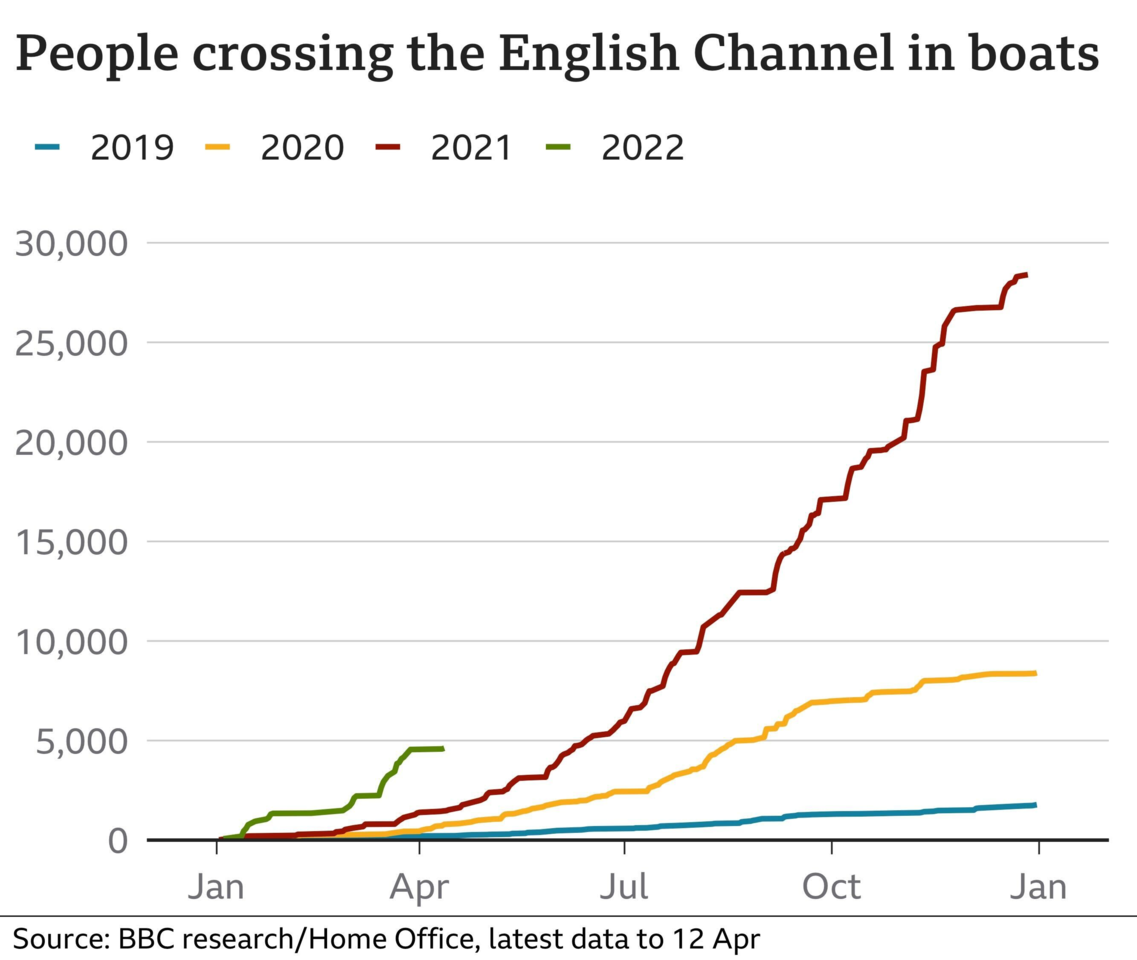
More than 6,000 people have crossed in small boats so far this year. The latest Home Office figures suggest last year, 28,526 people made the crossing, up from 8,466 in 2020.
More than 160 charities and campaign groups have urged ministers to scrap the policy - which has also drawn criticism from opposition parties and some Conservatives.
Sir David Normington, a former head civil servant in the Home Office, told BBC Newsnight the policy was inhumane and morally reprehensible, adding it was "probably unlawful and it may well be unworkable".
Labour's shadow justice minister Ellie Reeves called it "unethical and unworkable" and said it would fail to deter people from crossing the Channel.
Liberal Democrat leader Sir Ed Davey said the scheme would be a "bureaucratic nightmare" and claimed it had been announced as part of a "cynical distraction" from the Partygate scandal surrounding No 10.
Ian Blackford, the SNP's Westminster leader, said it was "absolutely chilling".
Gillian Triggs, an assistant secretary-general at the UNHCR, said such a policy - which is similarly used in Australia - could be effective as a deterrent but there were "much more legally effective ways of achieving the same outcome".
Australia has used offshore detention centres since 2001, with thousands of asylum seekers being transferred out of the country since then.
It has been frequently criticised by the UN and rights groups over substandard conditions at its centres and its own projections show it will spend $811.8m (£460m) on offshore processing in 2021-22.
Last year, the UK government raised concerns at the UN about claims of "extrajudicial killings, deaths in custody, enforced disappearances and torture" in Rwanda, as well as restrictions to civil and political rights.
But a Home Office spokeswoman said Rwanda was a "safe and secure country with a track record of supporting asylum seekers" and that under the plans, the country would "process claims in accordance with the UN Refugee convention, national and international laws".
Speaking to ITV's Good Morning Britain on Friday justice and migration minister Tom Pursglove argued that while the short-term costs would be "pretty equivalent" to what the UK was paying currently to accommodate those claiming asylum, the new scheme would save British taxpayers money in the "longer term".
The scheme comes as part of broader efforts to cut the number of people entering the UK by crossing the Channel in small boats - with the Royal Navy taking operational command of patrolling the Channel from UK Border Force.












