

Haitian Prime Minister involved in planning the President's assassination, says judge who oversaw case
The veteran officers had all gone after high-profile targets before -- oligarchs, drug traffickers, gang leaders, even politicians.
But this operation felt different, according to extensive conversations CNN had with two sources involved in its planning.
This time, if they successfully executed their mission, the sources said it would change the trajectory of an entire nation by helping investigators prove their country's prime minister was connected to an assassination.
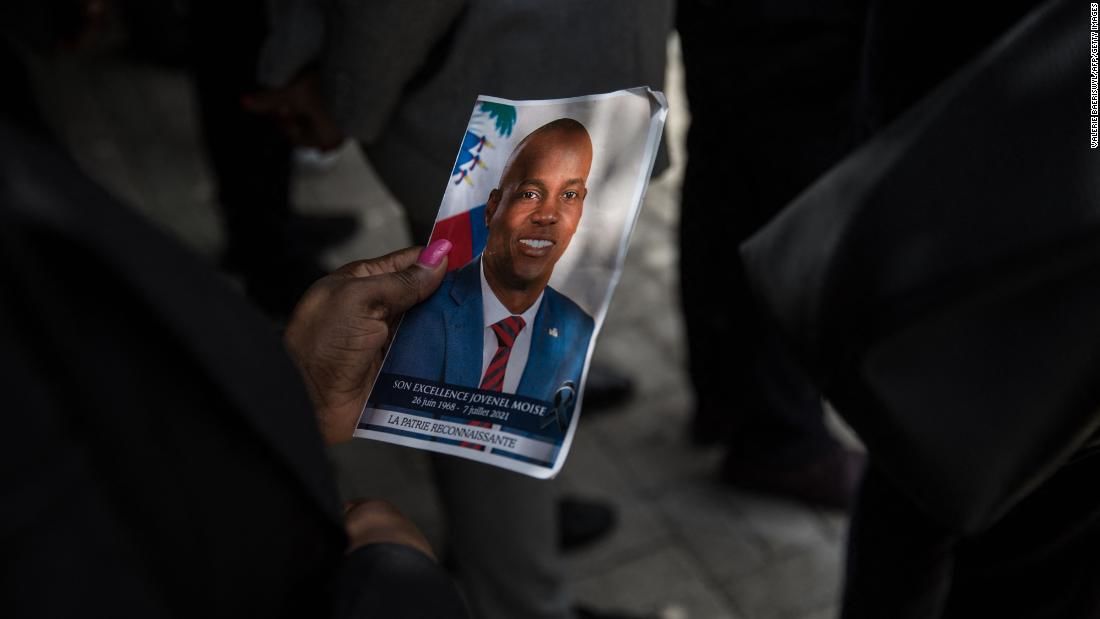
Roughly two months earlier, in the early morning hours of July 7, 2021, Haitian President Jovenel Moïse was assassinated in the presidential residence.
More than two dozen armed men swarmed the president's compound where they encountered little to no resistance from security forces there to protect the president.
Moïse was shot 12 times and killed. His wife, Martine Moïse, was also shot multiple times but survived.
The man in charge of organizing the assassination squad, according to Haitian authorities, was a former Haitian anti-corruption official named Joseph Felix Badio, who was on the run.
But on that early September night, those undercover officers thought they knew exactly where Badio would be: at a meeting with Haitian Prime Minister Ariel Henry, inside his official residence in the capital.
A confidential informant had told the officers that Henry would meet with Badio that night. Since the assassination, the pair had already met twice in-person, according to investigators.
For weeks, Haitian investigators believed that Henry himself was involved in both the planning of the assassination and a subsequent cover-up.
A private meeting between Henry and one of the top suspects in the case, they believed, would help connect those dots.
The plan was to arrest Badio when he left the house and then, at a later date and with proof of the meeting in hand, arrest Henry as well.
But Badio never showed up.
Henry stayed inside all night, and after sunrise, the officers decided to abandon their mission.
Investigators told CNN they later learned that word of the would-be raid had leaked. Badio and Henry had been tipped off, they said, so the pair called it off.
The failed raid is just one example of Haitian investigators being thwarted in their attempts to investigate the assassination of the president.
Multiple law enforcement sources have told CNN one man lies at the center of much of that obstruction: Ariel Henry. We are not identifying them for security reasons.
Those sources say they have laid out a series of questionable actions that, they say, detail the Prime Minister's alleged involvement in the assassination: both in plotting Moïse's death and in helping orchestrate the subsequent cover-up. And, when two of the top judicial authorities sought potential charges against him, they were fired.
"Henry is at the center of everything," one investigator told CNN. "All he has done since taking over as PM is obstruct (the investigation) and f**k us over."
CNN's calls to Henry have not been returned, although he has previously denied any involvement in the assassination.
The Prime Minister has often described solving the murder case as a personal mission.
"Nothing. Absolutely nothing. No political maneuver, no media campaign, no distraction can deter me from this goal to bring justice for President Moïse," Henry told world leaders at the United Nations General Assembly in September.
Judge: 'Ariel is connected ... to the mastermind'
The official case looking into the assassination is still proceeding in Haiti, but practically, it is all but dead. It has produced no new arrests, no new suspects or any evidence since August but technically, it continues.
Dozens of suspects arrested in the first few weeks after the assassination are still being held in a Haitian prison. None of them have been formally charged.
Until recently, Judge Garry Orélien was the top judicial official in Haiti overseeing the case.
In a recording taken in the fall of 2021, when he was still presiding over the investigation, Orélien makes his views on Henry's involvement very clear.
"Ariel (Henry) is connected and friends with the mastermind of the assassination. They planned it with him. Ariel is a prime suspect of Jovenel Moïse's assassination, and he knows it," Orélien said in the recording, obtained exclusively by CNN.
CNN has verified the recording by comparing it to other known recordings of Orélien and through extensive conversations CNN has had with him, as well as from voice messages. Orélien did not know he was being recorded.
"I don't recall talking to anyone about the case in great detail," said Orélien when asked about the recording. "Lots of people are trying to influence the case and I will not play their game."
Henry, the suspect
Henry became prime minister on July 20 after a power-sharing agreement was brokered in the wake of Moïse's death.
Moïse had nominated Henry to the post two days before he was killed, but Henry had not yet been sworn in at the time of Moïse's death. In mid-July, the American, French, European Union and other embassies in Haiti all called for Henry to lead the country in the interim, paving the way for him to take power.
But it didn't take long for questions to arise about Henry's alleged connections to at least one of the assassination's participants, or his alleged attempts to shut down the investigation and cover it up.
In early August, just a couple of weeks after Henry's inauguration, police investigators produced an initial report on the assassination, as required by Haitian law.
In that report, Haiti's then-top prosecutor Bed-Ford Claude, said that there was clear evidence that phone calls were made between Henry and Badio, a top suspect in the assassination, in the hours after the President's murder.
Claude went public with the evidence in early September, barring him from leaving the country and requesting in a letter that Henry appear for formal questioning.
"It is confirmed you, Ariel Henry, had multiple phone calls, especially two on July 7, (about two hours after the president was assassinated) at 4:03 AM and 4:20 AM with one of the main suspect(s) wanted in the assassination of President Jovenel Moïse, Joseph Felix Badio," Claude said in the letter.
Claude told CNN shortly after the letter was released that he was discussing charges against Henry with a judge.
Henry declined to appear for questioning, and later, Henry told CNN he had "no recollection" of a phone call, "or if it took place."
He said the allegations by Claude and his boss, Justice Minister Rockefeller Vincent, were merely political.
"I want to tell those who still have not understood, that the diversionary tactics to seed confusion and impede justice from doing its work serenely will not stand," Henry wrote in a series of tweets.
Several days later, Henry fired Claude and Vincent.
"The evidence is overwhelming...Ariel is one of the main suspects in my opinion," Claude said to CNN recently when asked for comment.
"I wanted to indict Ariel Henry after questioning him and I think Ariel knew it, and fired me, and ignored my request (to come in for questioning)," he said.
Vincent, the justice minister, has gone into hiding in Haiti, fearing for his safety. He spoke to CNN in the fall about Henry from an undisclosed location.
"He should resign. And we are still waiting for him to resign," he said. "Because on the night of the president's death, a few hours later ... he had phone conversations with the president's assassin," Vincent said.
But multiple law enforcement sources have told CNN that any official inquiries into Moïse's death have been stalled for months.
As a result of that inaction, CNN has learned a small group of investigators have quietly continued their work investigating the assassination, determined not to let impunity rule the day.
"I'm not afraid for my life," one investigator told CNN when asked if he feared for his safety. "You can't kill a president and just get away with it."
Several of those investigators now say that Badio, who still remains at large in Haiti, is currently under Henry's protection and is being hidden from authorities who would arrest him, if given the chance.
"Henry is doing his best to shield Badio from us because he knows that if we get Badio, he could give up the entire operation, including proving definitively who the masterminds are," one investigator told CNN.
Henry's attempts at obstructing justice are clear, according to multiple Haitian law enforcement officials CNN has spoken to.
But there are also a number of other developments that, while not directly attributable to Henry, have unfolded under his administration -- developments the group of investigators say are not coincidental.
'It won't see the light of day'
For one, the preliminary report about the assassination, produced in August, failed to progress into a full-blown investigation after it was submitted to judicial authorities.
The report included evidence seized from the phones of suspects that had been arrested shortly after the president was murdered, according to a copy of the report seen by CNN.
Investigators said they saw messages on at least one of these phones that alluded to bank transfers between the US and Haiti -- transfers that investigators believe could provide crucial evidence in finding out who funded the assassination plot.
However, when investigators requested permission in August to expand their investigation, as required by Haitian law, including following up on the alleged bank transfers, they never received an answer from the head of the judicial police, Frédéric Leconte.
A source close to the investigation told CNN that investigators have never been given any reason why their request was ignored.
"That means there is no longer a formal investigation in Haiti into the president's assassination," the source told CNN. "It's incredibly frustrating."
Leconte, who reports to both the Minister of Justice and to Henry, could not be reached for comment.
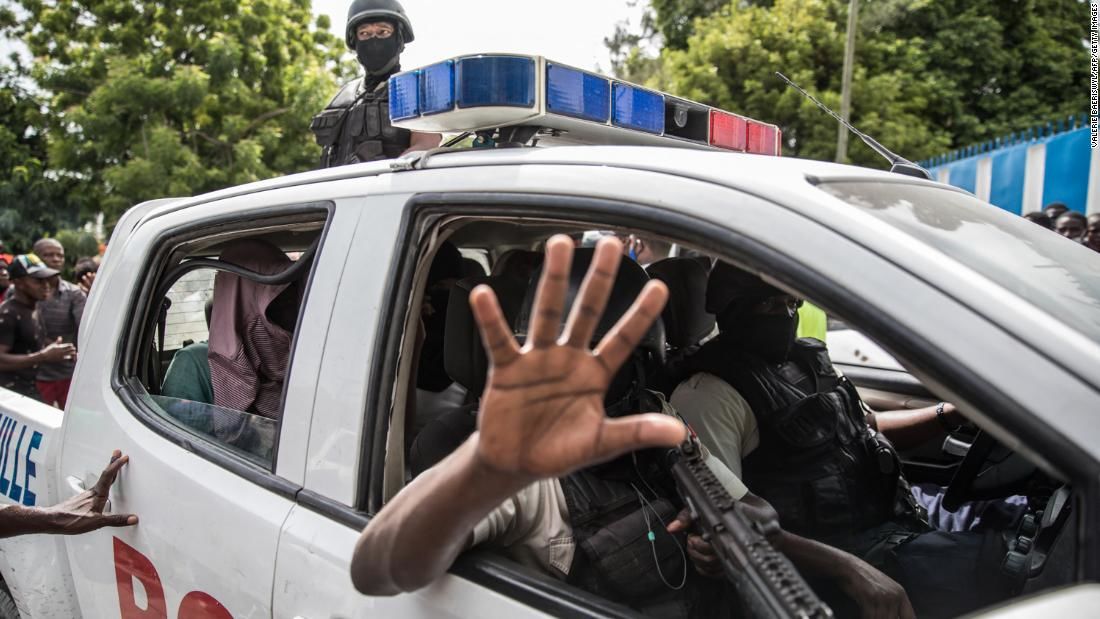
Henry then reshuffled his cabinet in November, appointing a lawyer, Berto Dorcé, as justice minister.
Prior to that appointment, Dorcé was among several attorneys who filed a letter to the country's top prosecutor arguing that Henry should not be forced to answer questions about his alleged complicity in the assassination, citing Henry's executive privilege.
Dorcé was arrested for drug trafficking in 1997, according to a Haiti law enforcement source, a charge he said at the time was untrue.
He now oversees huge swaths of the justice apparatus in Haiti. That gives him the ability to block any further requests from prosecutors or judges to question or charge Henry.
There is no official record of him blocking such a request. But at least one of the judges, Orélien, who could have questioned Henry or sought charges against him while leading the investigation, believed he wouldn't get very far if he tried.
In the secret recording from November, Orélien is asked why he has not gone after Henry legally, given that he believes Henry is complicit in the assassination and the cover-up.
"Do you think I can touch Ariel (Henry) now? How can I do that? I won't be able to give (any order to indict him), it won't see the light of day," Orélien said.
Dorcé did not respond to CNN's request for comment.
"It all can't be just a coincidence," one investigator said. "All of these things are connected."
As the group of investigators continue to search for justice, there are growing calls for Henry to step down.
"Ariel Henry doesn't have any legitimacy or credibility to govern. His positions might send us to a deeper crisis," said James Beltis, president of the Transition National Council, a group of Haitian civil society leaders who want to install an independent transitional government to oversee the next round of elections.
But Henry has no plans to step aside, something the US government has so far raised no opposition to.
However, when asked by CNN why the US continues to support a prime minister that investigators have clearly implicated in the presidential assassination, a US State Department spokesperson conspicuously made no mention of backing Henry, and referred CNN to the US Department of Justice and to the government of Haiti.
CNN also asked why the US government has stayed so quiet on the claims against Henry.
"The United States has vocally and repeatedly supported a thorough, independent investigation into President Moïse's assassination consistent with both Haitian law and international rule of law standards," said the spokesperson. "We want to see those who planned, funded, and carried out the assassination of President Moïse held accountable. The Haitian people need to see a transparent process and resolution to this investigation to demonstrate that perpetrators of such heinous crimes cannot escape justice."
The US Justice Department has ramped up its own investigation into the assassination, recently extraditing and charging two top suspects in the case for allegedly planning the assassination on US soil. According to the federal complaint, one of the men provided the arms and ammunition to kill Haiti's President.
Two Haitian investigators told CNN they believe that if their US counterparts keep digging, Henry will emerge as a key suspect for them as well.











