

How can we help kids cope with 'eco-anxiety'?
Striding onto the streets of Glasgow, 16-year-old Amy O'Brien joined tens of thousands of other marchers last November for a Global Day of Action for Climate Justice. O'Brien is an activist with Fridays for Future Ireland, a youth movement that uses school strikes to campaign for climate justice. She had taken the train and ferry from her home town of Mitchelstown in County Cork to Glasgow to attend the 26th UN Climate Change Conference of the Parties (COP26). But while the journey was motivated by her activism, it also had a deeply personal side effect: it gave her hope.
O'Brien had spent half her life worrying about the impact of global climate change, to the point of feeling an intense fear over the planet's future – an increasingly common phenomenon among children and teenagers. Now the sight of so many diverse banner-carrying campaigners, of all ages, offered her "a glimmer of the future that is possible".
"It was a really colourful scene, and there was music and there were people dancing," O'Brien recalls. "At one point it started lashing with rain, and so you would think it would dampen the scene, but actually there was such a bright, hopeful and exuberant protest. Everyone seemed so happy to be together, showing up for the world we want to see."
O'Brien has been acutely aware of the climate crisis since the age of eight, when she first learned in primary school about the impact of melting Arctic ice on polar bears.
"Even at the start, I was upset for animals and that nature was having to change because of us," she says. "I felt a bit powerless." By age 13 or 14, "fear kicked in" as she witnessed increased flooding of Cork's River Lee, and learned how extreme weather was displacing people in countries like India and the Philippines. "Their lives are torn apart, and these are the same people who contributed the least to this crisis," O'Brien says. "I started to feel fear and hurt for what they were already going through."
The intense feeling that O'Brien experiences in the midst of the climate crisis, has a name: eco-anxiety, defined by the American Psychological Association as "a chronic fear of environmental doom".
Eco-anxiety can be caused by the stressful and frightening experience of "watching the slow and seemingly irrevocable impacts of climate change unfold, and worrying about the future for oneself, children and later generations", according to a report published by the association and two other organisations, Climate for Health and Eco-America. It may come with "feelings of loss, helplessness, and frustration", and guilt, as the sufferers feel they are unable to stop climate change.
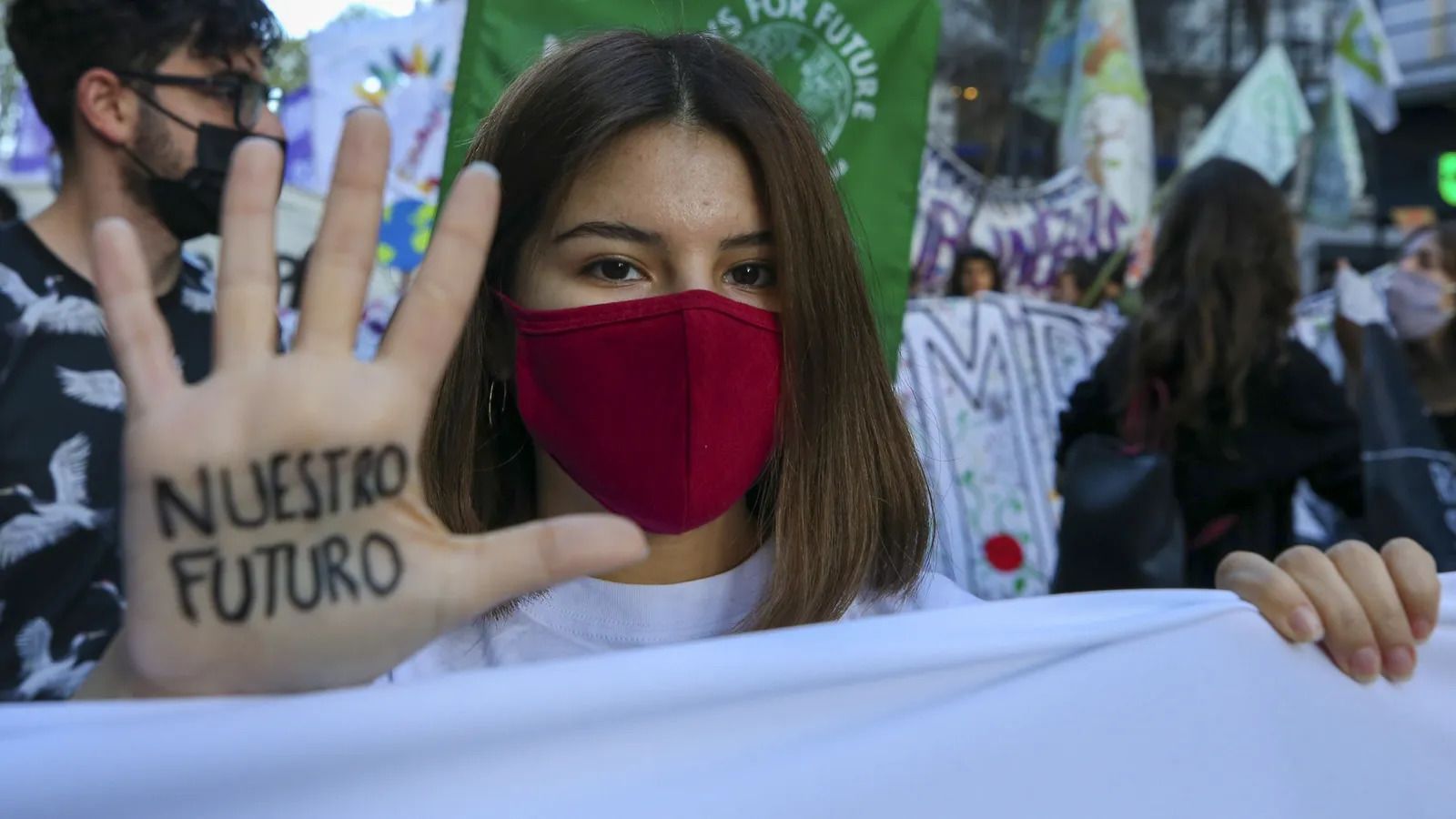 A protester in Buenos Aires, Argentina, shows a message on her hand saying "our future"
As a broader form of environmental fear, eco-anxiety isn't exactly new – in the 19th century, the Victorians worried about growth-stunting, lung-choking black smoke from coal-burning in the UK. But as human activity increases the risk of extreme weather, including heatwaves, droughts and flooding, and as the United Nations warns of a "code red for humanity", surveys show that kids are suffering from climate anxiety at even higher rates than adults – including feelings of worry, fear, anger, grief, despair, guilt and shame. These often fluctuating moods and feelings can include positive sensations as well, such as hope.
"Children are infinitely more informed than their parents think, a lot of the time," says Caroline Hickman, a psychotherapist at the University of Bath in the UK. She led a 2021 global online survey of climate anxiety in 10,000 teenagers and young adults aged 16-25 in 10 countries, including the UK, US, Brazil, India and the Philippines.
Close to 60% of the young people who responded to the survey said that they felt "very" or "extremely" worried about climate change while 75% said that "the future is frightening", 56% believe that "humanity is doomed" and 39% were hesitant to have children. Fifty-eight percent of respondents felt that governments were betraying them or future generations.
Parents instinctively want to protect their kids from painful, scary, traumatic stuff
Offering children honest answers to their questions about climate catastrophe isn't always easy, though. Parents instinctively want to protect their kids from "painful, scary, traumatic stuff", Hickman says. But although climate anxiety is distressing, it's also rational, she and her co-authors contend. So when a 10-year-old child asks, "is it true that in 100 years the Earth will be burned to a crisp?" it's "not pure fantasy", Hickman says. "It's not, 'Mummy, can sharks fly?' The question is grounded in reality."
If a child asks questions about climate change, first find out what they have learned about the topic, Hickman advises, including whether they are reading scaremongering stories online. Then, "tell her it's a brilliant question", she says, and add: "I want you to feel proud of those feelings. Because you only feel that anxiety or worry because you care about the planet."
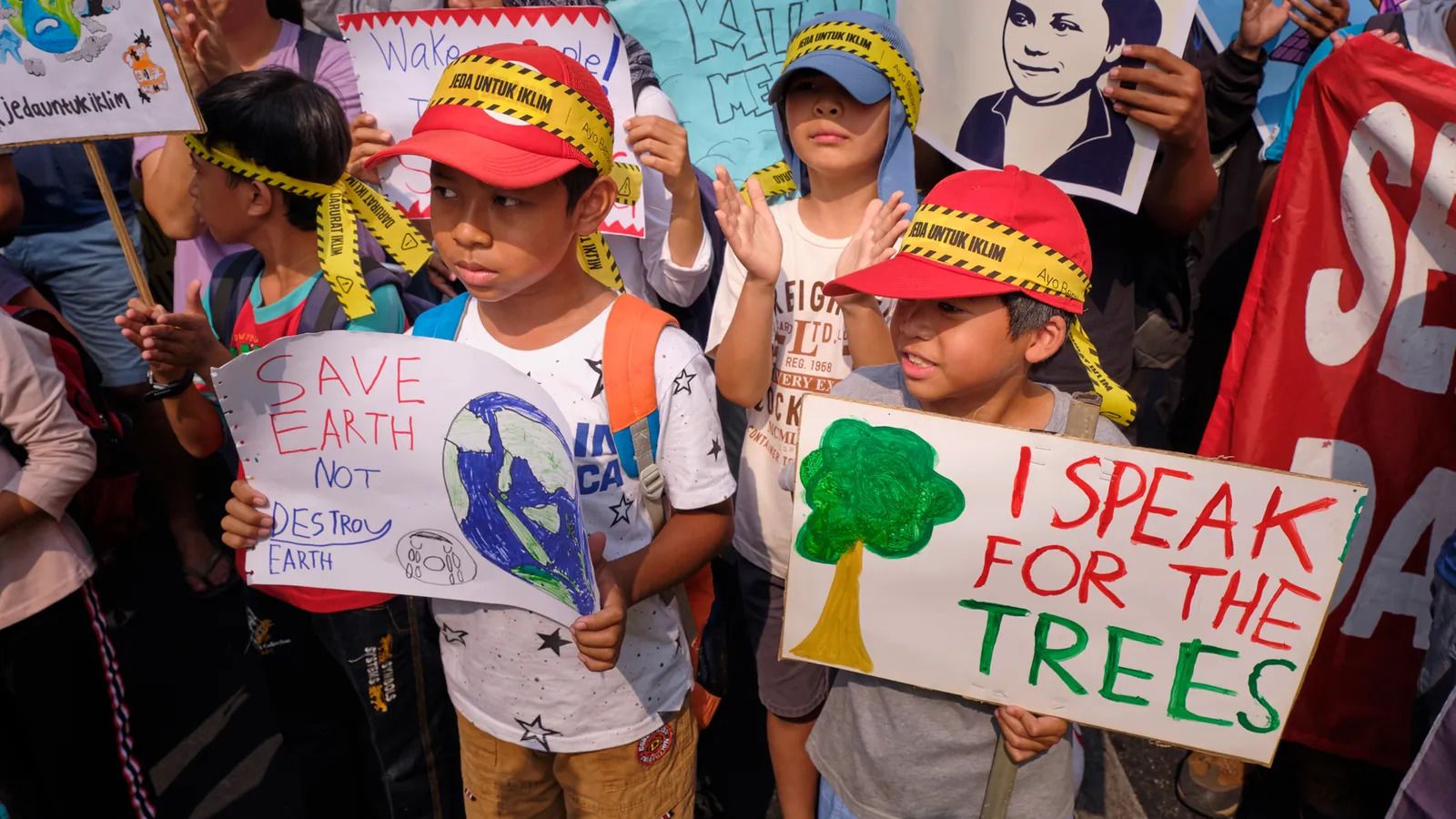 School children demonstrate in Jakarta, Indonesia. Fear of climate change has united young people all over the world
Hickman enthusiastically endorses "lots of conversations" with kids around climate change. But parents also need to calibrate their responses to children at different ages, advises climate educator Harriet Shugarman, executive director of Climate Mama, an advocacy organisation for parents.
In her book How to Talk to Your Kids About Climate Change: Turning Angst into Action, Shugarman offers advice to parents of kids from nursery school age to late-teen years on how they can mitigate anxiety and take action on climate change.
"When kids are coming to you with questions directly, we have to tell the truth, whatever age they're at," she says. But we should also strengthen their own sense of agency. "Kids do have power, and we want to try to work to build that up at each age," she advises.
With very young children, the first step is to create "a sense of wonder in nature" – watching ants in the grass on outings to city parks, or sharing stories and songs. Include your five-to-six-year-old kids in climate marches, take photos of the protests, and have kids send their own drawings or letters to local officials, she suggests.
By the time kids reach the ages of 10-13 years old, they are probably learning about climate change in school. Encourage them to discuss climate change with teachers, neighbours and family, Shugarman says. Also, "we can remind them that there are so many scientists, businesspeople, organisations, elected officials, working on the climate crisis all over the world."
By ages 14-16 years old, teenagers are approaching the age at which they'll be able to vote. "Their elected officials are interested in what they have to say because they are future voters," Shugarman says. Political engagement for older teens is crucial. "So many young people seem so disillusioned, rightly so, perhaps, with our democracies. But they are very fragile and we need them to be participatory."
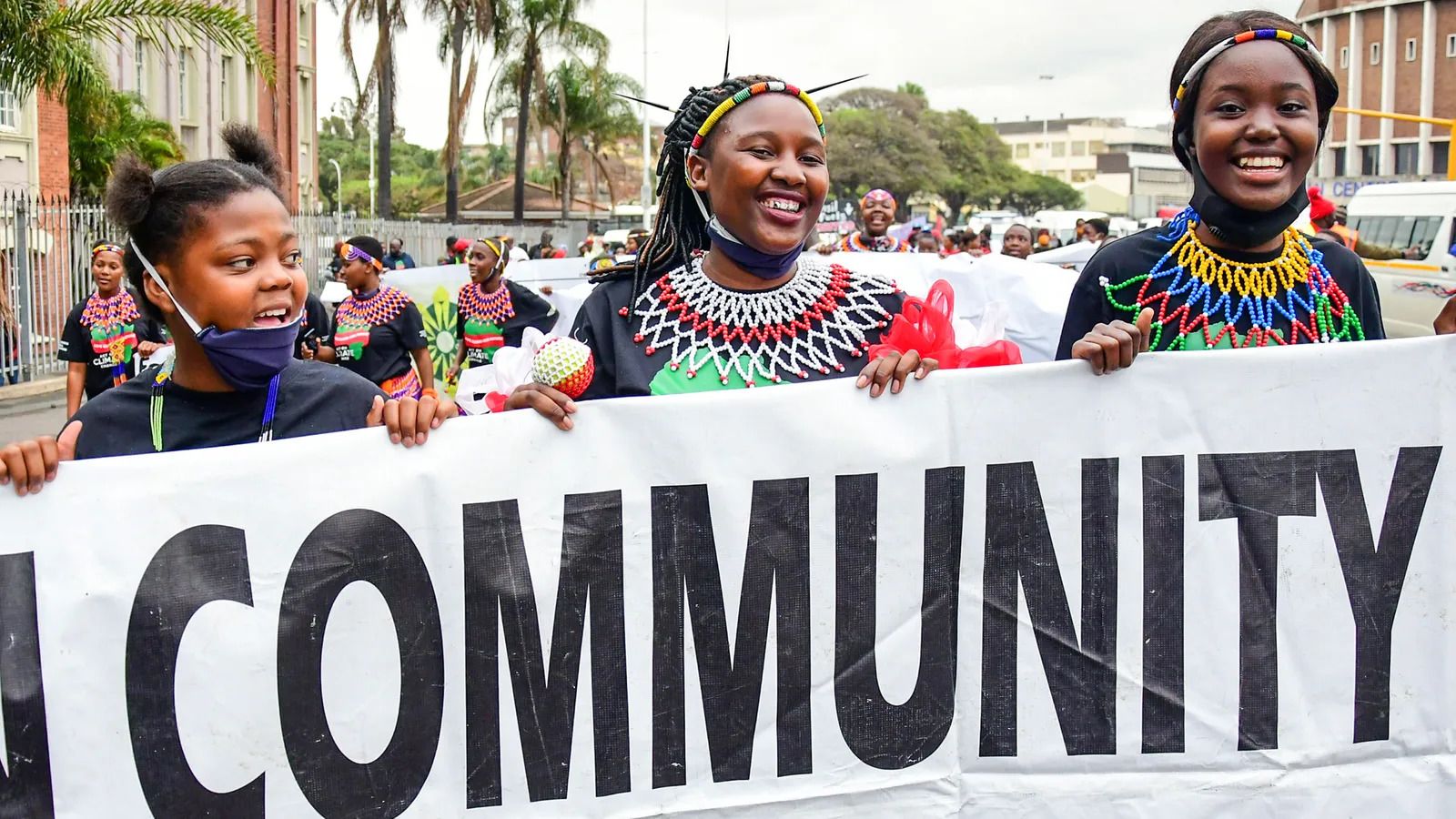 Young activists in Durban, South Africa. Africa is vulnerable to climate change, yet contributes only 3.8% to global emissions
Action and participation may also help temper one of the societal risks of eco-anxiety: as well-founded as the fear of the environmental crisis may be, when taken too far, it could actually hinder positive change.
Ilan Kelman, professor of disasters and health at University College London Institute for Risk and Disaster Reduction in the UK, fears that eco-anxiety in young people may be feeding a state of "eco-paralysis" where they feel unable to take action because their emotional distress is overwhelming.
We should also be incredibly inspired by how far humanity has come – Ilan Kelman
"There's no claim whatsoever that it's all good news," Kelman says of the state of the planet. The increase in heat and humidity will lead to very high mortality, he stresses, and "a lot of people are going to have no option but to be forced to move or to die". Furthermore, "if the Antarctica and Greenland ice sheets go, then that is extremely concerning. We're looking at a major reconfiguration of the world's shore lines."
Even so, "the doomsday scenarios, the calamity, the utter destruction: I cannot find any scientific support for that," Kelman says. "Even in the worst case scenarios, 'Earth burnt to a crisp' is not a feasible outcome," he notes. "I've yet to find a scenario which within the next hundred years, or in fact the next thousand or ten thousand years, a scenario in which humans become extinct because of climate change."
"We should also be incredibly inspired by how far humanity has come," Kelman emphasises. He advises climate-anxious youngsters to "focus on the science, and balance the real worries with all the wonderful inspiration, wisdom and success which humanity has shown over decades and centuries".
He includes among these successes the divestment by pension funds and foundations in fossil fuels, localised energy systems such as small wind turbines or solar roof panels, guerilla gardening in neglected spaces, rainwater harvesting, accessible science on the internet, as well as broader social progress that has improved the lives of many, such as laws outlawing discrimination and oppression and granting people equal rights.
Kelman notes that action on climate isn't limited to public protests. Young people can consider a career in journalism, science and technology, medicine and health, or standing for political office. "A lot of youth activists have been amazing in taking governments to court," he says, referring to the increasing number of campaigners suing governments and companies to take action against climate change. "That has been inspirational, that has been successful. Put your energies into the legal system, to end fossil fuel subsidies, to make governments legally adhere to the pledges that they're making."
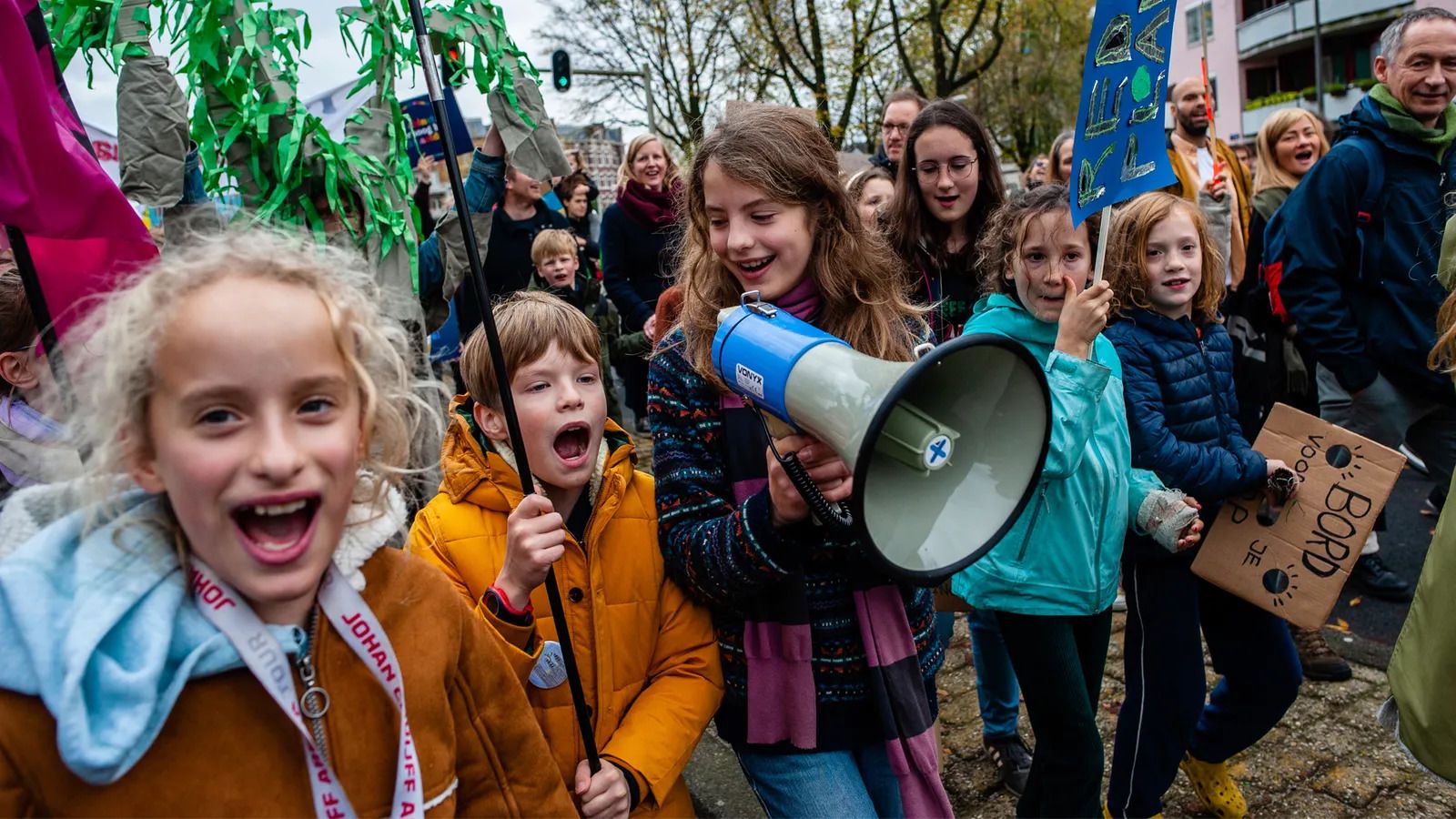 Many young people find hope in campaigning, like these children at a climate march in Amsterdam
Many of the young people campaigning against climate change are driven as much by anger as anxiety, Hickman says.
"I started research with children and young people around climate change 10 years ago – children as young as five, up to mid-20s, in the Maldives, Nigeria, Bangladesh, Brazil, France, the UK and America," she says. "What I started hearing over and over again from children, was, 'it's not the environmental problems that are frightening me; yes, they are upsetting; what really frightens me is government failure to act on this'."
That anger at government inertia is familiar for Rose Kobusinge, a 26-year-old climate justice activist and PhD student at the University of Coventry in the UK. Born in Western Uganda, Kobusinge says her "real understanding" of climate change came in her early-20s. She was motivated to act when she saw how droughts in her home in the Kabarole and Ntoroko districts of Uganda were drying crops and killing livestock, and receding glaciers in the Rwenzori mountains were triggering "massive floods and landslides in Kasese and Bundibugyo in Western Uganda, my closest neighbouring districts".
The African continent is vulnerable to climate change, she notes, yet its contribution to global greenhouse gas emissions is the smallest – just 3.8% of the total.
"Children and young people, we are taking climate change as a real threat, because we know it's the future of the children that is at stake," Kobusinge says. At COP26, which she attended, she saw how world leaders made big promises, yet fell short on action.
"I feel that there is limited time," Kobusinge says. "Our global leaders are supposed to care about the most vulnerable, to care about the poor, to care about the children and the youth, [but] are not doing what they should be doing. It makes me feel uncertain about the future." Even so, "when I look at young people, civil societies and indigenous communities coming together to ask for climate justice, that gives me a little bit of hope", she says. She encourages activists to support one another and create safe spaces, online or in-person, to share feelings.
Using your anxiety positively "is like a blessing in disguise", she says, because it can prompt action and motivation.
That's advice that Amy O'Brien has taken to heart. Using Telegram and Zoom, she connects with MAPA activists (Most Affected People and Areas, or communities in Africa, Latin America, and the Pacific Islands, that suffer most from the effects of climate change). Together with five other young activists, she hosts the late-night Sustainable Sleepover Club podcast, where participants talk about "anything and everything", including "movies and chocolates, climate justice, gender equality and trans rights." To "educate and empower", she writes for the Fridays for Future international newsletter, as well as her local newspaper.
"Through activism, I've met so many other activists who really care about the climate crisis," O'Brien says, and that gives her hope: "Hope is also now my driving force, like a little light pushing me to act."
Seeing the numbers of diverse protesters on the coalition day of action at COP26, "really emphasised to me that I'm not alone; there are so many people who care about this, and we will win, because we're fighting together," she says. "We were dancing to protests, we laughed when it rained, a rainbow started shining… and it was just really beautiful. From the whole experience, I learned about the power of my voice as well."











