U.S. Congress Pivotal to Sustaining AUKUS Momentum and Strengthening Trilateral Security
Bipartisan legislative support and defence leadership engagement aim to advance the Australia-United Kingdom-United States partnership amid strategic challenges.
Congressional backing has emerged as a central factor in maintaining the forward momentum of the trilateral security partnership between the United States, the United Kingdom and Australia, known as AUKUS, as defence leaders and lawmakers seek to reaffirm its strategic importance.
The U.S. House of Representatives in 2025 passed the bipartisan AUKUS Reform for Military Optimization and Review (ARMOR) Act, aimed at streamlining the exchange of advanced technologies and defence articles among the three partners.
The legislation is seen as critical to reducing bureaucratic barriers that could slow implementation of shared goals, particularly the collaborative development and deployment of advanced capabilities.
The AUKUS partnership, first announced in 2021, is designed to "promote a free and open Indo-Pacific that is secure and stable" by deepening diplomatic, security and defence cooperation, including helping Australia acquire nuclear-powered submarines and joint work on emerging technologies such as artificial intelligence, undersea capabilities and hypersonics.
Congressional engagement has been indispensable in authorising and overseeing elements of the agreement, including export controls and accelerated technology sharing frameworks.
Bipartisan push from lawmakers has underscored the strategic necessity of maintaining AUKUS.
Members of the House have organized caucuses and working groups to focus on the partnership’s implementation, highlighting legislative support as essential to overcoming industrial and regulatory bottlenecks.
Congressional advocacy also comes amid Pentagon reviews and evolving White House policy guidance on aligning AUKUS with broader U.S. national interests.
The sustained bipartisan involvement in legislative initiatives has reinforced confidence among allied capitals that the United States remains committed to delivering on shared security commitments.
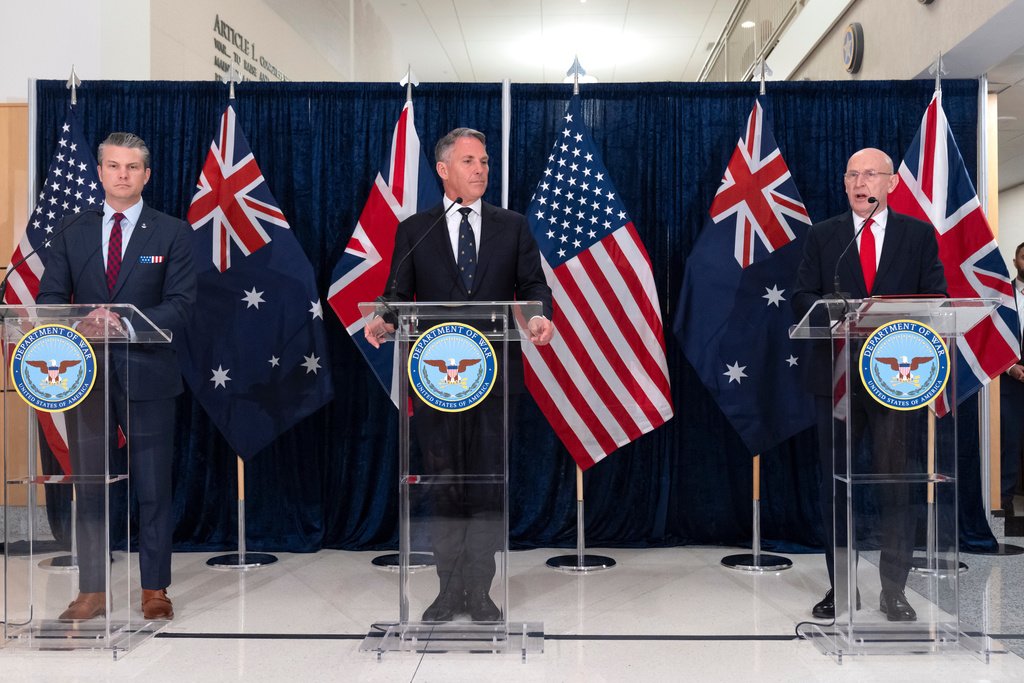
Defence and foreign-policy leaders from the three nations recently convened in Washington to reinvigorate AUKUS goals, signalling renewed momentum for the nuclear-submarine programme and broader cooperation across the Indo-Pacific.
The engagement by defence chiefs, working alongside congressional sponsors of key legislation, reflects a coordinated effort to ensure AUKUS remains a cornerstone of regional deterrence and technological collaboration amidst intensifying global strategic competition.
The U.S. House of Representatives in 2025 passed the bipartisan AUKUS Reform for Military Optimization and Review (ARMOR) Act, aimed at streamlining the exchange of advanced technologies and defence articles among the three partners.
The legislation is seen as critical to reducing bureaucratic barriers that could slow implementation of shared goals, particularly the collaborative development and deployment of advanced capabilities.
The AUKUS partnership, first announced in 2021, is designed to "promote a free and open Indo-Pacific that is secure and stable" by deepening diplomatic, security and defence cooperation, including helping Australia acquire nuclear-powered submarines and joint work on emerging technologies such as artificial intelligence, undersea capabilities and hypersonics.
Congressional engagement has been indispensable in authorising and overseeing elements of the agreement, including export controls and accelerated technology sharing frameworks.
Bipartisan push from lawmakers has underscored the strategic necessity of maintaining AUKUS.
Members of the House have organized caucuses and working groups to focus on the partnership’s implementation, highlighting legislative support as essential to overcoming industrial and regulatory bottlenecks.
Congressional advocacy also comes amid Pentagon reviews and evolving White House policy guidance on aligning AUKUS with broader U.S. national interests.
The sustained bipartisan involvement in legislative initiatives has reinforced confidence among allied capitals that the United States remains committed to delivering on shared security commitments.
Defence and foreign-policy leaders from the three nations recently convened in Washington to reinvigorate AUKUS goals, signalling renewed momentum for the nuclear-submarine programme and broader cooperation across the Indo-Pacific.
The engagement by defence chiefs, working alongside congressional sponsors of key legislation, reflects a coordinated effort to ensure AUKUS remains a cornerstone of regional deterrence and technological collaboration amidst intensifying global strategic competition.