

Media protest restrictions on ex-officers trial in Floyd killing
A coalition of media groups has said restrictions on access to the federal civil rights trial of three former Minneapolis police officers charged in George Floyd’s death would amount to an unconstitutional closing of the courtroom.
US District Judge Paul Magnuson, citing COVID-19, restricted the number of people who may be in his courtroom for the proceedings against the former officers on charges that they deprived Floyd of his rights while acting under government authority.
Jury selection in the high-profile trial begins this week and opening arguments are scheduled next week. The fired Minneapolis officers – Tou Thao, J Kueng and Thomas Laneare – are charged with violating Floyd’s civil rights; a fourth officer, Derek Chauvin pleaded guilty in the federal case in December.
Floyd’s death, captured on video by a bystander, shocked the United States and sparked months of protests and violent confrontations with police over racial justice in cities across the US in 2020.
Chauvin is the white former Minneapolis officer who kept Floyd pinned to the pavement with his knee on the Black man’s neck despite Floyd’s pleas that he couldn’t breathe. Chauvin was convicted of murder in a criminal trial last year and sentenced to 22.5 years in prison.
In keeping with longstanding federal court rules, the proceedings against Thao, Kueng and Laneare will not be livestreamed or broadcast to the public.
Magnuson restricted how much can be seen on a closed-circuit feed of the proceedings, which will be relayed to overflow rooms where only a limited number of journalists and members of the public can watch.
Chauvin’s state trial on murder charges was broadcast. The judge in that case made an exception to the state’s normal limits on cameras, citing the need for public access amid the pandemic.
“We do not need to explain to this Court the gravity of the trial, the impact Mr. Floyd’s death had on the Twin Cities and the world, or the public’s ongoing and intense concern for how the criminal justice system deals with those accused of killing him,” news organisations including The Associated Press said in a letter dated January 17.
“As a result, ensuring the trial … is open to the press and public is imperative.”
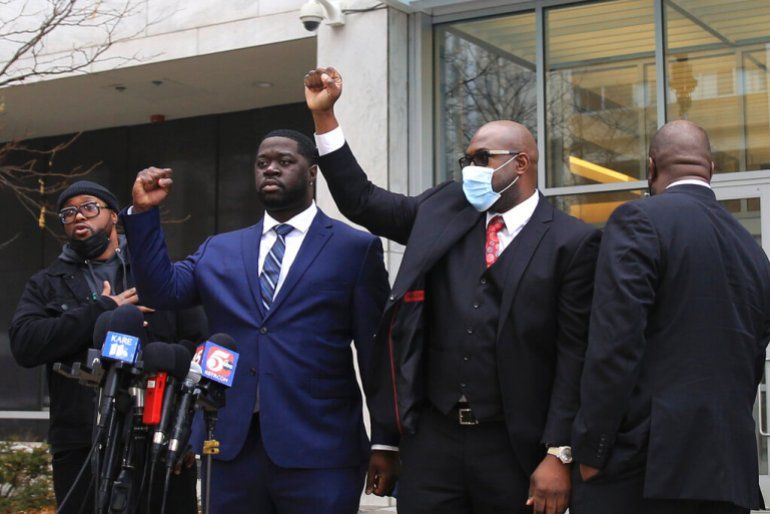 Philonise Floyd, George Floyd’s brother, and Brandon Williams, Floyd’s
nephew, reacted during a news conference after former Minneapolis Police
Officer Derek Chauvin has pleaded guilty to violating Floyd’s civil
rights
Philonise Floyd, George Floyd’s brother, and Brandon Williams, Floyd’s
nephew, reacted during a news conference after former Minneapolis Police
Officer Derek Chauvin has pleaded guilty to violating Floyd’s civil
rights
Two media members are to be allowed in the courtroom during jury selection. The media coalition pointed out that no members of the public will be allowed for that phase, not even members of the defendants’ families or the Floyd family.
During the trial itself, only four reporters and a sketch artist will be admitted, plus some family members, but nobody from the general public.
Seating in overflow rooms for the media and public will be limited to about 40 each. Spectators in the overflow rooms will watch via monitors that will provide only limited views. Trial exhibits would not be made public immediately.
“It is in the best interest of all involved for the media coverage of this trial to be fair and accurate and to enhance public understanding of the federal judicial system, including understanding of how juries reach their verdicts,” the media organisations’ letter said.
“The best way to ensure such coverage is to provide to the media unfettered access to the trial and the evidence it involves.”
Magnuson “has tried to accommodate the interests of the media and the public, but as the letter says, he needs to try harder,” said Jane Kirtley, director of the Silha Center for the Study of Media Ethics and Law at the University of Minnesota, which is one of the 18 groups that signed the letter.
Kirtley said the recent state court trials of Chauvin, and of former Brooklyn Center Officer Kim Potter in the shooting death of Daunte Wright, showed that cameras are not disruptive and don’t violate the privacy interests of witnesses or jurors.











