Ministers Examine Social-Care Levy as Burnham Seeks Funding Settlement
A proposed mandatory contribution of 1.8 per cent on earnings is among options under consideration, but the government says no decision on a new tax has been made.
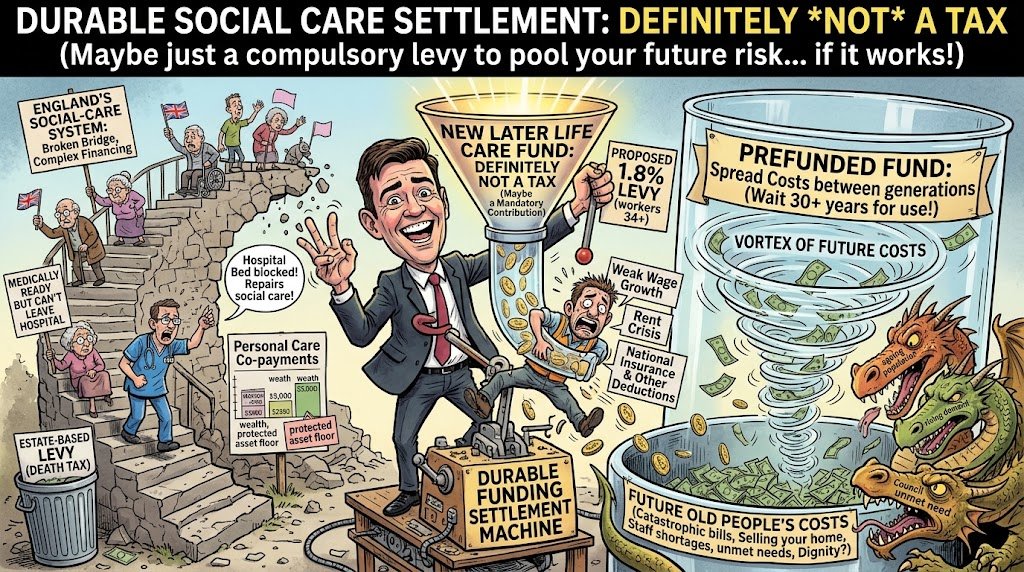
A proposed national social-care levy is among the funding models being examined as Prime Minister Andy Burnham seeks a durable settlement for England’s overstretched care system, though the government has not adopted the plan and says no particular tax is being imposed.
The option would require workers aged 34 and above to contribute 1.8 per cent of earnings over 6,240 pounds a year into a new Later Life Care Fund.
Unlike National Insurance, the proposed fund would not principally pay for today’s care services.
Contributions would be invested over time on behalf of each working-age cohort and used to help meet that cohort’s social-care costs in later life.
For an employee earning 50,000 pounds a year, the contribution would be about 788 pounds annually.
On an 80,000-pound salary, it would be about 1,327 pounds.
Those figures are illustrations of one proposed model, not announced tax liabilities.
The central problem is not in dispute.
England’s adult social-care system is financed through a complicated mixture of local-authority funding, means-tested support, personal assets and family contributions.
It provides help with essential daily tasks such as washing, dressing, eating and getting around, but it is not a universal service free at the point of use.
Many people who need substantial care must pay significant sums themselves, sometimes from savings or by selling their homes.
The system is under strain from an ageing population, rising demand, workforce shortages and the financial pressure placed on councils.
Public spending on adult social care has increased, yet unmet need remains extensive and local authorities have devoted an ever larger share of their budgets to care.
The effect is felt across the wider health system: patients who are medically ready to leave hospital can remain in beds because appropriate care at home or in the community is unavailable.
Burnham has argued that the National Health Service will not return to acceptable waiting-time standards unless social care is repaired.
His case is that reform should not merely reduce hospital pressures or protect inheritances, but create a service that allows older and disabled people to live with greater security and dignity.
The proposed levy is intended to address one of the system’s most difficult features: the unpredictable nature of later-life care costs.
A small proportion of people face very high bills, while many contribute little or nothing.
That uncertainty makes private insurance difficult to develop at scale and leaves families exposed to costs that can exceed 100,000 pounds.
Under the model being examined, the national fund would pool part of that risk.
It would include an annual allowance for personal care, followed by co-payments that rise with a person’s wealth.
People with greater assets, including housing wealth, would make a larger contribution, but a protected asset floor of 75,000 pounds would be retained.
The approach would separate funding for later-life care from support for working-age adults with care needs.
Proponents argue that a prefunded system is more sustainable than simply raising general taxation each year.
By investing contributions over decades, it could spread costs between generations and reduce reliance on annual public spending decisions.
It could also make the eventual entitlement clearer for workers who contribute throughout their careers.
That case depends on difficult assumptions.
Investment returns can disappoint, administrative costs can erode funds, and demographic change can place greater demands on the system than predicted.
A compulsory levy would also fall on workers who are already contributing through income tax, National Insurance, pensions and other deductions while often struggling with housing costs and weak wage growth.
A different approach would mirror the pay-as-you-go social-insurance systems used in Germany and Japan, where current workers help finance the care of present pensioners.
Such systems can deliver broader coverage more quickly, but they become increasingly expensive as the ratio of workers to older people declines.
Both countries are confronting the consequences of ageing populations and rising care needs.
Other ideas remain in circulation.
They include a universal care service modelled more closely on the National Health Service; free personal care in stages, as used in Scotland; a cap on individual care costs; and a levy on estates after death.
Burnham previously supported an estate-based contribution during his time as health secretary, but the idea attracted the politically damaging label of a "death tax" and was never implemented.
The government has now said it has no plan to introduce such a levy.
It has also stressed that the immediate task is to build broad political and public agreement rather than impose a pre-selected funding mechanism.
That distinction is material: the 1.8 per cent proposal is an option developed for consideration, not an announced policy, a bill before Parliament or a confirmed rise in workers’ taxes.
The funding debate is inseparable from the question of what any reformed system would promise.
A more generous entitlement would improve access and reduce the fear of catastrophic bills, but it would cost more.
A narrower system could be cheaper, but would leave more of the risk with households.
Any durable compromise must decide how much care is guaranteed, who pays, how wealth is treated and what protection is afforded to people with little income or savings.
An independent review led by Baroness Louise Casey is expected to set out short-term recommendations later this year, with longer-term conclusions previously scheduled for 2028. Burnham has indicated that the process could be accelerated, while promising a public conversation and seeking cross-party participation.
The proposed levy has therefore put a politically uncomfortable question into plain view: reforming social care will require either more public money, greater contributions from individuals and families, a reduction in other spending, or some combination of all three.
The government’s next formal step is the Casey review, which will shape the options presented for a national settlement.
The option would require workers aged 34 and above to contribute 1.8 per cent of earnings over 6,240 pounds a year into a new Later Life Care Fund.
Unlike National Insurance, the proposed fund would not principally pay for today’s care services.
Contributions would be invested over time on behalf of each working-age cohort and used to help meet that cohort’s social-care costs in later life.
For an employee earning 50,000 pounds a year, the contribution would be about 788 pounds annually.
On an 80,000-pound salary, it would be about 1,327 pounds.
Those figures are illustrations of one proposed model, not announced tax liabilities.
The central problem is not in dispute.
England’s adult social-care system is financed through a complicated mixture of local-authority funding, means-tested support, personal assets and family contributions.
It provides help with essential daily tasks such as washing, dressing, eating and getting around, but it is not a universal service free at the point of use.
Many people who need substantial care must pay significant sums themselves, sometimes from savings or by selling their homes.
The system is under strain from an ageing population, rising demand, workforce shortages and the financial pressure placed on councils.
Public spending on adult social care has increased, yet unmet need remains extensive and local authorities have devoted an ever larger share of their budgets to care.
The effect is felt across the wider health system: patients who are medically ready to leave hospital can remain in beds because appropriate care at home or in the community is unavailable.
Burnham has argued that the National Health Service will not return to acceptable waiting-time standards unless social care is repaired.
His case is that reform should not merely reduce hospital pressures or protect inheritances, but create a service that allows older and disabled people to live with greater security and dignity.
The proposed levy is intended to address one of the system’s most difficult features: the unpredictable nature of later-life care costs.
A small proportion of people face very high bills, while many contribute little or nothing.
That uncertainty makes private insurance difficult to develop at scale and leaves families exposed to costs that can exceed 100,000 pounds.
Under the model being examined, the national fund would pool part of that risk.
It would include an annual allowance for personal care, followed by co-payments that rise with a person’s wealth.
People with greater assets, including housing wealth, would make a larger contribution, but a protected asset floor of 75,000 pounds would be retained.
The approach would separate funding for later-life care from support for working-age adults with care needs.
Proponents argue that a prefunded system is more sustainable than simply raising general taxation each year.
By investing contributions over decades, it could spread costs between generations and reduce reliance on annual public spending decisions.
It could also make the eventual entitlement clearer for workers who contribute throughout their careers.
That case depends on difficult assumptions.
Investment returns can disappoint, administrative costs can erode funds, and demographic change can place greater demands on the system than predicted.
A compulsory levy would also fall on workers who are already contributing through income tax, National Insurance, pensions and other deductions while often struggling with housing costs and weak wage growth.
A different approach would mirror the pay-as-you-go social-insurance systems used in Germany and Japan, where current workers help finance the care of present pensioners.
Such systems can deliver broader coverage more quickly, but they become increasingly expensive as the ratio of workers to older people declines.
Both countries are confronting the consequences of ageing populations and rising care needs.
Other ideas remain in circulation.
They include a universal care service modelled more closely on the National Health Service; free personal care in stages, as used in Scotland; a cap on individual care costs; and a levy on estates after death.
Burnham previously supported an estate-based contribution during his time as health secretary, but the idea attracted the politically damaging label of a "death tax" and was never implemented.
The government has now said it has no plan to introduce such a levy.
It has also stressed that the immediate task is to build broad political and public agreement rather than impose a pre-selected funding mechanism.
That distinction is material: the 1.8 per cent proposal is an option developed for consideration, not an announced policy, a bill before Parliament or a confirmed rise in workers’ taxes.
The funding debate is inseparable from the question of what any reformed system would promise.
A more generous entitlement would improve access and reduce the fear of catastrophic bills, but it would cost more.
A narrower system could be cheaper, but would leave more of the risk with households.
Any durable compromise must decide how much care is guaranteed, who pays, how wealth is treated and what protection is afforded to people with little income or savings.
An independent review led by Baroness Louise Casey is expected to set out short-term recommendations later this year, with longer-term conclusions previously scheduled for 2028. Burnham has indicated that the process could be accelerated, while promising a public conversation and seeking cross-party participation.
The proposed levy has therefore put a politically uncomfortable question into plain view: reforming social care will require either more public money, greater contributions from individuals and families, a reduction in other spending, or some combination of all three.
The government’s next formal step is the Casey review, which will shape the options presented for a national settlement.