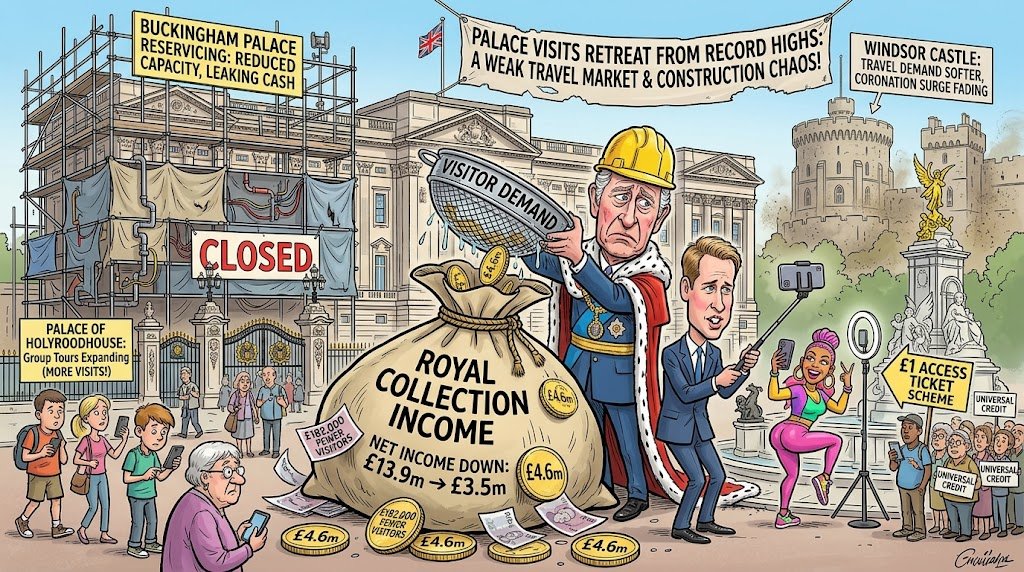
Royal Collection Trust Income Falls as Palace Visits Retreat From Record Highs
The charity’s visitor numbers declined by 182,000 in 2025–26, with reduced Buckingham Palace capacity and a weaker travel market contributing to the fall.
The Royal Collection Trust recorded a fall in visitor income and attendance during the 2025–26 financial year, as reduced capacity at Buckingham Palace and softer travel demand brought an end to the exceptional post-Coronation visitor surge.
The charity, which cares for the Royal Collection and manages public access to the official royal residences, received 2.7 million visitors during the year.
That was 182,000 fewer than in the preceding period, a decline of almost 7 per cent across sites including Buckingham Palace, Windsor Castle and the Royal Mews.
Total income fell by 4.6 million pounds.
Net income, after expenses, tax and other adjustments, declined from 13.9 million pounds to 3.5 million pounds.
The figures concern the Royal Collection Trust’s charitable and commercial operations; they are separate from the Sovereign Grant, the public funding mechanism used to support official royal duties and the maintenance of occupied royal palaces.
The fall should not be read simply as a verdict on public interest in the monarchy.
The trust identified practical limitations at Buckingham Palace as a principal reason why record attendance could not be repeated.
The 2024 summer opening had delivered unusually high visitor numbers, but capacity was reduced in 2025 while work continued under the Buckingham Palace Reservicing Programme, the long-term project replacing essential electrical, plumbing and heating infrastructure.
The programme has required parts of the palace to be closed or operated with tighter access arrangements.
It is intended to protect the building for future generations and is due to reach its final phase in 2027. The King and Queen have decided not to make Buckingham Palace their primary London residence after the works are complete, a decision intended to create greater opportunities for public access while preserving the palace as the ceremonial and administrative centre of royal life.
At Windsor Castle, the trust cited a subdued travel and tourism market and the fading effect of the post-Coronation surge.
The decline was not uniform.
Visitor numbers at the Palace of Holyroodhouse in Edinburgh rose because the site opened on additional days and expanded its programme of group tours.
The results demonstrate how heavily heritage attractions depend on both practical capacity and the wider economy.
Royal residences attract overseas visitors, domestic tourists, school groups and specialist audiences, but travel costs, household budgets, currency movements and international confidence can quickly affect ticket sales.
Major royal events can create extraordinary peaks in demand, yet those peaks are not a reliable annual baseline.
The trust has responded by testing new ways to reach younger visitors.
Its annual review said social-media advertising featuring content creators had increased attendance from a younger demographic at an exhibition on the Edwardian period.
Some promotional activity was paid and some unpaid.
The strategy reflects a wider change in heritage marketing, where institutions increasingly use short-form video and digital creators to reach people who may not regard galleries, palaces or historic collections as part of their usual leisure choices.
The use of influencers is not merely an attempt to chase fashion.
It addresses a long-term challenge for cultural organisations: how to attract new audiences without diluting the scholarship, conservation work and historical context that justify their existence.
For the trust, a younger visitor today may become a repeat visitor, member, donor or online customer tomorrow.
The Royal Collection includes paintings, manuscripts, decorative arts, furniture, jewellery and historic objects accumulated by monarchs over centuries.
Ticket income supports conservation, public displays, educational activity and loans to exhibitions in Britain and abroad.
During the year, the trust conserved more than 2,500 works and loaned over 100 items to 40 exhibitions and displays in seven countries.
The organisation is also expanding its access offers.
Its one-pound ticket scheme for people receiving Universal Credit has been made permanent across its sites, including Buckingham Palace during the summer opening of 2026. The policy is designed to lower a financial barrier that can make high-profile cultural attractions inaccessible to households under pressure.
The contrasting developments point to a more nuanced picture than a simple decline in popularity.
Visitor numbers fell, and income weakened, but part of that reduction was anticipated because fewer people could be admitted to Buckingham Palace during major works.
At the same time, the trust is adjusting its marketing, extending access initiatives and preparing for greater public use of the palace after the reservicing programme concludes.
The next test will be whether increased capacity, wider access and digital outreach can restore visitor numbers once the palace works are complete.
The trust has already made the one-pound access offer permanent and continues to use public openings to fund the care of the collection.
The charity, which cares for the Royal Collection and manages public access to the official royal residences, received 2.7 million visitors during the year.
That was 182,000 fewer than in the preceding period, a decline of almost 7 per cent across sites including Buckingham Palace, Windsor Castle and the Royal Mews.
Total income fell by 4.6 million pounds.
Net income, after expenses, tax and other adjustments, declined from 13.9 million pounds to 3.5 million pounds.
The figures concern the Royal Collection Trust’s charitable and commercial operations; they are separate from the Sovereign Grant, the public funding mechanism used to support official royal duties and the maintenance of occupied royal palaces.
The fall should not be read simply as a verdict on public interest in the monarchy.
The trust identified practical limitations at Buckingham Palace as a principal reason why record attendance could not be repeated.
The 2024 summer opening had delivered unusually high visitor numbers, but capacity was reduced in 2025 while work continued under the Buckingham Palace Reservicing Programme, the long-term project replacing essential electrical, plumbing and heating infrastructure.
The programme has required parts of the palace to be closed or operated with tighter access arrangements.
It is intended to protect the building for future generations and is due to reach its final phase in 2027. The King and Queen have decided not to make Buckingham Palace their primary London residence after the works are complete, a decision intended to create greater opportunities for public access while preserving the palace as the ceremonial and administrative centre of royal life.
At Windsor Castle, the trust cited a subdued travel and tourism market and the fading effect of the post-Coronation surge.
The decline was not uniform.
Visitor numbers at the Palace of Holyroodhouse in Edinburgh rose because the site opened on additional days and expanded its programme of group tours.
The results demonstrate how heavily heritage attractions depend on both practical capacity and the wider economy.
Royal residences attract overseas visitors, domestic tourists, school groups and specialist audiences, but travel costs, household budgets, currency movements and international confidence can quickly affect ticket sales.
Major royal events can create extraordinary peaks in demand, yet those peaks are not a reliable annual baseline.
The trust has responded by testing new ways to reach younger visitors.
Its annual review said social-media advertising featuring content creators had increased attendance from a younger demographic at an exhibition on the Edwardian period.
Some promotional activity was paid and some unpaid.
The strategy reflects a wider change in heritage marketing, where institutions increasingly use short-form video and digital creators to reach people who may not regard galleries, palaces or historic collections as part of their usual leisure choices.
The use of influencers is not merely an attempt to chase fashion.
It addresses a long-term challenge for cultural organisations: how to attract new audiences without diluting the scholarship, conservation work and historical context that justify their existence.
For the trust, a younger visitor today may become a repeat visitor, member, donor or online customer tomorrow.
The Royal Collection includes paintings, manuscripts, decorative arts, furniture, jewellery and historic objects accumulated by monarchs over centuries.
Ticket income supports conservation, public displays, educational activity and loans to exhibitions in Britain and abroad.
During the year, the trust conserved more than 2,500 works and loaned over 100 items to 40 exhibitions and displays in seven countries.
The organisation is also expanding its access offers.
Its one-pound ticket scheme for people receiving Universal Credit has been made permanent across its sites, including Buckingham Palace during the summer opening of 2026. The policy is designed to lower a financial barrier that can make high-profile cultural attractions inaccessible to households under pressure.
The contrasting developments point to a more nuanced picture than a simple decline in popularity.
Visitor numbers fell, and income weakened, but part of that reduction was anticipated because fewer people could be admitted to Buckingham Palace during major works.
At the same time, the trust is adjusting its marketing, extending access initiatives and preparing for greater public use of the palace after the reservicing programme concludes.
The next test will be whether increased capacity, wider access and digital outreach can restore visitor numbers once the palace works are complete.
The trust has already made the one-pound access offer permanent and continues to use public openings to fund the care of the collection.