Trump Administration Pressures Banks to Restrict Financial Access for Undocumented Immigrants
New federal guidance encourages banks to scrutinize immigration-related credit risks and share more customer information, advancing a broader strategy intended to make remaining in the United States without legal status increasingly difficult.
The Trump administration is using the regulatory power of the federal financial system to make banking, borrowing and other routine commercial activity more difficult for people living in the United States without legal authorization.
The immediate mechanism is not a blanket statutory ban on bank accounts.
Instead, regulators are pressing financial institutions to apply existing customer-identification, fraud-prevention and credit-risk rules more aggressively when immigration status may affect a customer’s employment, repayment capacity or continued presence in the country.
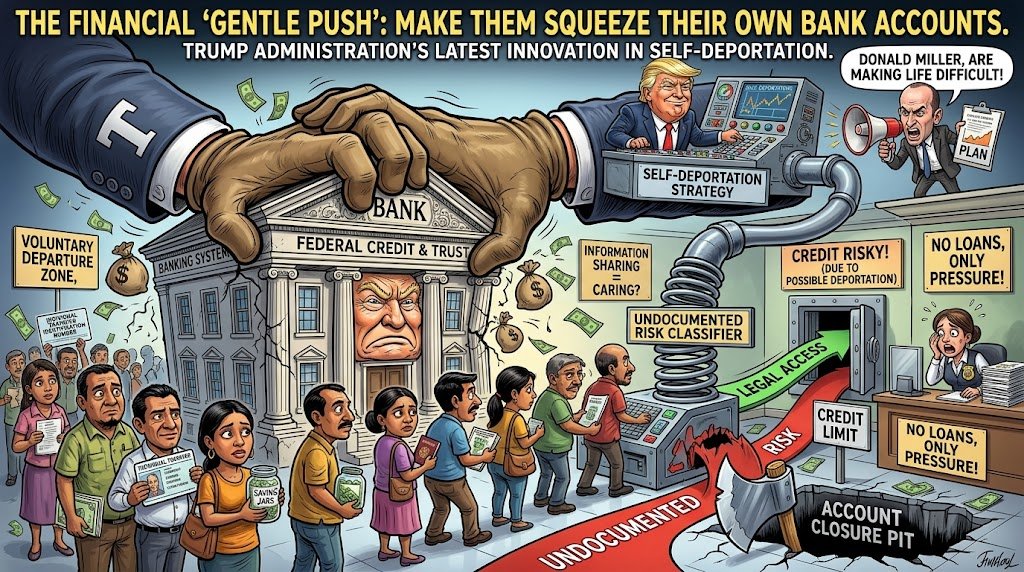
The initiative forms part of President Donald Trump’s broader self-deportation strategy: reducing the practical advantages of remaining in the country unlawfully so that more migrants leave voluntarily rather than wait for arrest and removal proceedings.
White House deputy chief of staff Stephen Miller has described access to bank accounts, credit cards and direct-deposit wages as evidence that undocumented immigrants participate extensively in the formal economy.
Statements attributed to him present the loss of financial access as a major incentive for voluntary departure, although the precise wording circulating online has not been independently authenticated.
Federal banking regulators issued guidance in July directing banks, credit unions and other lenders to consider the risks associated with extending credit to borrowers who lack authorization to work in the United States.
The guidance emphasizes that deportation, detention or loss of employment could interrupt a borrower’s income and impair repayment.
It does not expressly order institutions to close deposit accounts or reject every undocumented applicant, but it gives banks a regulatory basis for treating such customers as presenting elevated credit risk.
The Treasury Department had already expanded the financial component of the immigration campaign.
Guidance issued in June encouraged institutions to share information more rapidly and to flag patterns that could indicate identity theft, payroll fraud, money laundering, labor exploitation or unlawful employment.
The measures rely partly on information-sharing provisions established under the Patriot Act and on the existing duties of the Financial Crimes Enforcement Network, known as FinCEN.
Treasury Secretary Scott Bessent has framed the policy as an effort to expose financial crime and protect the integrity of the banking system rather than to turn private banks directly into immigration police.
That distinction matters legally and operationally.
Federal law does not generally prohibit a person without lawful immigration status from holding a bank account.
Financial institutions must verify a customer’s identity, but many accept an Individual Taxpayer Identification Number, foreign passport or other documentation instead of a Social Security number.
An Individual Taxpayer Identification Number also does not establish immigration status; it is issued for tax administration and can be held by citizens, lawful residents, visa holders and undocumented taxpayers.
The administration’s approach therefore works through pressure, supervision and risk classification rather than a single universal prohibition.
Regulators can question lending practices, examine compliance systems and warn institutions about exposure to fraud or repayment losses.
Banks may respond by requiring additional documents, declining loans, reviewing existing relationships or closing accounts they consider too risky.
The practical effect could extend beyond credit into checking accounts, payment services and remittances, even where the formal guidance does not explicitly require exclusion.
The policy also reflects a shift in the purpose of traditional banking controls.
Know-your-customer rules were designed principally to prevent money laundering, sanctions evasion, terrorist financing and identity fraud.
Applying those tools to immigration enforcement creates a much broader category of risk because unlawful presence is a civil violation in many circumstances and does not by itself prove financial misconduct.
Institutions must still comply with consumer-protection, privacy and anti-discrimination laws when deciding whom to serve.
Banks face substantial implementation problems.
Most institutions do not maintain a reliable, continuously updated record of every customer’s citizenship or immigration status.
A lawful visa may expire, an asylum application may remain pending, temporary protection may be extended or withdrawn, and mixed-status families may share accounts.
Tax numbers and foreign identification documents cannot by themselves determine whether someone is unlawfully present.
A system built on indirect indicators consequently carries the risk of false identification and disruption for citizens, permanent residents and lawful migrants.
Financial institutions also have strong commercial and compliance incentives to avoid overbroad exclusions.
Driving customers out of regulated banks can push money into cash transactions, informal transfer networks, check-cashing businesses and high-cost lenders, making transactions harder rather than easier for authorities to monitor.
Industry resistance is therefore likely to focus not only on civil-liberties concerns but also on cost, legal exposure and the possibility that aggressive account closures could weaken anti-money-laundering oversight.
The administration argues that access to employment, credit and financial infrastructure helps sustain unlawful residence and undermines immigration enforcement.
Its supporters view the banking initiative as a lawful use of regulatory authority to reduce fraud, prevent unauthorized employment and reinforce the consequences of violating immigration law.
Critics contend that the government is using financial supervision to impose an immigration penalty that Congress has not enacted and that the effects may fall on lawful customers whose records resemble those targeted by the policy.
What is confirmed is that the government has moved beyond discussing the idea.
Treasury and federal banking regulators have issued guidance, expanded information-sharing expectations and begun pressing financial institutions to incorporate immigration-related exposure into their risk decisions.
The next phase will be implemented through bank examinations, compliance reviews and direct engagement between federal officials and the financial industry.
The immediate mechanism is not a blanket statutory ban on bank accounts.
Instead, regulators are pressing financial institutions to apply existing customer-identification, fraud-prevention and credit-risk rules more aggressively when immigration status may affect a customer’s employment, repayment capacity or continued presence in the country.
The initiative forms part of President Donald Trump’s broader self-deportation strategy: reducing the practical advantages of remaining in the country unlawfully so that more migrants leave voluntarily rather than wait for arrest and removal proceedings.
White House deputy chief of staff Stephen Miller has described access to bank accounts, credit cards and direct-deposit wages as evidence that undocumented immigrants participate extensively in the formal economy.
Statements attributed to him present the loss of financial access as a major incentive for voluntary departure, although the precise wording circulating online has not been independently authenticated.
Federal banking regulators issued guidance in July directing banks, credit unions and other lenders to consider the risks associated with extending credit to borrowers who lack authorization to work in the United States.
The guidance emphasizes that deportation, detention or loss of employment could interrupt a borrower’s income and impair repayment.
It does not expressly order institutions to close deposit accounts or reject every undocumented applicant, but it gives banks a regulatory basis for treating such customers as presenting elevated credit risk.
The Treasury Department had already expanded the financial component of the immigration campaign.
Guidance issued in June encouraged institutions to share information more rapidly and to flag patterns that could indicate identity theft, payroll fraud, money laundering, labor exploitation or unlawful employment.
The measures rely partly on information-sharing provisions established under the Patriot Act and on the existing duties of the Financial Crimes Enforcement Network, known as FinCEN.
Treasury Secretary Scott Bessent has framed the policy as an effort to expose financial crime and protect the integrity of the banking system rather than to turn private banks directly into immigration police.
That distinction matters legally and operationally.
Federal law does not generally prohibit a person without lawful immigration status from holding a bank account.
Financial institutions must verify a customer’s identity, but many accept an Individual Taxpayer Identification Number, foreign passport or other documentation instead of a Social Security number.
An Individual Taxpayer Identification Number also does not establish immigration status; it is issued for tax administration and can be held by citizens, lawful residents, visa holders and undocumented taxpayers.
The administration’s approach therefore works through pressure, supervision and risk classification rather than a single universal prohibition.
Regulators can question lending practices, examine compliance systems and warn institutions about exposure to fraud or repayment losses.
Banks may respond by requiring additional documents, declining loans, reviewing existing relationships or closing accounts they consider too risky.
The practical effect could extend beyond credit into checking accounts, payment services and remittances, even where the formal guidance does not explicitly require exclusion.
The policy also reflects a shift in the purpose of traditional banking controls.
Know-your-customer rules were designed principally to prevent money laundering, sanctions evasion, terrorist financing and identity fraud.
Applying those tools to immigration enforcement creates a much broader category of risk because unlawful presence is a civil violation in many circumstances and does not by itself prove financial misconduct.
Institutions must still comply with consumer-protection, privacy and anti-discrimination laws when deciding whom to serve.
Banks face substantial implementation problems.
Most institutions do not maintain a reliable, continuously updated record of every customer’s citizenship or immigration status.
A lawful visa may expire, an asylum application may remain pending, temporary protection may be extended or withdrawn, and mixed-status families may share accounts.
Tax numbers and foreign identification documents cannot by themselves determine whether someone is unlawfully present.
A system built on indirect indicators consequently carries the risk of false identification and disruption for citizens, permanent residents and lawful migrants.
Financial institutions also have strong commercial and compliance incentives to avoid overbroad exclusions.
Driving customers out of regulated banks can push money into cash transactions, informal transfer networks, check-cashing businesses and high-cost lenders, making transactions harder rather than easier for authorities to monitor.
Industry resistance is therefore likely to focus not only on civil-liberties concerns but also on cost, legal exposure and the possibility that aggressive account closures could weaken anti-money-laundering oversight.
The administration argues that access to employment, credit and financial infrastructure helps sustain unlawful residence and undermines immigration enforcement.
Its supporters view the banking initiative as a lawful use of regulatory authority to reduce fraud, prevent unauthorized employment and reinforce the consequences of violating immigration law.
Critics contend that the government is using financial supervision to impose an immigration penalty that Congress has not enacted and that the effects may fall on lawful customers whose records resemble those targeted by the policy.
What is confirmed is that the government has moved beyond discussing the idea.
Treasury and federal banking regulators have issued guidance, expanded information-sharing expectations and begun pressing financial institutions to incorporate immigration-related exposure into their risk decisions.
The next phase will be implemented through bank examinations, compliance reviews and direct engagement between federal officials and the financial industry.