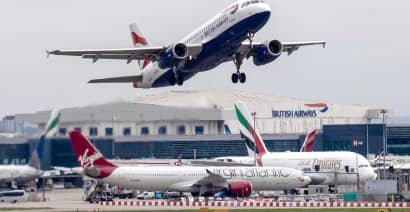
UK Moves to Let Airlines Consolidate Flights as Jet Fuel Costs Pressure Aviation Sector
Government introduces temporary flexibility allowing carriers to merge or cancel underfilled services to reduce fuel waste and stabilize summer schedules amid sustained price shocks
The UK government has introduced a temporary policy shift allowing airlines to consolidate or cancel flights in advance as rising jet fuel costs and supply pressures continue to strain aviation planning ahead of the summer travel season.
The measure is designed to reduce inefficient fuel use caused by partially filled aircraft operating multiple daily services on the same routes.
Under the new framework, airlines can merge passengers from separate flights onto fewer planes or cancel selected services, provided changes are made in advance—typically at least two weeks before departure.
The intention is to give passengers time to be rebooked while preventing last-minute cancellations and unnecessary fuel burn.
What is confirmed is that the policy does not stem from an immediate jet fuel shortage in the UK. Government and industry statements consistently indicate that airlines are still receiving adequate supply through advance purchasing and airport storage systems.
However, the broader aviation market is under pressure from elevated global fuel prices, which have been driven by geopolitical disruption and constrained supply routes affecting energy markets.
The operational mechanism of the policy also includes changes to airport slot regulations.
Normally, airlines risk losing valuable takeoff and landing rights if they do not use them regularly.
Under the temporary arrangement, carriers will not be penalised for cancelling or consolidating flights linked to fuel-related efficiency measures.
This removes a structural incentive that previously encouraged airlines to operate near-empty flights simply to retain airport slots.
Airlines are expected to apply the changes selectively, focusing on routes with multiple daily departures to the same destination.
Industry modelling suggests that only a small percentage of total seat capacity—primarily off-peak or low-demand rotations—may be removed, but this could still affect scheduling consistency across short-haul European networks.
The stakes are economic as much as operational.
Jet fuel is one of the largest cost components in aviation, and sustained price increases compress airline margins while pushing carriers to adjust capacity, fares, or both.
Some airlines across Europe have already reduced flight frequencies or raised ticket prices in response to similar pressures, while others rely on hedging strategies that delay but do not eliminate exposure to market volatility.
For passengers, the immediate impact is not expected to be widespread disruption, but a gradual shift in how schedules are managed.
Flights may be moved between services on the same day, and in some cases rebooked onto different carriers if consolidation is applied across overlapping routes.
Airlines and regulators argue that this approach reduces uncertainty compared to short-notice cancellations.
The broader implication is structural: aviation systems built around rigid slot usage and high-frequency scheduling are being temporarily adapted to accommodate cost-driven efficiency constraints.
The policy signals a shift toward prioritizing fuel efficiency and schedule stability over maximum route redundancy during periods of sustained cost pressure.
The government has framed the measure as a contingency tool rather than a permanent reform, aimed at maintaining operational resilience in a volatile energy environment while avoiding large-scale disruption to summer travel demand.
The measure is designed to reduce inefficient fuel use caused by partially filled aircraft operating multiple daily services on the same routes.
Under the new framework, airlines can merge passengers from separate flights onto fewer planes or cancel selected services, provided changes are made in advance—typically at least two weeks before departure.
The intention is to give passengers time to be rebooked while preventing last-minute cancellations and unnecessary fuel burn.
What is confirmed is that the policy does not stem from an immediate jet fuel shortage in the UK. Government and industry statements consistently indicate that airlines are still receiving adequate supply through advance purchasing and airport storage systems.
However, the broader aviation market is under pressure from elevated global fuel prices, which have been driven by geopolitical disruption and constrained supply routes affecting energy markets.
The operational mechanism of the policy also includes changes to airport slot regulations.
Normally, airlines risk losing valuable takeoff and landing rights if they do not use them regularly.
Under the temporary arrangement, carriers will not be penalised for cancelling or consolidating flights linked to fuel-related efficiency measures.
This removes a structural incentive that previously encouraged airlines to operate near-empty flights simply to retain airport slots.
Airlines are expected to apply the changes selectively, focusing on routes with multiple daily departures to the same destination.
Industry modelling suggests that only a small percentage of total seat capacity—primarily off-peak or low-demand rotations—may be removed, but this could still affect scheduling consistency across short-haul European networks.
The stakes are economic as much as operational.
Jet fuel is one of the largest cost components in aviation, and sustained price increases compress airline margins while pushing carriers to adjust capacity, fares, or both.
Some airlines across Europe have already reduced flight frequencies or raised ticket prices in response to similar pressures, while others rely on hedging strategies that delay but do not eliminate exposure to market volatility.
For passengers, the immediate impact is not expected to be widespread disruption, but a gradual shift in how schedules are managed.
Flights may be moved between services on the same day, and in some cases rebooked onto different carriers if consolidation is applied across overlapping routes.
Airlines and regulators argue that this approach reduces uncertainty compared to short-notice cancellations.
The broader implication is structural: aviation systems built around rigid slot usage and high-frequency scheduling are being temporarily adapted to accommodate cost-driven efficiency constraints.
The policy signals a shift toward prioritizing fuel efficiency and schedule stability over maximum route redundancy during periods of sustained cost pressure.
The government has framed the measure as a contingency tool rather than a permanent reform, aimed at maintaining operational resilience in a volatile energy environment while avoiding large-scale disruption to summer travel demand.