Apple Briefly Crosses Five Trillion Dollar Mark as Investors Favour Restraint on AI Spending
The iPhone maker reclaimed its position ahead of Nvidia after a rotation out of chip shares sharpened investor interest in its cash-generative business model.
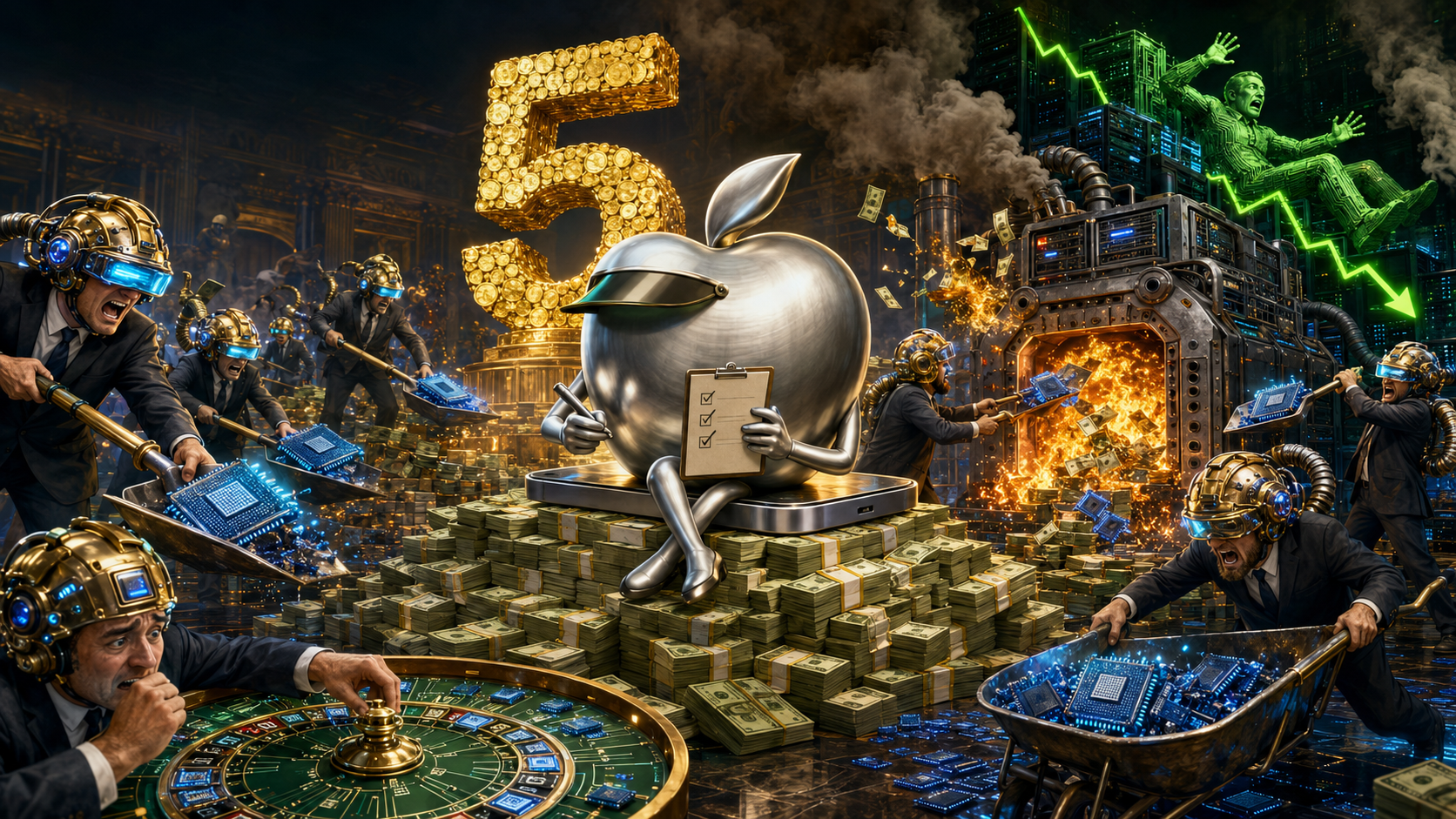
Apple briefly surpassed a five-trillion-dollar market valuation after its shares reached an intraday record of 342.89 dollars, lifting the company’s value to about 5.04 trillion dollars before the advance ebbed.
The shares closed below the threshold, but the move returned Apple to the position of the world’s most valuable listed company, ahead of Nvidia.
The milestone came only months after Apple first exceeded four trillion dollars in market value.
Its shares have risen by roughly a quarter this year, outpacing several large technology rivals during a period in which investors have grown more discriminating about the costs attached to the artificial-intelligence boom.
The central attraction is not that Apple has abandoned artificial intelligence.
It has introduced Apple Intelligence, continues to develop a more capable version of Siri and remains a significant buyer of advanced components.
Its distinction lies in capital discipline: rather than committing to the most expansive data-centre construction and model-training programmes, it has pursued a more selective strategy built around its devices, proprietary chips and external partnerships.
That approach has become more appealing as concerns mount over the scale and timing of returns from artificial-intelligence infrastructure.
Investors have increasingly questioned whether the enormous outlays planned by companies building data centres, buying processors and training frontier models can be justified by near-term revenues.
The resulting sell-off has hit chipmakers particularly hard, with Nvidia, Samsung Electronics and SK Hynix among the companies affected by the reassessment.
Apple has benefited from that rotation, but its valuation still rests on its underlying operations.
Demand for its hardware and the steady expansion of its services business give the group a large recurring revenue base, while its comparatively modest artificial-intelligence capital commitments have helped preserve the perception of robust cash generation.
There are constraints.
The global push to build artificial-intelligence infrastructure has tightened supplies of memory and storage components, raising costs for device makers.
Apple must also demonstrate that its delayed and more measured artificial-intelligence offering can improve its products without surrendering ground to competitors that have moved faster in consumer-facing software.
The company is broadening its commercial reach as it prepares for that test.
Its new Apple Upgrade programme in the United States, operated with Klarna, offers leases for iPhones, iPads, Apple Watches and Macs, with monthly payments beginning at 17.99 dollars for an iPhone.
Customers can return a device, upgrade it or buy it at the end of the agreement.
A leadership transition will add further significance to the coming months.
Tim Cook is due to become Apple’s executive chair on 1 September, when John Ternus, the company’s hardware chief, succeeds him as chief executive.
Ternus will inherit a company valued as much for disciplined execution as for its capacity to adapt its devices and services to the next phase of artificial intelligence.
The shares closed below the threshold, but the move returned Apple to the position of the world’s most valuable listed company, ahead of Nvidia.
The milestone came only months after Apple first exceeded four trillion dollars in market value.
Its shares have risen by roughly a quarter this year, outpacing several large technology rivals during a period in which investors have grown more discriminating about the costs attached to the artificial-intelligence boom.
The central attraction is not that Apple has abandoned artificial intelligence.
It has introduced Apple Intelligence, continues to develop a more capable version of Siri and remains a significant buyer of advanced components.
Its distinction lies in capital discipline: rather than committing to the most expansive data-centre construction and model-training programmes, it has pursued a more selective strategy built around its devices, proprietary chips and external partnerships.
That approach has become more appealing as concerns mount over the scale and timing of returns from artificial-intelligence infrastructure.
Investors have increasingly questioned whether the enormous outlays planned by companies building data centres, buying processors and training frontier models can be justified by near-term revenues.
The resulting sell-off has hit chipmakers particularly hard, with Nvidia, Samsung Electronics and SK Hynix among the companies affected by the reassessment.
Apple has benefited from that rotation, but its valuation still rests on its underlying operations.
Demand for its hardware and the steady expansion of its services business give the group a large recurring revenue base, while its comparatively modest artificial-intelligence capital commitments have helped preserve the perception of robust cash generation.
There are constraints.
The global push to build artificial-intelligence infrastructure has tightened supplies of memory and storage components, raising costs for device makers.
Apple must also demonstrate that its delayed and more measured artificial-intelligence offering can improve its products without surrendering ground to competitors that have moved faster in consumer-facing software.
The company is broadening its commercial reach as it prepares for that test.
Its new Apple Upgrade programme in the United States, operated with Klarna, offers leases for iPhones, iPads, Apple Watches and Macs, with monthly payments beginning at 17.99 dollars for an iPhone.
Customers can return a device, upgrade it or buy it at the end of the agreement.
A leadership transition will add further significance to the coming months.
Tim Cook is due to become Apple’s executive chair on 1 September, when John Ternus, the company’s hardware chief, succeeds him as chief executive.
Ternus will inherit a company valued as much for disciplined execution as for its capacity to adapt its devices and services to the next phase of artificial intelligence.