Beautiful Virgin Islands

Friday, Aug 14, 2026

ExxonMobil: Oil giant predicted climate change in 1970s - scientists

ExxonMobil: Oil giant predicted climate change in 1970s - scientists

One of the world's largest oil companies accurately forecast how climate change would cause global temperature to rise as long ago as the 1970s, researchers claim.

ExxonMobil's private research predicted how burning fossil fuels would warm the planet but the company publicly denied the link, they suggest.

The academics analysed data in the company's internal documents.

ExxonMobil denied the allegations.

"This issue has come up several times in recent years and, in each case, our answer is the same: those who talk about how "Exxon Knew" are wrong in their conclusions," the company told BBC News.

Corporations including ExxonMobil have made billions from selling fossil fuels that release emissions that scientists, governments and the UN say cause global warming.

The findings suggest that ExxonMobil's predictions were often more accurate than even world-leading Nasa scientists.

"It really underscores the stark hypocrisy of ExxonMobil leadership, who knew that their own scientists were doing this very high quality modelling work and had access to that privileged information while telling the rest of us that climate models were bunk," Naomi Oreskes, professor of the history of science at Harvard University, told BBC News.

The findings are a "smoking gun", suggests co-author Geoffrey Supran, associate professor of environmental science and policy at the University of Miami.

"Our analysis allows us for the first time to actually put a number on what Exxon knew, which is that the burning of their fossil fuel products was going to heat the planet by about 0.2C of warming every decade," he said.

Researchers have never before quantified the scientific evidence in ExxonMobil's documents, he says.

In response, ExxonMobil pointed to a 2019 US court ruling that concluded: "ExxonMobil executives and employees were uniformly committed to rigorously discharging their duties in the most comprehensive and meticulous manner possible."

"ExxonMobil is committed to being part of the solution to climate change and the risks it poses," a spokesperson said.
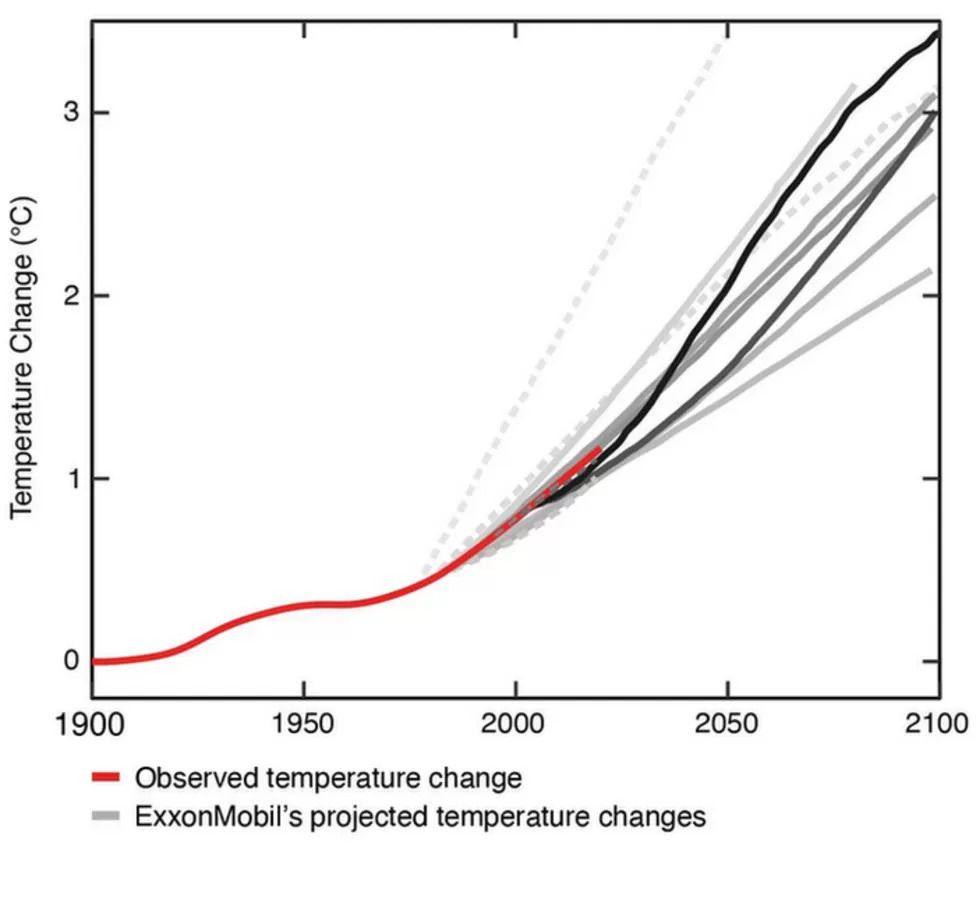

A chart that researchers say compares ExxonMobil's predictions of temperature rise with actual temperature increase

"Their excellent climate modelling was at least comparable in performance to one of the most influential and well-regarded climate scientists of modern history," Prof Supran said, comparing ExxonMobil's work to Nasa's James Hansen who sounded the alarm on climate in 1988.

Prof Oreskes said the findings show that ExxonMobil "knowingly misled" the public and governments. "They had all this information at their disposal but they said very, very different things in public," she explained.

Previous investigations have unearthed Exxon documents that suggest the company sought to spread doubt about the science. One internal paper set out the "Exxon position" to "emphasise the uncertainty in scientific conclusions" about the greenhouse effect.

The research, published in the academic journal Science, also suggests that ExxonMobil had reasonable estimates for how emissions would need to be reduced in order to avoid the worst effects of climate change in a world warmed by 2C or more.

Their scientists also correctly rejected the theory that an ice age was coming at a time when other researchers were still debating the prospect.

Prof Oreskes and Prof Supran carried out the research after journalists in 2015 uncovered evidence suggesting ExxonMobil's knew about climate change, but were accused by ExxonMobil of "cherry-picking" the truth.

They plotted scientific data in more than 100 publications from Exxon and Exxon Mobil between 1977 and 2014 to calculate their predictions of global temperature rise.

Prof Oreskes suggests that it showed the company was internally using climate science when publicly it called the models "speculative" or "bad science".

The findings add to ongoing pressure on the company over what it knew about climate change. Campaigners allege it spread misinformation in order to protect its business interests in fossil fuels and are suing the company in a number of US courts.

In May a court in Massachusetts, US ruled that ExxonMobil must face trial over accusations it lied about climate change.


Newsletter

Related Articles

Beautiful Virgin Islands
0:00
0:00
Close
China’s Kimi Launches AI-Focused Credit Card With Agricultural Bank of China and American Express
Former Labour Adviser Arrested on Suspicion of Spying for China Held Privileged Access as Top Party Donor
Turkish Parliament Passes Landmark Bill Granting Conditional Amnesty to Disarmed PKK Members
Donald Trump Warns FIFA Against Ousting Gianni Infantino Amid Revolt by Global Football Leaders
Jeff Bezos Joins Investor Group Closing In on $6 Billion Liverpool FC Stake
UK Councils to Receive Sweeping Planning Powers to Ban New Vape and Betting Shops
Russia’s A7 Builds a State-Linked Payments Network Beyond Western Sanctions
Hyper-Realistic Reborn Dolls Draw Collectors Seeking Comfort and Craft
Gen Z Cuts Back on Dating as a Night Out Nears $200
Patients Turn to Artificial Intelligence for Therapy as Psychiatrists Warn of Privacy and Clinical Risks
Couples Embrace ‘Sleep Divorce’ to Protect Rest and Reduce Tension
Meta Ordered to Pay $567 Million and Change Facebook and Instagram Safeguards for Children
Up to only 10 Months in Prison for Swedish Officer’s Murderer Sparks Anger
Success: Nvidia Turned Gaming Chips Into the Engine of the AI Boom
Jorge Messi, Lionel Messi’s Father and Longtime Agent, Dies at 68
AI’s Next Bottleneck Is Power, Not Just Nvidia Chips
Advertising trick: Pepsi’s Harrier Jet Commercial Led to a $700,000 Court Fight
Meta Raises AI Spending Target to as Much as $145bn Despite Pressure Over Returns
Danube Drought Exposes Nazi Wrecks and Pushes Central Europe’s Power System to the Brink
Joe Biden’s Cancer Has Spread Beyond His Bones, Hunter Biden Says
Air Traffic Control Outage Grounded Flights Across the Midwest
Why 2027 Could Be a Strong Year for Stocks—and Why the Forecast Is Fragile
Why Markets May Look Quiet in August After Big Tech Earnings
Australian Crew Evacuates Seriously Ill American From Antarctica in Midwinter Darkness
Trump’s Top General Seeks an Exit Strategy From Iran War, Report Says
Brock Lesnar Retires From Wrestling, Closing a Career of Rare Athletic Range and Lasting Controversy
Trump-Era Policy Shifts Test the Boundaries of U.S. Institutions
UK Drought Cuts Harvests and Raises Food-Security Fears
UFO: Pentagon Releases Video of Unidentified Object Tracked Over Middle East
US Health Secretary: “I’m Not Afraid of Germs — I Used to Snort Cocaine Off Toilet Seats”
Ukraine Tells Senate Republicans Its Drone War Offers a Blueprint for America
Weight-Loss Drug Boom Tests the Limits of Prescription Advertising Rules
Trump Keeps Hegseth at Pentagon While Leaving Door Open for DeSantis
UK Clears Paramount’s Warner Bros. Discovery Deal, but US Trial Looms
UK Prosecutors Add 38 Charges Against Andrew and Tristan Tate
Taiwan’s President Joins Wartime Command Drill as China Pressure Grows
Saudi Arabia, Turkey and Pakistan Sign Mutual-Defence Pact
HMRC’s 2029 Tax Shift Could Overlap Old and New Self-Assessment Bills
Thetford Disorder Prompts Expanded Police Powers Amid Asylum-Housing Protests
Cambridge Faces Calls for Independent Review of Jason Arday Appointment
Scotland’s ‘Cock of the North’ Woodland Is Being Felled After Wind Damage
Reform UK and Greens Unite Against Vast Solar Plans for Kent Marshland
New Zealand Draws Wealthy Americans With Revamped Investor Visa
Senate Panel Votes to Hold Anthony Fauci in Contempt After Fifth Amendment Testimony
Cambridge Professor Jason Arday Resigns as University Opens Inquiry Into His Credentials
Manchester Power Failure Disrupts Trains Across North West Into Friday
Lightning Strike Kills Yala FC Player During Match in Southern Thailand
Senate Scrutinises AI-Driven Personalised Pricing
Spain Seeks Mainland Transfers for 1,100 Children Stranded in Ceuta
Spain and Morocco Trade Blame After 72,000 Migrants Enter Ceuta
×









