

Government taskforce urges permanent job flexibility for all workers
Millions of employees could be given the chance to switch permanently to more flexible working arrangements under forthcoming guidance designed to encourage firms to make long-term some of the emergency changes ushered in by the pandemic.
The government’s flexible working taskforce is drawing up guidance – before the expected lifting of the remaining lockdown restrictions, including the requirement to work from home, on 21 June – to support the emergence of new, hybrid ways of working. For example, staff might come into offices only occasionally and work at home or at a neighbourhood cafe for the rest of the week.
Peter Cheese, the co-chair of the taskforce, said the pandemic had demonstrated that people could work productively away from traditional workplaces, with 71% of firms reporting that home working had either boosted or made no difference to productivity. “This is an opportunity to shift ways of working, which have barely changed for generations,” he said. “It will allow more people with other life commitments to participate in work and it will improve wellbeing.”
While a consultation on strengthening flexible working rights is expected after the local elections this week, some of the government’s most senior figures, including Boris Johnson and his chancellor, Rishi Sunak, have suggested employers should reopen offices to help the recovery of city-centre businesses. One unnamed minister went as far as to brief the Telegraph last summer that workers should be sacked if they did not return to the office.
“There have been mixed messages from the government,” said Cheese, who is chief executive of the Chartered Institute of Personnel and Development (CIPD). “If the cities have far fewer people, local businesses are going to have to adapt.”
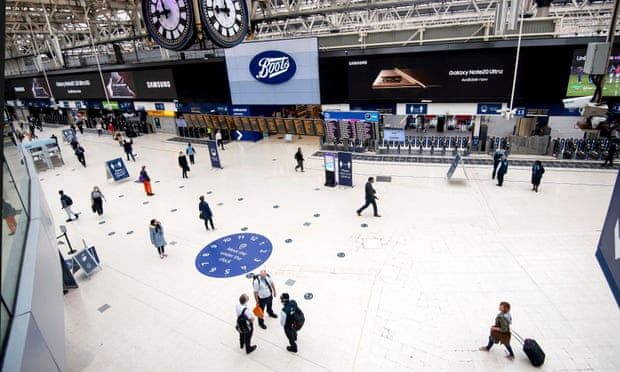 Waterloo station in London at ‘rush hour’ on 3 September 2020.
The taskforce, which met last month, is considering whether employment contracts need to change to enable more ad hoc, hybrid working in different locations. Employers will still need to ensure employees have a safe place to work.
“We need to understand what the law is and what might have to change,” Cheese said. “But we are going to have to learn as we go along.”
There are concerns, however, that these new ways of working could become the preserve of middle-class professionals with office-based jobs. Another member of the taskforce, Sue Coe, who is a TUC policy officer, said employers should offer different kinds of flexibility. “We are concerned about the potential for a two-tier workforce emerging with the flexible working haves, who can work from home, and the flexible working have-nots, who cannot,” she said. “These workers need access to flexitime, part-time working, job shares. We need flexible working for everybody.”
Research by the CIPD shows 44% of employees have not worked from home at all during the pandemic as their jobs do not allow it – yet only 30% of employers are planning to introduce other types of flexible working in the next six to 12 months.
The taskforce may recommend that new recruits should be able to apply immediately for flexible working instead of waiting the current 26 weeks. Cheese believes that firms should be forced to publish flexible working data.
He said: “We could say to organisations we want to see better evidence about how you are enacting flexible working practices and how many people are working in flexible ways. It is not just about employment law [changes] – it is about encouraging these behaviours by requiring greater transparency.”
Although the right to request flexible working was extended to all employees in 2014, the proportion of the workforce actually allowed to work flexibly has flatlined at just over a quarter of workers.
Coe said: “The right to request is a right to be turned down.”
The TUC would like the taskforce to propose a duty on employers to include flexible options in job adverts. “It would mainstream flexibility,” Coe added. “Instead of workers going cap in hand to managers and flexible working being doled out sparingly as a perk, people would have the right to take up the advertised flexibility.”
The pandemic has shown how quickly employers were able to identify the roles that could be performed at home. “It was done for one of the more complex areas of flexible working,” Coe said. “Why can’t employers do that, for, say, flexitime or job shares?”
The Department for Business, Energy and Industrial Strategy has been approached for comment.











