Smartphones Are Getting More Expensive, Sales Are Collapsing, and Even Apple Admits: "Prices Will Rise"
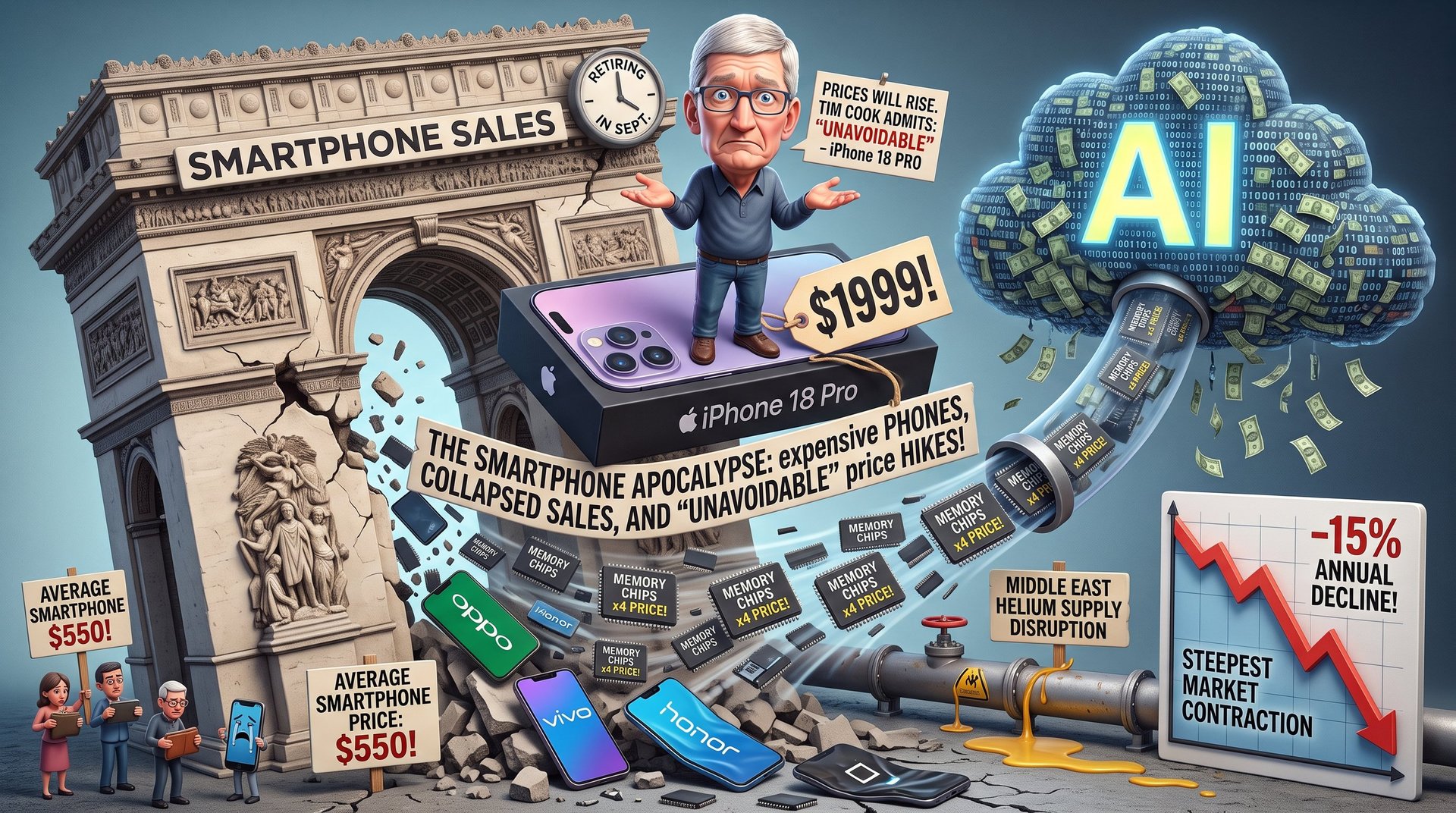
Surging memory prices, soaring demand for artificial intelligence hardware and supply chain disruptions are driving smartphone prices higher while analysts forecast the steepest annual market contraction on record.
The global smartphone market is facing an unprecedented upheaval that is expected to reshape the technology consumer landscape.
A combination of sharply rising memory component prices, geopolitical pressures affecting the supply of critical raw materials, and mounting demand for artificial intelligence hardware has prompted leading analysts to dramatically lower their sales forecasts.
According to research firms IDC and Omdia, the market is expected to contract by roughly thirteen to fifteen percent this year, marking the steepest annual decline in the industry's history.
Shipment volumes are projected to fall back to levels last seen more than a decade ago.
Apple Chief Executive Officer Tim Cook acknowledged in an interview yesterday that consumer price increases have become unavoidable.
Cook, who is expected to retire this September after fifteen years as Apple's chief executive, described the surge in memory costs as a "once-in-a-century flood."
He said Apple had made extensive efforts to absorb higher costs in order to shield customers from price increases, but maintaining that strategy was no longer economically sustainable.
As a result, consumers are expected to pay more beginning with the iPhone eighteen lineup, which is scheduled to be unveiled this autumn.
Preliminary estimates from research firms suggest that the Pro models alone could rise in price by several hundred dollars in order to preserve Apple's profit margins.
The primary driver of the crisis is the large-scale reallocation of manufacturing capacity by major memory producers, including Samsung, SK hynix and Micron.
The rapid expansion of generative artificial intelligence has forced these companies to devote most of their production capacity to high-bandwidth memory, or HBM, used in artificial intelligence servers and data centers.
As a consequence, the supply of DRAM and NAND memory chips for consumer electronics has tightened significantly, while prices have climbed to more than four times their level of a year ago.
The situation has been compounded by security tensions in the Middle East, which have disrupted the global supply chain for helium gas, a critical material used in semiconductor manufacturing.
While Apple and Samsung possess the purchasing power to secure component supplies well in advance, the crisis is hitting smaller and mid-sized Android manufacturers far more severely, particularly Chinese brands such as Oppo, Vivo and Honor.
These companies, which rely on narrow margins in lower-priced devices, are facing manufacturing cost increases of as much as thirty percent.
Analysts therefore expect the overall Android market to shrink by approximately twenty percent this year, while the average global selling price of a smartphone is projected to climb to a record level of about five hundred and fifty dollars.
Memory components have traditionally been among the least expensive and most readily available parts used in smartphone manufacturing.
Increasing storage capacity or random-access memory was once a simple and cost-effective way for manufacturers to improve performance without substantially raising retail prices.
That dynamic has now changed.
The demanding requirements of on-device artificial intelligence applications, which run directly on smartphones and require significantly larger memory capacities, have transformed what was once an inexpensive component into the industry's most costly bottleneck.
The shift is driven by the need to adopt newer memory standards capable of supporting these advanced artificial intelligence workloads.
Looking ahead, the crisis is expected to accelerate a broader restructuring of the consumer electronics market.
Weaker brands that cannot pass higher costs on to consumers may be forced to exit the market, while larger manufacturers are likely to reduce the number of entry-level models and concentrate on premium smartphones and foldable devices, segments that have remained comparatively resilient and continue to grow.
Analysts expect pricing stability will not return before the middle of twenty twenty-seven.
Even then, smartphone prices are expected to remain permanently higher than they were before the current crisis.
A combination of sharply rising memory component prices, geopolitical pressures affecting the supply of critical raw materials, and mounting demand for artificial intelligence hardware has prompted leading analysts to dramatically lower their sales forecasts.
According to research firms IDC and Omdia, the market is expected to contract by roughly thirteen to fifteen percent this year, marking the steepest annual decline in the industry's history.
Shipment volumes are projected to fall back to levels last seen more than a decade ago.
Apple Chief Executive Officer Tim Cook acknowledged in an interview yesterday that consumer price increases have become unavoidable.
Cook, who is expected to retire this September after fifteen years as Apple's chief executive, described the surge in memory costs as a "once-in-a-century flood."
He said Apple had made extensive efforts to absorb higher costs in order to shield customers from price increases, but maintaining that strategy was no longer economically sustainable.
As a result, consumers are expected to pay more beginning with the iPhone eighteen lineup, which is scheduled to be unveiled this autumn.
Preliminary estimates from research firms suggest that the Pro models alone could rise in price by several hundred dollars in order to preserve Apple's profit margins.
The primary driver of the crisis is the large-scale reallocation of manufacturing capacity by major memory producers, including Samsung, SK hynix and Micron.
The rapid expansion of generative artificial intelligence has forced these companies to devote most of their production capacity to high-bandwidth memory, or HBM, used in artificial intelligence servers and data centers.
As a consequence, the supply of DRAM and NAND memory chips for consumer electronics has tightened significantly, while prices have climbed to more than four times their level of a year ago.
The situation has been compounded by security tensions in the Middle East, which have disrupted the global supply chain for helium gas, a critical material used in semiconductor manufacturing.
While Apple and Samsung possess the purchasing power to secure component supplies well in advance, the crisis is hitting smaller and mid-sized Android manufacturers far more severely, particularly Chinese brands such as Oppo, Vivo and Honor.
These companies, which rely on narrow margins in lower-priced devices, are facing manufacturing cost increases of as much as thirty percent.
Analysts therefore expect the overall Android market to shrink by approximately twenty percent this year, while the average global selling price of a smartphone is projected to climb to a record level of about five hundred and fifty dollars.
Memory components have traditionally been among the least expensive and most readily available parts used in smartphone manufacturing.
Increasing storage capacity or random-access memory was once a simple and cost-effective way for manufacturers to improve performance without substantially raising retail prices.
That dynamic has now changed.
The demanding requirements of on-device artificial intelligence applications, which run directly on smartphones and require significantly larger memory capacities, have transformed what was once an inexpensive component into the industry's most costly bottleneck.
The shift is driven by the need to adopt newer memory standards capable of supporting these advanced artificial intelligence workloads.
Looking ahead, the crisis is expected to accelerate a broader restructuring of the consumer electronics market.
Weaker brands that cannot pass higher costs on to consumers may be forced to exit the market, while larger manufacturers are likely to reduce the number of entry-level models and concentrate on premium smartphones and foldable devices, segments that have remained comparatively resilient and continue to grow.
Analysts expect pricing stability will not return before the middle of twenty twenty-seven.
Even then, smartphone prices are expected to remain permanently higher than they were before the current crisis.