

‘Who’s talking climate change now?’ energy producers say
Proponents of fossil fuel production hit back against efforts to tackle the climate crisis by urgently phasing out the burning of hydrocarbons, as the Russian invasion of Ukraine severely disrupts energy supplies.
A series of summits in the United Arab Emirates addressed the threat of climate change this week, with acknowledgements that a pivot away from fossil fuels towards cleaner sources of power is needed to keep global temperatures from rising.
However, glaring faultlines lie on when and how to achieve this. For fossil fuel producers, more investment, not less, is needed in oil and gas.
“We definitely at this time need to include all available resources,” UAE Minister of Energy Suhail al-Mazrouei said at an energy forum in Dubai.
“We cannot ignore or say we are going to abandon certain production. It’s just not the right time, whatever reason you have,” he said, adding that doing so would make energy prices too high for millions around the world.
It was a drumbeat echoed throughout the week in Dubai, reflecting the prominent voice fossil fuel producers are seeking to have in the global climate change conversation. It rang out at the Atlantic Council Global Energy Forum, the World Government Summit, and a UAE-sponsored climate week in partnership with the United Nations.
OPEC Secretary-General Mohammad Sanusi Barkindo said at the upcoming UN climate talks, known as COP27, in Egypt and next year’s COP28 in the UAE, producers can address issues around “inclusiveness to ensure no sector is left behind, to address the issue of investment in the industry and to reassess the conversation”.
He said limiting global temperature rise to no more than 1.5 degrees Celsius (2.7 degrees Fahrenheit) and the role of oil and gas “are not mutually exclusive”. That amount of warming compared with pre-industrial times is a benchmark and scientists say warming beyond it will expose people worldwide to far more extremes.
‘Radical action’
As extreme weather events including superstorms, forest fires, and floods increasingly hit countries around the world, even the slightest increase in global temperatures will worsen the situation.
But to drive home their argument, proponents of more fossil fuel investments pointed repeatedly to current high oil and gas prices as reminders of the global demand for oil. There was near derision at times that countries such as the United States, United Kingdom, and others are calling for fossil fuel use to ramp down in the long term, but also pleading for more oil to bring down prices for consumers.
The UN’s Intergovernmental Panel on Climate Change and other international bodies have said that to address climate change there should not be new investments in fossil fuel infrastructure, the fossil fuels most responsible for climate change must phase out over time.
That was reiterated in a 350-page report this week by the International Renewable Energy Agency that said the world must take “radical action” by investing $5.7 trillion each year through 2030 to shift away from fossil fuels. IRENA, with headquarters in the UAE capital of Abu Dhabi, said investments of $700bn should be diverted away from the hydrocarbon sector each year.
“The energy transition is far from being on track and anything short of radical action in the coming years will diminish, even eliminate, chances to meet our climate goals,” said Francesco La Camera, the director-general of IRENA, when the report came out.
Scientists have said global greenhouse gas emissions need to drop 45 percent by the end of this decade compared with 1990 levels. But recent data show that despite rapid growth in renewable energy, total emissions are going up, not down, amid rising energy demand and the expansion of fossil fuel use.
‘Energy security first and foremost’
OPEC projected that more oil will be needed through 2040 and beyond, particularly in Asia.
Brent crude stands at $105 a barrel, the highest in eight years and the Russian invasion of Ukraine has roiled the energy sector.
“Look at what is happening today. Who’s talking about climate change now? Who’s talking about attending to energy security first and foremost?” said Saudi Arabia’s Energy Minister Prince Abdulaziz bin Salman at the World Government Summit in Dubai.
Without energy security, countries will lose the means to tackle climate change, he said.
‘Must not unplug’
The International Monetary Fund’s Managing Director Kristalina Georgieva encouraged advanced economies to meet the goal of providing $100bn a year in climate finance to developing countries. She made the remarks this week at Dubai’s World Government Summit, where she unveiled an IMF paper titled, Feeling the Heat, about adapting to climate change in the Middle East.
The argument made repeatedly by Sultan al-Jaber, who is both the UAE’s special envoy for climate change and managing director of Abu Dhabi’s state-owned oil company, is that the energy transition will take time. And in that period of time, he said, the world will need more oil and gas.
“Put simply, we cannot and we must not unplug the current energy system before we have built the new one,” he said at the energy forum.
At the UN-backed climate week event, he said the push to divest from hydrocarbons has led to a supply crunch.
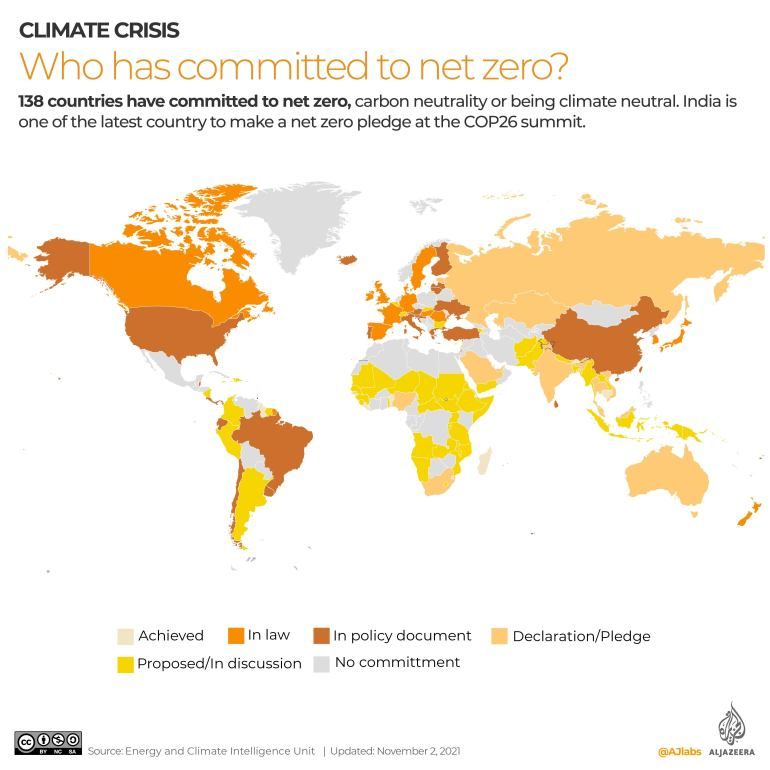
In his dual roles as climate change envoy and head of ADNOC, the state-owned oil and gas firm, al-Jaber symbolises the two paths the UAE has taken. On one hand, the country has committed to net-zero emissions within its own borders by 2050. On the other, it is committing to more oil and gas production for export. The country’s commitments do not apply to the emissions from burning that fuel.
Al-Jaber summed up this dual track, saying the UAE is expanding production capacity of what he dubbed “the world’s least carbon-intensive oil to over five million barrels per day” and its natural gas capacity by 30 percent. Simultaneously, the UAE has plans to invest $160bn in renewable energy to achieve its net-zero pledge.
‘Futile investments, stranded assets’
Saudi Arabia, which pledged to have net-zero emissions by 2060, is similarly cutting emissions domestically while vowing to keep pumping oil until the last drop. The production capacity increases come as Gulf Arab countries experience rising temperatures and humidity, as well as water scarcity, threatening food security and life across the Middle East.
UN Secretary-General Antonio Guterres has called for an end to private sector financing for coal power, which surged to record highs last year.
“Lenders need to recognize that coal and fossil fuels are futile investments that will lead to billions of dollars in stranded assets,” he said.
With countries such as the United States ramping up domestic fossil fuel production amid energy price hikes and fears of supply shortages because of Russia’s war in Ukraine, Guterres urged governments not to delay the shift away from fossil fuels.
“The current crisis shows that we must accelerate, not slow, the renewable energy transition,” he said. “This is the only true path to energy security.”











