

Antony Blinken: What we've learnt from new US policy on Africa
There's a notable shift to how the US sees and speaks about Africa, if the speech by US Secretary of State Antony Blinken is anything to go by. He talked about partnerships and steered clear of the condescending lectures of the past. The declaration by America's chief diplomat that "Africa is the future" signals the continent can no longer be ignored.
Africa is the world's youngest continent, estimates say by 2050 one in four people in the world will be African. This population dividend will shape the global affairs for decades to come but many challenges remain.
Mr Blinken, who was unveiling the Biden administration's Africa policy, said the US will focus its engagement on five key areas: enhancing trade; dealing with the Covid-19 pandemic; climate change; promoting democracy and peace and security.
1: Trade
US trade with Africa - 54 countries - accounts for less than 2% of its total external trade.
It is also dominated by oil exports, including from Nigeria, where Mr Blinken announced the US administration's policy for the continent.
He touted the Prosper Africa programme, launched by the previous US administration, which "aims to increase two-way trade and investment".
There have been previous bids to achieve that including through the Clinton-era Africa Growth and Opportunity Act.
Agoa, as it's more commonly known, grants preferential access to a number of developing countries to the US market.
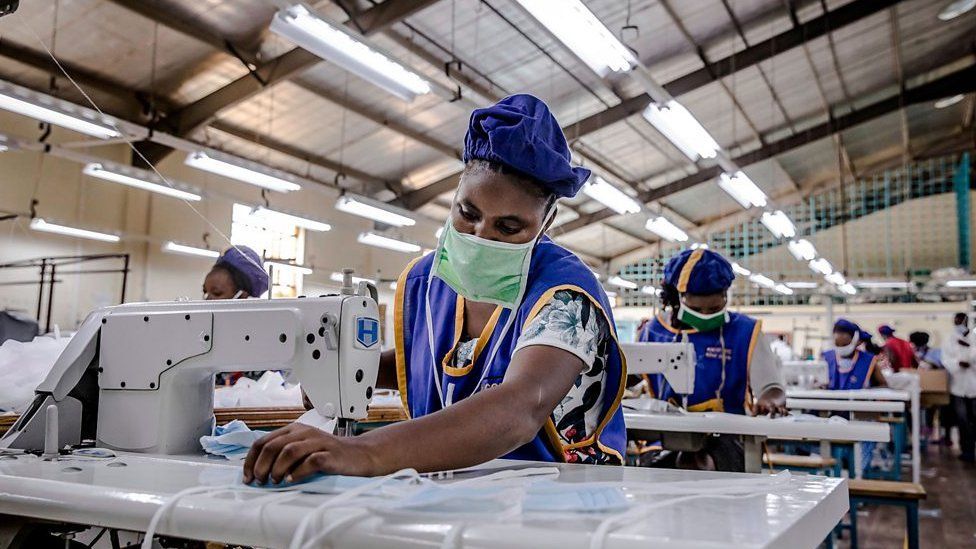 Agoa has helped create jobs on the continent especially in the apparel industry
It was meant to boost the economies of countries that were kept out of the lucrative US market by bigger players. But there are concerns it has failed to deliver for the most part.
In the case of clothing, while industries have been set up in African countries like Ethiopia and Kenya where tens of thousands of locals are employed as tailors, most of the fabrics are imported from China where they are produced more cheaply.
There has been little, if any, impact therefore on the textile industry, or in agriculture where raw materials would be sourced.
The African market, while being large, is also disjointed from country to country, with significant infrastructure, logistical and tariffs challenges.
The Africa Continental Free Trade Area was created and championed by the African Union to address those barriers.
Mr Blinken said the US welcomed the trade deal and was working to make sure African countries take full advantage of it: "We want to see Africa's economic power in the world grow."
He also announced that the US aims to "help close the global infrastructure gap" through the Build Back Better world initiative.
China is already a major player in infrastructure development in Africa and the Trump administration's stated Africa policy was countering China on the continent.
""Our Africa policy is about Africa not about China," Mr Blinken told me.
But in his speech he seemed to take a swipe at the Chinese model: "Too often, international infrastructure deals are opaque, coercive, burden countries with unmanageable debt, are environmentally destructive, and don't always benefit the people who actually live there."
He said the US was going to do things differently.
2: Covid-19
The second priority outlined by Mr Blinken was combating the Covid-19 pandemic.
A new public-private initiative - the Global Covid Corps - "will connect America businesses with countries that need logistical help with the so-called 'last mile' - turning vaccine doses into actual shots in arms."
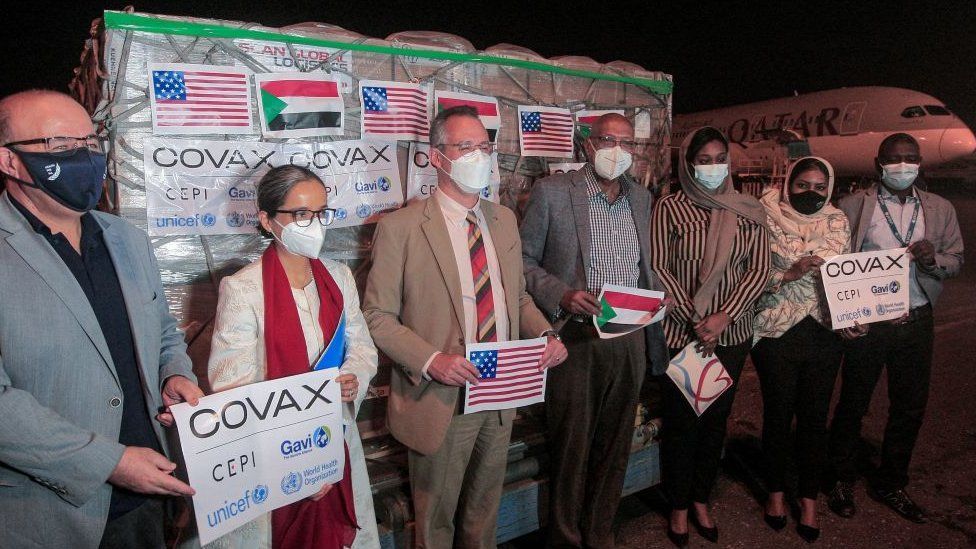 US has been a major donor of
Kenya, his first stop during his maiden Africa tour, is the first country on the continent to join the initiative.
The initiative however falls far short of the expectations of the continent's health advocates.
They have been calling for the waiving of intellectual property rights by manufacturers so that developing countries can mass-produce vaccine doses to satisfy their populations.
So far, a number of African countries have secured rights to "finish and fill" which essentially entails the final processes and packaging of doses.
Africa has the lowest vaccination rate of any continent, with only 6% of Africans fully inoculated as of the end of last month, according to the World Health Organization. In comparison, the US CDC reports that more than 58% of the US population is fully vaccinated.
3: Climate change
The African continent has been cited as most vulnerable to the effects of climate change whereas it contributes least to it.
The US says it is investing in climate adaptation projects globally, for which it plans to allocate $3bn (£2bn) every year by 2024.
The Obama-era Power Africa, which focusses on connecting people to the grid, continues with a heavy bias for renewable energy.
"We've connected more than 25 million homes and businesses across the continent to electricity, 80% of which is based on renewables," said Mr Blinken, adding that the US was involved in the development of what is billed as Africa's largest solar farm, a collaboration between Botswana and Namibia.
It will add to the increasing solar and wind farms cropping up across the continent.
4: Democracy
"A global democratic recession" has been another major talking-point during Mr Blinken's visit.
In a rare acknowledgement from an American official, he talked about the US's own vulnerability to the challenges of democracy, in an apparent reference to the tumultuous transition from the Trump administration.
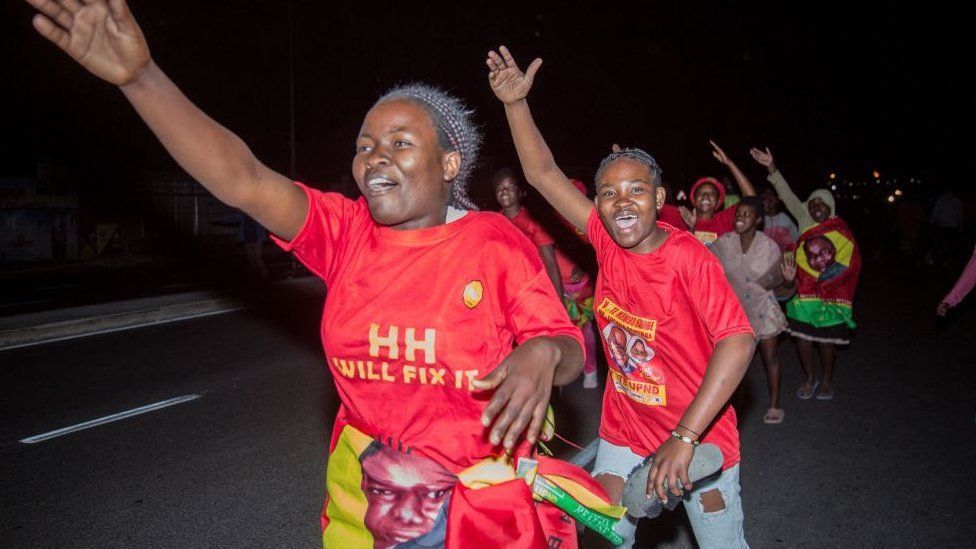 The Zambia election in August has been hailed as a great victory for democracy on the continent
It's a major departure in tone from previous US officials who have often taken the role of the stern big brother - waging a reprimanding finger at a younger sibling.
Africa has experienced more coups this year that in recent decades. In Mali, Guinea, and now Sudan the military has seized power. But there have also been peaceful, democratic transitions in Zambia - to an opposition leader - and Niger.
Mr Blinken decried the increasing use of technology by authoritarian leaders: "As we debate how to govern the use of technologies to ensure they strengthen democracies - not undermine them - the choices that governments, industries, and innovators make here will affect people's rights and freedoms everywhere for a long time to come."
5: Peace and security
Discussions during the Secretary of State's Africa tour have predominantly been about peace and security, from the Horn of Africa to the Sahel. This is no doubt a growing challenge tied to political stability as well as climate change.
The newly unveiled US Africa policy is a continuation of previous administrations but with greater emphasis on equal partnership.
"Too many times, the countries of Africa have been treated as junior partners - or worse - rather than equals," he said.
But whether that equality will actually be realised remains to be seen.
However, coming from the Trump administration that appeared uninterested in Africa, applied budget cuts to programmes on the continent and with the former president himself describing its countries in derogatory terms, it no doubt will be a welcome change in stance.
It is in part a reflection of what the Biden-Harris administration values.
But, to a greater extent, Africa is becoming increasingly difficult to ignore.
All predictions point to a continent that will play a growing and influential role in the global economy, security, and politics.











