

Even convicted scammer Anna Sorokin thinks Sam Bankman-Fried's defense is a lame attempt at saving himself
Sam Bankman-Fried, the once-billionaire founder of the cryptocurrency exchange FTX, told Andrew Ross Sorkin of The New York Times that he wasn't aware of the details that led to his company's implosion in November.
"I didn't know exactly what was going on," Bankman-Fried, 30, told the Times on November 30. "Obviously, that's a pretty big mistake and oversight, that I wasn't more aware."
But convicted scammer Anna Sorokin told Insider that Bankman-Fried's apology press tour is insincere garbage.
"He's just trying to save himself," she said.
Sorokin isn't the only one to balk at Bankman-Fried's explanation. Bankman-Fried's defense isn't acceptable for business leaders who should know the inner workings of their companies. However, it is an excuse that other villainized founders have tried and failed to use in the past, like Elizabeth Holmes, the founder and CEO of the now-defunct Theranos.
"Generally speaking, when you go into these types of cases, there's two types of defenses: 'I didn't know' and 'It wasn't me,'" Neama Rahmani, the president of the law firm West Coast Trial Lawyers and a former federal prosecutor, previously told The New York Times of Holmes' case.
Once valued at $32 billion, FTX filed for bankruptcy and Bankman-Fried stepped down as CEO in November. Meanwhile, multiple billions are owed to creditors, and the Department of Justice and Securities and Exchange Commission are investigating FTX.
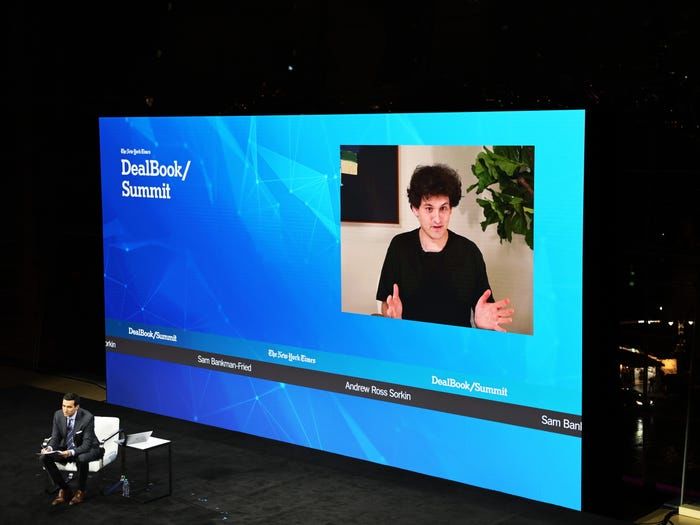 Michael M. Santiago
'I didn't know' was his only defense
Sorkin started his interview by noting there are two views of what occurred at FTX. The first is that Bankman-Fried is a young founder who made a series of terrible decisions. The second is that he committed a Ponzi scheme that took advantage of the relationship between FTX and Alameda Research, a trading firm that Bankman-Fried cofounded in 2017. Bankman-Fried denied the latter allegations, saying, "I did not ever try to commit fraud on anyone."
"I haven't been running Alameda. I haven't been thinking about its finances," he said. "I haven't been making those decisions. But as CEO of FTX, it was still my duty to make sure someone was doing diligence."
Holmes took a similar approach, but to no avail
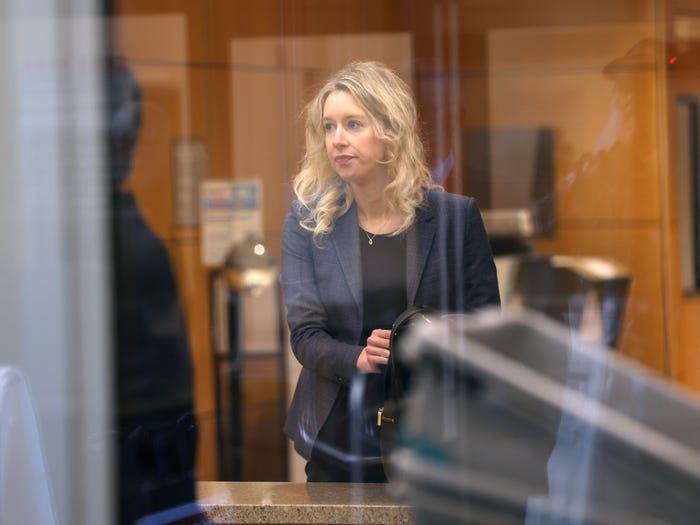 Elizabeth Holmes was sentenced to more than 11 years in federal prison.
Holmes, who was found guilty on four counts of defrauding investors in January 2022, told the SEC "I don't know" more than 600 times during its questioning of her in 2019. In November, she was sentenced to more than 11 years in prison.
Holmes' efforts to blame others for Theranos' mistakes while highlighting her ignorance is a common tactic among fraud defendants, Rahmani told the Times. Holmes and her team "are going to do everything they can to distance themselves from that knowledge," he said.
While denial can be a plausible defense, jurors are often too savvy to accept the strategy. Jeffrey Cohen, an associate professor at Boston College Law School, previously told The Times that a better strategy is to appeal to jurors' humanity.
"What I would expect a defendant in a high-profile case to do is try to humanize themselves and make the jury see that they're not just a corporate CEO, but a person with the flaws that any person might have who's running a large corporation," Cohen said.










