Greece Eases EU Biometric Entry Rules for UK Tourists in Move to Prevent Airport Gridlock
Athens has temporarily exempted British travellers from new EU fingerprint and facial scan requirements under the Entry/Exit System, prioritising tourism flows as Europe’s border overhaul triggers widespread delays.
SYSTEM-DRIVEN change in European border management is reshaping how millions of non-EU travellers enter the Schengen Area, with Greece emerging as the first major EU destination to suspend key biometric requirements for UK visitors.
What is confirmed is that Greece has temporarily exempted British passport holders from the European Union’s Entry/Exit System (EES) biometric checks, which normally require fingerprints and facial imaging at border control.
The exemption applies on arrival in Greece and effectively restores a faster passport-only entry process for UK tourists during the system’s early rollout phase.
The EES, which became operational across much of the Schengen Area in April 2026, is designed to replace passport stamping with digital tracking of entry and exit for short-stay non-EU travellers.
It records biometric data and travel history to enforce visa limits and improve border security.
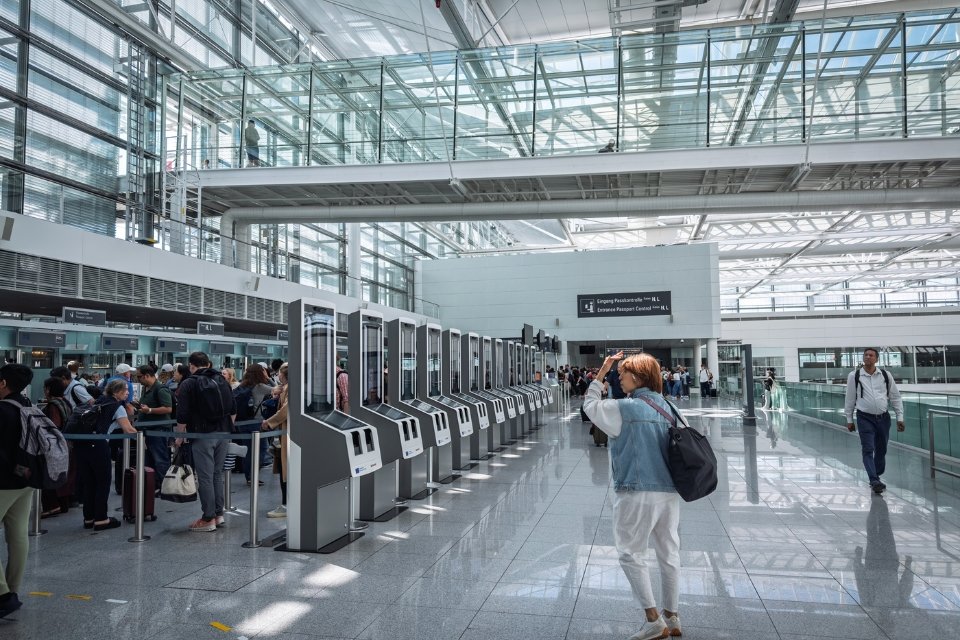
However, its initial deployment has led to significant congestion at airports across Europe as millions of travellers undergo first-time registration.
Greece’s decision is explicitly linked to operational pressure on airports during peak tourism season.
The country depends heavily on British visitors, particularly to island destinations where infrastructure is limited and processing capacity at border control is already constrained.
Officials have framed the exemption as a practical measure to prevent prolonged queues and maintain throughput at arrival terminals.
Under the temporary arrangement, UK travellers entering Greece will not be required to submit fingerprints or facial scans, unlike other non-EU passengers entering Schengen states.
Instead, they will continue to pass through standard passport checks, a system that significantly reduces processing time per passenger.
The broader European context is critical.
Other Schengen countries are still enforcing full EES biometric registration, and early rollout data indicates delays of up to several hours at some airports, particularly where staffing and infrastructure have not yet scaled to demand.
These bottlenecks have already prompted operational warnings from airlines and travel industry groups concerned about summer disruption.
Greece’s move introduces a clear divergence within the Schengen implementation phase.
While the EES is a unified EU system, enforcement flexibility at national border points allows member states to adjust rollout procedures.
Athens has effectively used that flexibility to prioritise tourism continuity over full procedural adoption in the short term.
The economic stakes are significant.
UK visitors represent one of Greece’s largest non-EU tourism segments, and peak-season arrivals concentrate heavily in a narrow summer window.
Any sustained delays at border control could have immediate downstream effects on airline scheduling, hotel occupancy, and regional economies dependent on tourism revenue.
The decision also raises regulatory pressure within the EU system itself.
If other high-volume tourist destinations adopt similar exemptions, the uniformity of the EES rollout could be weakened, potentially forcing adjustments to staffing, technology deployment, or enforcement timelines across the bloc.
For now, Greece’s exemption applies as a temporary measure aligned with early EES rollout conditions, designed to preserve speed of entry while Europe’s new biometric border infrastructure stabilises across its first peak travel season.
What is confirmed is that Greece has temporarily exempted British passport holders from the European Union’s Entry/Exit System (EES) biometric checks, which normally require fingerprints and facial imaging at border control.
The exemption applies on arrival in Greece and effectively restores a faster passport-only entry process for UK tourists during the system’s early rollout phase.
The EES, which became operational across much of the Schengen Area in April 2026, is designed to replace passport stamping with digital tracking of entry and exit for short-stay non-EU travellers.
It records biometric data and travel history to enforce visa limits and improve border security.
However, its initial deployment has led to significant congestion at airports across Europe as millions of travellers undergo first-time registration.
Greece’s decision is explicitly linked to operational pressure on airports during peak tourism season.
The country depends heavily on British visitors, particularly to island destinations where infrastructure is limited and processing capacity at border control is already constrained.
Officials have framed the exemption as a practical measure to prevent prolonged queues and maintain throughput at arrival terminals.
Under the temporary arrangement, UK travellers entering Greece will not be required to submit fingerprints or facial scans, unlike other non-EU passengers entering Schengen states.
Instead, they will continue to pass through standard passport checks, a system that significantly reduces processing time per passenger.
The broader European context is critical.
Other Schengen countries are still enforcing full EES biometric registration, and early rollout data indicates delays of up to several hours at some airports, particularly where staffing and infrastructure have not yet scaled to demand.
These bottlenecks have already prompted operational warnings from airlines and travel industry groups concerned about summer disruption.
Greece’s move introduces a clear divergence within the Schengen implementation phase.
While the EES is a unified EU system, enforcement flexibility at national border points allows member states to adjust rollout procedures.
Athens has effectively used that flexibility to prioritise tourism continuity over full procedural adoption in the short term.
The economic stakes are significant.
UK visitors represent one of Greece’s largest non-EU tourism segments, and peak-season arrivals concentrate heavily in a narrow summer window.
Any sustained delays at border control could have immediate downstream effects on airline scheduling, hotel occupancy, and regional economies dependent on tourism revenue.
The decision also raises regulatory pressure within the EU system itself.
If other high-volume tourist destinations adopt similar exemptions, the uniformity of the EES rollout could be weakened, potentially forcing adjustments to staffing, technology deployment, or enforcement timelines across the bloc.
For now, Greece’s exemption applies as a temporary measure aligned with early EES rollout conditions, designed to preserve speed of entry while Europe’s new biometric border infrastructure stabilises across its first peak travel season.