

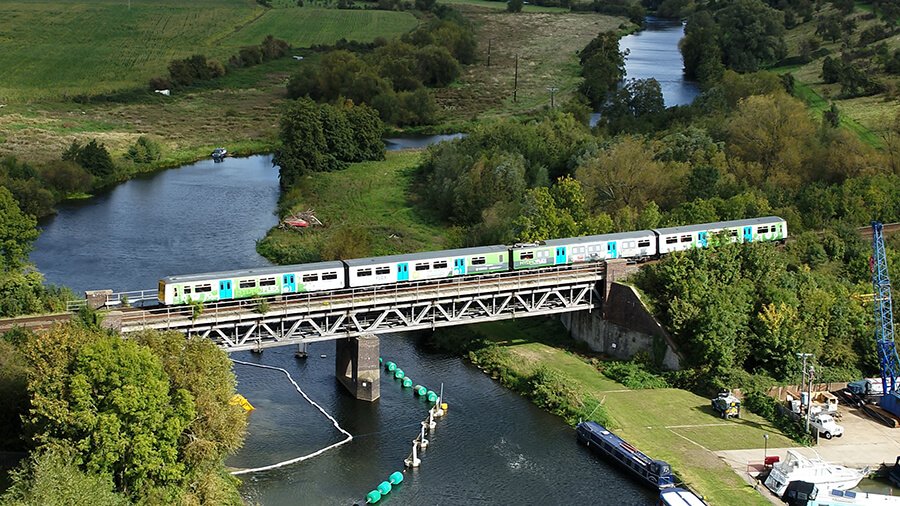
The first ever hydrogen powered train has run on the UK mainline
The trials of the train, known as HydroFLEX , which have been supported with a £750,000 grant from the Department for Transport, follow almost two years’ development work and more than £1million of investment by both the University of Birmingham and Porterbrook.
Unlike diesel trains, hydrogen-powered trains do not emit harmful gases, instead using hydrogen and oxygen to produce electricity, water and heat. The ground-breaking technology behind the trains will also be available by 2023 to retrofit current in-service trains to hydrogen - helping decarbonise the rail network and make rail journeys greener and more efficient.
Transport Secretary Grant Shapps, who met with leading rail experts from the University of Birmingham’s Birmingham Centre for Railway Research and Education (BCRRE) onsite to see first-hand HydroFLEX on the mainline, has also announced the ambition for Tees Valley to become a trailblazing Hydrogen Transport Hub. Bringing together representatives from academia, industry and government to drive forward the UK’s plans to embrace the use of hydrogen as an alternative fuel could create hundreds of jobs while seeing the region become a global leader in the green hydrogen sector. Tees Valley is perfectly placed to reap these benefits, following the development there of the world’s largest versatile hydrogen refuelling facility made possible through Government funding.
Grant Shapps, the UK’s Secretary of State for Transport, said: “As we continue on our road to a green recovery, we know that to really harness the power of transport to improve our country – and to set a global gold standard – we must truly embed change.
“That’s why I’m delighted that through our plans to build back better we are embracing the power of hydrogen and the more sustainable, greener forms of transport it will bring.”
Professor Stephen Jarvis, Head of the College of Engineering and Physical Sciences at the University of Birmingham, said: “BCRRE is setting the pace for rail innovation both in the UK and globally. The HydroFLEX project is a great example of how world-class R&D, together with the right industry partnerships, can deliver decarbonisation technologies that are both innovative and practical.
“Successful mainline testing is a major milestone for HydroFLEX and is a clear demonstration of the important role hydrogen has to play in the UK’s rail industry. Through BCRRE and Porterbrook, we are looking forward to delivering this technology into the UK transport market, ensuring a cleaner future for our railways.”
To kick start the development in Tees Valley, the Department for Transport has commissioned a masterplan to understand the feasibility of the hub and how it can accelerate the UK’s ambitions in Hydrogen. The masterplan, expected to be published in January, will pave the way for exploring how green hydrogen could power buses, HGV, rail, maritime and aviation transport across the UK. The aim would then be for the region to kick on and become a global leader in industrial research on the subject of hydrogen as a fuel as well as an R&D hub for hydrogen transport more generally, attracting hundreds of jobs and boosting the local economy in the process.
Through our £23m Hydrogen for Transport Programme, the plans announced also include £6.3m of funding for a green hydrogen refuelling station and 19 hydrogen-powered refuse vehicles in Glasgow, a world-first for the size of the fleet. This will give a post-Covid boost to local economies through the creation of green jobs while also de-carbonising the transport network.
The next stages of HydroFLEX are already well underway, with the University of Birmingham developing a hydrogen and battery powered module that can be fitted underneath the train, which will allow for more space for passengers in the train’s carriage.
Mary Grant, CEO of Porterbrook, said: “Porterbrook is committed to innovation and the delivery of a carbon neutral and sustainable railway. The mainline testing of HydroFLEX achieves another important milestone on this journey.
“I’m also delighted to be able to announce our intention to start producing HydroFLEX trains, creating the world’s first electric and hydrogen powered bi-mode rolling stock, as well as generating significant opportunities for the UK supply chain.”
The department is developing even more ways to slash emissions across transport, as work to create the Transport Decarbonisation Plan continues. The plan will develop a first-of-a-kind approach to decarbonise every mode of transport and is due to be published before the end of this year.
Julian David, techUK’s CEO said: “The announcement on the further progress of the Hydrogen for Transport Programme is a demonstration of the UK Government’s commitment to developing a hydrogen infrastructure as part of its efforts to decarbonise transport and encourage the shift to zero emission vehicles.
“With the growing demand to switch to a net zero economy, the advancement of R&D means we can further demonstrate this innovative technology for road, rail, and freight and logistics as an efficient and economic solution. techUK is excited to work together with the tech community and the Government to spearhead the market offering for green hydrogen.”
What is HydroFLEX?
The HydroFLEX project is a ground-breaking partnership between the University of Birmingham’s Birmingham Centre for Railway Research and Education (BCRRE) and railway rolling stock company, Porterbrook. A UK first, its aim is to demonstrate how hydrogen could be deployed across the rail network to offer a cleaner alternative to current diesel trains.
The project involves the conversion of an existing Class 319 train, fitted with a hydrogen fuel cell, giving it the ability to run autonomously on hydrogen power on non-electrified routes.
With new funding for mainline testing recently announced, this project is a great example of what can be achieved by combining academic research, expertise and private sector know-how.
In addition to BCRRE and Porterbrook who led the initiative, HydroFLEX has been made possible by extensive collaboration across the industry, including: Chrysalis Rail for installation; Denchi Group for traction batteries; Ballard Power Systems for the fuel cell; Luxfer for hydrogen storage tanks; SNC Lavalin for design and hazard identifications; Aura for exterior livery design; and dg8 for design and engineering support
Why do we need hydrogen trains?
Transport currently accounts for around a quarter of the UK's greenhouse gas emissions and the UK Government has committed to reduce its carbon emissions by at least 80%, against 1990 levels, by 2050.
Hydrogen fuel cell technology is an effective alternative to diesel engines. Potentially entirely carbon neutral in operation, they are more environmentally friendly while offering similar performance.











