

James Webb 'super telescope' set for Christmas Day blast off
The €10 billion telescope – fitted into the hold of an Ariane 5 rocket – should have left on 22 December. However, if final weather checks prove favourable, blast-off should occur between 7.20 and 7.52am local time, or 12.20 GMT.
The telescope will be released from the rocket after a 26-minute ride into space.
It will then boldly go where no ubertelescope has gone before – 1.6 million kilometres from Earth to a destination known as the second Lagrange Point, or L2. This is a so-called "sweet spot" in space where gravitational forces and the orbital motion of a body balance each other.
Unlike Hubble, the existing main space telescope that revolves around Earth, the JWST will orbit the Sun.
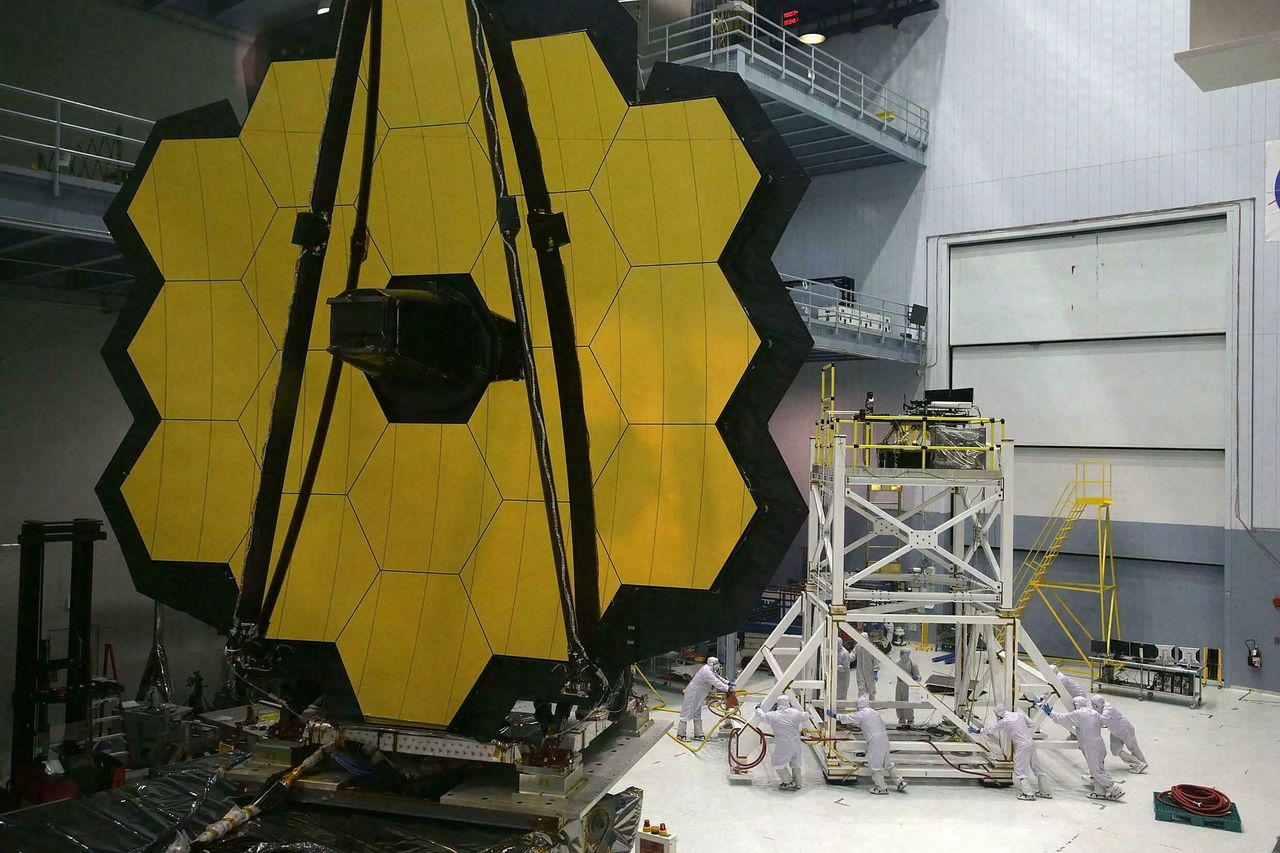 Webb's centerpiece is its giant primary
mirror, a concave structure 21.5 feet (6.5 meters) wide and made up of
18 smaller hexagonal mirrors
Webb's centerpiece is its giant primary
mirror, a concave structure 21.5 feet (6.5 meters) wide and made up of
18 smaller hexagonal mirrors
Named after Nasa's chief during the 1960s, the telescope's primary mirror – consisting of 18 hexagonal segments of gold-coated beryllium metal – has a much bigger light-collecting area, enabling it to observe objects at greater distances and farther back into time than Hubble.
New look
It is expected to revolutionise astronomers' understanding of the universe and our place in it.
The JWST will view the cosmos in the infrared spectrum, allowing it to gaze through clouds of gas and dust where stars are being born, while Hubble operated primarily at optical and ultraviolet wavelengths.
Webb's instruments also make it ideal to search for potentially life-supporting atmospheres around scores of newly documented exoplanets – celestial bodies orbiting distant stars – and to observe worlds much closer to home, such as Mars and Saturn's icy moon Titan.
The telescope is an international collaboration led by Nasa in partnership with the European and Canadian space agencies. The Ariane launch vehicle is part of the European contribution.
“The whole reason we launch telescopes like Webb is that we know that planets of all sizes are out there," said Dr Knicole Colón, an astrophysicist at Nasa's Goddard Space Flight Centre in the United States.
"We want to find ones that have similar temperatures and sizes as Earth to see if they could possibly be anything like Earth.”











