Beautiful Virgin Islands

Monday, Jul 13, 2026

Jobs 'crisis' twice as bad as previous recession

Jobs 'crisis' twice as bad as previous recession

Employers in Britain are planning more than twice as many redundancies than they did at the height of the last recession, new figures show.

About 180,000 job cuts were planned from January to March 2009, while 380,000 were planned from May to July this year.

Completed redundancies could reach 735,000 this autumn, researchers say.

The figures were obtained by an Institute for Employment Studies (IES) Freedom of Information request.

Social distancing measures to prevent the spread of Covid-19 brought large parts of the UK economy to a standstill, forcing workers to stay at home, closing shops and bringing transport to a halt.

As a result, many businesses have been forced to consider reducing their workforces by making employees redundant.

Employers in England, Scotland and Wales must notify the Insolvency Service if they plan to make 20 or more workers redundant in any single "establishment" using a form called HR1.

This information is not usually published, but on 8 September a Freedom of Information request by the BBC revealed that employers had listed more than 380,000 positions as at risk between May and July 2020.



The IES has now obtained and analysed data stretching back as far as 2008.

This shows that the current redundancy wave is more than double the previous three-monthly peak of 180,000 from January to March 2009.

Then the crisis, which had begun in the finance industry, was affecting most of the economy - and forcing many employers to reduce their staff.

"Comparing what is happening now with what was happening in the last recession shows us we are experiencing a jobs crisis unlike anything we have seen before," said Tony Wilson, Director of the IES.

The IES is calling for extra support for viable firms to help them retain staff, as well as training and advice to help those who lose their jobs find new employment rapidly.

A government spokesperson said: "Supporting jobs is an absolute priority which is why we've set out a comprehensive 'Plan for Jobs' to protect, create and support jobs across the UK by providing significant, targeted support where it is needed the most."

Government measures include the £2bn "kickstart scheme" to encourage employers to create new training placements and apprenticeships, extra work coaches in job centres, and a £1,000 incentive to encourage employers to bring staff back from furlough.


Will these planned redundancies be completed?


Because they are filed at the start of the redundancy process, HR1 forms give an early indication of what is happening in the labour market.

The HR1 redundancy figures don't pick up employers cutting fewer than 20 jobs, so the final total of redundancies is usually higher.

The Office for National Statistics also publishes a redundancy count based on the Labour Force Survey, which is used to calculate the monthly unemployment rate.

This is always published a few months after the data is gathered, so it hasn't yet picked up a big spike in redundancies or unemployment.
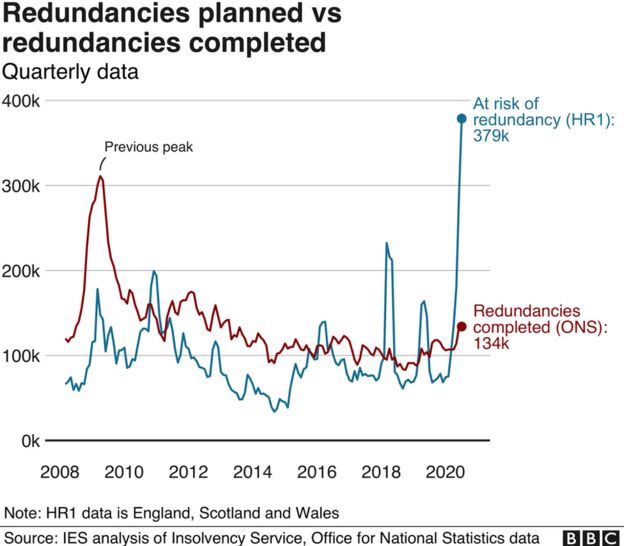


However, Labour Force Survey redundancy figures have been around 20% higher than HR1 figures in recent years.

On this basis, the IES estimates that 445,000 jobs could be made redundant between July and September, considerably worse than the three-month peak in the previous recession.

During that recession, however, actual redundancies were 80% higher than notified redundancies - which could lead to as many as 735,000 positions being cut at the height of the coronavirus crisis.

However, companies sometimes announce plans redundancies which they don't actually make, because circumstances change.

Early 2019, for example, saw a big spike in redundancy plans which were never completed. Mr Wilson believes they could have been linked to fears of a no-deal Brexit, which did not happen.

The 2018 spike could be linked to the collapse of the construction company Carillion, which had a lesser impact on jobs than initially feared.

Companies in Northern Ireland file HR1 forms with the Northern Ireland Statistics and Research Agency and they are not included in these figures.


Newsletter

Related Articles

Beautiful Virgin Islands
0:00
0:00
Close
World Cup Visitors Turn American Big-Box Stores Into Souvenir Stops
Netflix Weighs Always-On Channels, Bundles and Short-Form Video
Passenger Is Pulled Partly Outside Ryanair Jet After Window Fails Mid-Flight
The AI Invoice Shock: Layoffs Didn't Save Managers Money — They Cost Them More
Concern: Sexually Transmitted Bacterium Among Men Develops Antibiotic Resistance
Following Massive Investor Demand: SK Hynix Raises 26.5 Billion Dollars on Nasdaq
Passenger Partially Pulled Out of Ryanair Jet After Cabin Window Fails Mid-Flight
After Four Years, and Under a Heavy Veil of Secrecy: King Charles Meets His Grandchildren, Harry and Meghan's Children
Severe Heatwave Drives Dangerous Ground-Level Ozone Pollution Across Two Thirds of European Union
Westminster in Freefall as Farage's By-Election Gamble Triggers Broader Systemic Crises
Institutional Fractures and Political Volatility Reshape Britain's Domestic Landscape
Deadly Fire, Health Emergencies and Political Upheaval Shape a Volatile Global News Cycle
Flight Instructor Jumped to His Death — Student Landed the Plane: "You Know What You Need to Do"
The Physical and Electronic Barriers Disrupting Domestic Wireless Networks
France and Morocco Open World Cup Quarter-Finals as Collina Defends Refereeing
Prince Harry Suffers Major Court Defeat in Legal Battle Against Daily Mail Publisher
Bonnie Tyler, Welsh Singer Behind Total Eclipse of the Heart, Dies at 75
Tech Pulse: The Future of AI and Screen Culture
Global News Briefing: Escalating Geopolitical Tensions and Corporate Shakeups
Global News Brief: Escalating Conflicts, Public Health Crises, and World Cup Drama
Federal Financial Framework Shifts as Treasury Launches Universal Savings Program for Minors
French Court Allows Le Pen to Run for Presidency, but with an Electronic Tag: "I Will Appeal, and I Will Run"
$1.4 Trillion: The Lawsuit That Could Crush Meta
Europe's Growing Struggle with Extreme Heat and Air Conditioning
UK Daily Briefing: Legal Developments and Social Issues
Political Turmoil and Rising Costs
Anthropic Reengineers Agentic Architecture to Shift Autonomous Workplace Automation to the Cloud
Logic Flaw in Windows 11 Permission Architecture Silently Consumes Hundreds of Gigabytes of Local Storage
Apple Advances Late-Stage Operating Systems with Fourth Beta Deployments
Global Crisis Alert: Escalating Middle East Tensions and UK Political Upheaval
Deep Purple Has Released Its Best Album in Decades
Microsoft Lays Off 4,800 Employees and Xbox Suffers the Hardest Blow
Morocco and France Advance as 2026 FIFA World Cup Enters Quarterfinals.
Historic 2026 Tour de France Opens in Barcelona With Revamped Team Time Trial.
Global Mergers and Acquisitions Approach $4 Trillion Defying Geopolitical Tumult.
Negotiators Advance 20-Point Framework for Gaza Ceasefire and Demilitarization.
OECD Warns Middle East Conflict Will Depress Global Economic Growth.
Ukrainian Drones Strike Major Oil Terminal in St. Petersburg.
World Meteorological Organization Issues Urgent Alert Over Rapidly Intensifying El Niño.
United States Commemorates 250th Anniversary With Diplomatic Summits and Global Flotilla.
Iran Begins Days-Long Funeral for Supreme Leader Khamenei Amid Strait of Hormuz Standoff.
Technology giant reports surging carbon emissions driven by artificial intelligence infrastructure demands.
Artificial intelligence adoption accelerates workforce reductions across the technology and financial sectors.
Global technology and financial conglomerates collaborate to launch a new stablecoin standard.
United States regulators lift export restrictions on a major frontier artificial intelligence model.
Luxury bags take over the World Cup: style, status symbol, or just showing off?
×









