

Man Keeps a Rock For Years, Hoping It's Gold. It Turned Out to Be Far More Valuable
In 2015, David Hole was prospecting in Maryborough Regional Park near Melbourne, Australia.
Armed with a metal detector, he discovered something out of the ordinary – a very heavy, reddish rock resting in some yellow clay.
He took it home and tried everything to open it, sure that there was a gold nugget inside the rock – after all, Maryborough is in the Goldfields region, where the Australian gold rush peaked in the 19th century.
To break open his find, Hole tried a rock saw, an angle grinder, a drill, even dousing the thing in acid. However, not even a sledgehammer could make a crack. That's because what he was trying so hard to open was no gold nugget. As he found out years later, it was a rare meteorite.
"It had this sculpted, dimpled look to it," Melbourne museum geologist Dermot Henry told The Sydney Morning Herald.
"That's formed when they come through the atmosphere, they are melting on the outside, and the atmosphere sculpts them."
Unable to open the 'rock', but still intrigued, Hole took the nugget to the Melbourne Museum for identification.
"I've looked at a lot of rocks that people think are meteorites," Henry told Channel 10 News.
In fact, after 37 years of working at the museum and examining thousands of rocks, Henry explains only two of the offerings have ever turned out to be real meteorites.
This was one of the two.
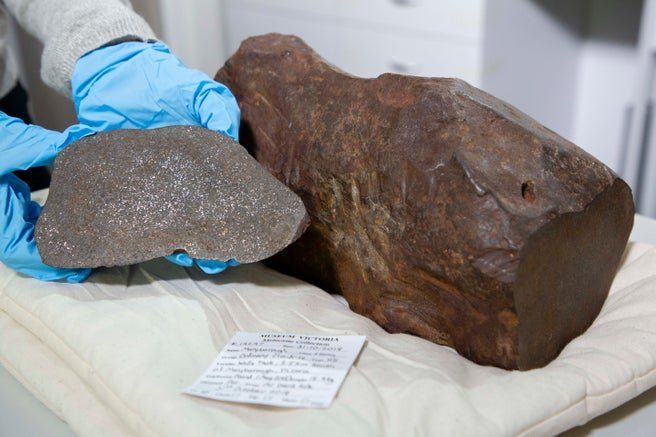
"If you saw a rock on Earth like this, and you picked it up, it shouldn't be that heavy," another Melbourne Museum geologist, Bill Birch, told The Sydney Morning Herald in 2019.
The researchers published a scientific paper describing the 4.6 billion-year-old meteorite, which they've called Maryborough after the town near where it was found.
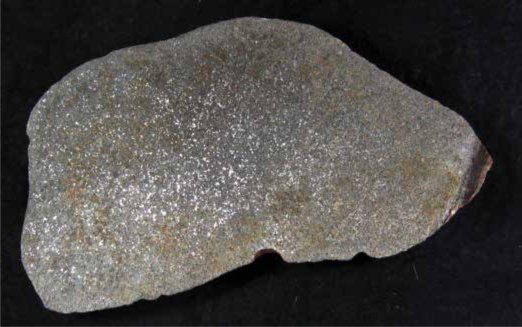
It's a huge 17 kilograms (37.5 pounds), and after using a diamond saw to cut off a small slice, they discovered its composition has a high percentage of iron, making it a H5 ordinary chondrite.
Once open, you can also see the tiny crystallized droplets of metallic minerals throughout it, called chondrules.
"Meteorites provide the cheapest form of space exploration. They transport us back in time, providing clues to the age, formation and chemistry of our Solar System (including Earth)," said Henry.
"Some provide a glimpse at the deep interior of our planet. In some meteorites, there is 'stardust' even older than our Solar System, which shows us how stars form and evolve to create elements of the periodic table.
"Other rare meteorites contain organic molecules such as amino acids; the building blocks of life."
Although the researchers don't yet know where the meteorite came from and how long it may have been on Earth, they do have some guesses.
Our Solar System was once a spinning pile of dust and chondrite rocks. Eventually gravity pulled a lot of this material together into planets, but the leftovers mostly ended up in a huge asteroid belt.
"This particular meteorite most probably comes out of the asteroid belt between Mars and Jupiter, and it's been nudged out of there by some asteroids smashing into each other, then one day it smashes into Earth," Henry told Channel 10 News.
Carbon dating suggests the meteorite has been on Earth between 100 and 1,000 years, and there's been a number of meteor sightings between 1889 and 1951 that could correspond to its arrival on our planet.
The researchers argue that the Maryborough meteorite is much rarer than gold, making it far more valuable to science. It's one of only 17 meteorites ever recorded in the Australian state of Victoria, and it's the second largest chondritic mass, after a huge 55-kilogram specimen identified in 2003.
"This is only the 17th meteorite found in Victoria, whereas there's been thousands of gold nuggets found," Henry told Channel 10 News.
"Looking at the chain of events, it's quite, you might say, astronomical it being discovered at all."
It's not even the first meteorite to take a few years to make it to a museum. In a particularly amazing story ScienceAlert covered in 2018, one space rock took 80 years, two owners, and a stint as a doorstop before finally being revealed for what it truly was.
Now is probably as good a time as any to check your backyard for particularly heavy and hard-to-break rocks – you might be sitting on a metaphorical gold mine.











