

One of US Navy's most powerful weapons makes rare appearance
The USS Nevada, an Ohio-class nuclear-powered submarine carrying 20 Trident ballistic missiles and dozens of nuclear warheads, pulled into the Navy base in the US Pacific Island territory on Saturday. It's the first visit of a ballistic missile submarine -- sometimes called a "boomer" -- to Guam since 2016 and only the second announced visit since the 1980s.
"The port visit strengthens cooperation between the United States and allies in the region, demonstrating US capability, flexibility, readiness, and continuing commitment to Indo-Pacific regional security and stability," a US Navy statement said.
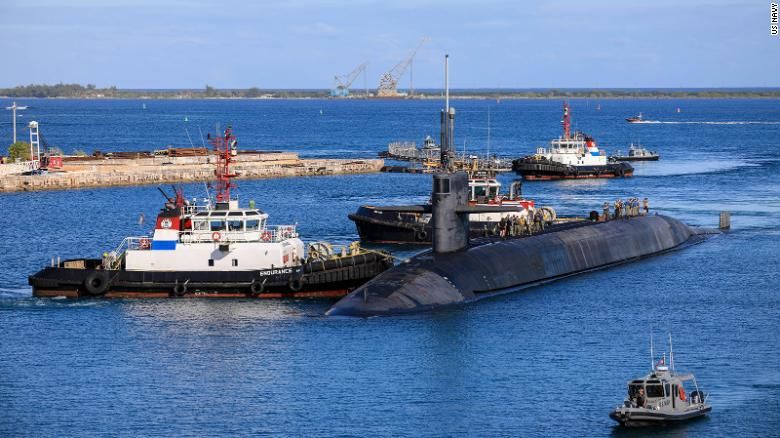
Movements of the 14 boomers in the US Navy's fleet are usually closely guarded secrets. Nuclear power means the vessels can operate submerged for months at a time, their endurance limited only by the supplies needed to sustain their crews of more than 150 sailors.
The Navy says Ohio-class submarines stay an average of 77 of days at sea before spending about a month in port for maintenance and replenishment.
It's rare for one to even be photographed outside their home ports of Bangor, Washington, and Kings Bay, Georgia. The secrecy surrounding the ballistic missile submarines makes them the "most important survivable leg of the nuclear triad," which also includes silo-based ballistic missiles on the US mainland and nuclear-capable bombers like the B-2 and B-52.
But with tensions brewing between the US and China over the status of the self-ruled island of Taiwan, and as North Korea ramps up missile tests, Washington can make a statement with its ballistic missile submarines that neither Beijing nor Pyongyang can, according to the analysts.
"It sends a message -- intended or not: we can park 100-odd nuclear warheads on your doorstep and you won't even know it or be able to do much about it. And the reverse isn't true and won't be for a good while," said Thomas Shugart, a former US Navy submarine captain and now an analyst at the Center for a New American Security.
North Korea's ballistic submarine program is in its infancy, and China's estimated fleet of six ballistic missile submarines is dwarfed by the US Navy's.
And China's ballistic missile subs don't have the capabilities of the US boomers, according to a 2021 analysis by experts at the Center for Strategic and
International Studies.
China's Type 094 ballistic missile subs are two times louder than the US subs, and therefore more easily detected, and carry fewer missiles and warheads, CSIS analysts wrote in August.
Besides the political signaling, the presence of the USS Nevada in the region presents another opportunity, said Alessio Patalano, professor of war and strategy at King's College in London.
"The presence of this type of boat -- especially in training and exercises -- adds an important opportunity to learn how to hunt those of other actors in the region," Patalano said.
"The DPRK (North Korea) is pursuing the development of such a type of a platform, and China already fields them. Honing in the skills to track them is as important as deploying them as strategic deterrent," he said.
The last time a US Navy boomer visited Guam was in 2016, when the USS Pennsylvania stopped there.
Analysts said tensions across the Indo-Pacific have significantly increased since that time, and more such military displays are likely from Washington in the current environment.
"This deployment reminds us that the nuclear order at sea in the (Indo-Pacific) matters, and whilst often outside wider public conversation, we are likely to see more of it in the development of regional strategic balance," Patalano said.











