

The first ETF launched 30 years ago, revolutionizing investing
Thirty years ago, the launch of the first exchange-traded fund ushered in a new era of investing. Now, the industry is bringing exotic trading strategies to the masses.
The SPDR S&P 500 ETF Trust, which tracks the benchmark U.S. stock index, gave investors the ability to buy and sell hundreds of stocks through a single, publicly traded share for the first time.
The SPDR ETF and the funds that followed popularized the idea of simply following the market, a strategy known as passive investing.
 A trader looks at his screen on the floor of the New York Stock
Exchange June 29, 2010. Investors fled the U.S. stock market on Tuesday
and the S&P 500 tumbled to its lowest level in eight months in a
sell-off triggered by a wave of increasin
A trader looks at his screen on the floor of the New York Stock
Exchange June 29, 2010. Investors fled the U.S. stock market on Tuesday
and the S&P 500 tumbled to its lowest level in eight months in a
sell-off triggered by a wave of increasinFew could have predicted the SPDR fund’s impact when it launched on Jan. 22, 1993.
"At the time, it was not a watershed moment, but it’s now hard to imagine investing without ETFs," said Todd Rosenbluth, an industry veteran and head of research at VettaFi. "A whole generation of investors only thinks about using ETFs to get diversified exposure. They’ve opened up markets that previously were harder to obtain access to."
The industry is quickly expanding to include active management and more exotic investing products like leveraged and inverse funds. Proponents say the suite of cheap investing options has helped democratize investing. Others, noting the fast growth of risky ETFs that use leverage to amplify both returns and losses, are sounding the alarm about the potential fallout for inexperienced investors.
For years, ETFs have gained ground on mutual funds, the traditional broad-based investment option still favored by 401(k) retirement plans. That trend accelerated in 2022. U.S. ETFs took in almost $600 billion on a net basis in 2022, second only to 2021’s record inflow, according to data from Morningstar Direct. Investors pulled nearly $1 trillion from mutual funds. That marked the largest gap in flows between the funds on record.
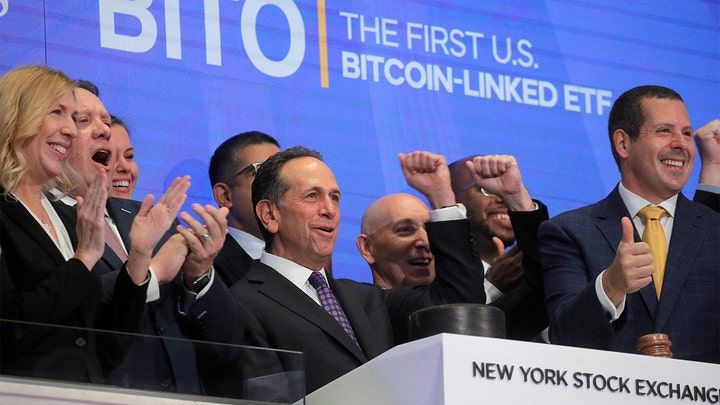 Michael Sapir, CEO of ProShares, rings the opening bell
celebrating ProShares Bitcoin Strategy ETF trading as BITO on the NYSE
Arca, at the New York Stock Exchange (NYSE) in New York City, October
19, 2021. REUTERS/Brendan McDermid
Michael Sapir, CEO of ProShares, rings the opening bell
celebrating ProShares Bitcoin Strategy ETF trading as BITO on the NYSE
Arca, at the New York Stock Exchange (NYSE) in New York City, October
19, 2021. REUTERS/Brendan McDermid
To be sure, ETFs aren’t on track to overtake mutual funds soon. ETFs had $6.5 trillion in assets at the end of 2022, versus $16.3 trillion for mutual funds. The SPDR ETF, best known by its ticker symbol SPY, remains the largest ETF, a behemoth with roughly $370 billion in assets.
Most ETFs are similar to index-tracking mutual funds, with several key advantages. ETFs can be bought and sold throughout the trading day, unlike mutual funds, which price once daily at market close.

Perhaps most important, their fees are significantly lower. The average expense ratio for index equity ETFs was 0.16% in 2021, or $16 annually per $10,000 of investment funds, compared with 0.47% for equity mutual funds, according to the Investment Company Institute.
Last year’s market selloff likely provided a reminder for investors to reassess their portfolios, leading to further adoption of ETFs, said Matthew Bartolini, head of SPDR research at State Street Global Advisors, the asset manager behind SPY.
"When you have underperforming active managers with a high fee, and you’re getting hit with a capital-gains tax, that’s going to lead people to leave," Mr. Bartolini said.
The downturn gave savvy investors an opportunity for tax-loss harvesting—selling funds to realize a loss and writing it off for tax purposes. A popular tax-loss harvesting strategy is to sell a mutual fund and quickly purchase an ETF with similar holdings. That practice, known as a wrapper swap, allows investors to realize a loss for tax purposes while staying invested.
Also driving growth in ETFs is the emergence of active strategies and other new products. Passive strategies still made up 95% of the ETF market in 2022, according to Morningstar. But of the 431 new ETFs launched, more than half were active strategies, according to Mr. Rosenbluth. Active funds took in 15% of total ETF flows last year, nearing $100 billion, a record for active strategies.
Popular active ETFs include Cathie Wood‘s ARK Innovation, an active fund that invests in "disruptive" companies, primarily unprofitable firms in the tech sector. Shares of the fund, a favorite among individual investors that soared during the pandemic, plunged 67% in 2022.
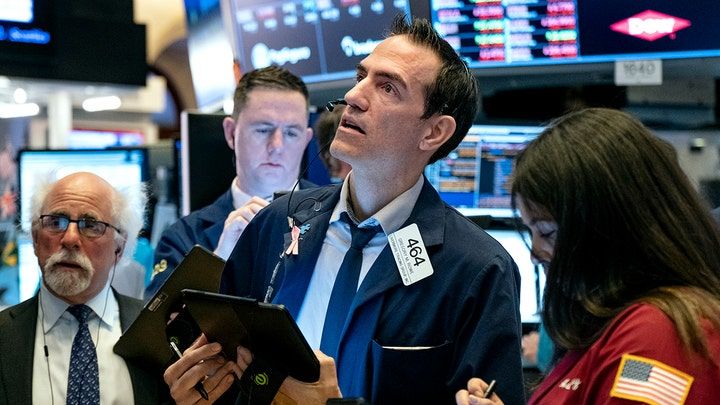 Trader Gregory Rowe, center, and others work on the floor of the New York Stock Exchange Monday, March 16, 2020.
Yet despite the poor performance, investors continued to pour funds into ARK. Individual investors showed similar interest in other speculative ETF offerings, including leveraged funds, raising concern over whether the industry is making it too easy for individuals to make risky bets.
For example, the Direxion Daily TSLA Bear 1x Shares ETF, launched in August, aims to provide the exact inverse performance of Tesla Inc. shares. The ETF is the first based around a single stock, according to Mr. Bartolini of State Street. It is the latest example of ETFs allowing widespread access to the kind of trade that once was reserved for institutional or high-net-worth investors with access to Wall Street dealers.
"I hope for the sake of the investors who are using leveraged funds, they really have done their homework and understand the risks that are inherent with these products," said Elisabeth Kashner, director of global funds research at FactSet.











