
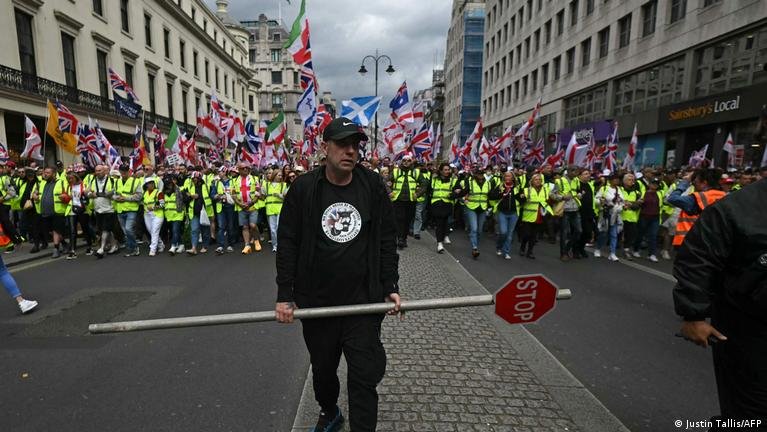
Far-Right Anti-Immigration Rally in London Draws Tens of Thousands Amid Heavy Police Presence
Supporters of activist Tommy Robinson gathered in central London as authorities deployed thousands of officers to manage simultaneous protests and rising political tensions over immigration
A system-driven public order operation in London has unfolded as tens of thousands of people joined an anti-immigration rally led by far-right activist Tommy Robinson, prompting one of the largest policing deployments in recent UK protest history.
What is confirmed is that a major demonstration against immigration took place in central London on Saturday, organised by Robinson, whose real name is Stephen Yaxley-Lennon.
The rally formed part of a broader day of coordinated public gatherings in the capital, including rival demonstrations and major city events that placed additional strain on policing resources.
Authorities deployed around four thousand officers to manage crowd control, prevent clashes, and maintain separation between opposing groups.
The protest centred on opposition to immigration policy and broader concerns among participants about cultural identity, border control, and government handling of asylum applications.
Supporters marched through central streets carrying British and English flags, with speeches and chants reflecting nationalist and anti-immigration sentiment.
Organisers framed the event as a patriotic mobilisation, while critics characterised it as promoting exclusionary and extremist narratives.
The key issue is how large-scale political demonstrations intersect with public order, free expression, and security enforcement.
UK authorities are required to balance the right to protest with legal obligations to prevent violence, hate speech, and disorder.
In this case, the scale of mobilisation led to extensive policing measures, including surveillance tools and restricted movement in key areas of Westminster.
At the same time, the event highlighted deepening political polarisation in the UK over immigration.
Similar rallies in recent years have attracted large crowds, reflecting sustained public attention on migration levels, asylum accommodation, and perceived pressures on public services.
These dynamics have increasingly become a central axis of domestic political debate, influencing party positioning and public messaging across the political spectrum.
The broader implications extend beyond the march itself.
Large, recurring demonstrations of this kind place logistical and financial pressure on policing and city infrastructure, while also shaping the tone of national political discourse.
For authorities, the priority remains preventing escalation into violence and maintaining separation between opposing groups in an increasingly charged protest environment.
What is confirmed is that a major demonstration against immigration took place in central London on Saturday, organised by Robinson, whose real name is Stephen Yaxley-Lennon.
The rally formed part of a broader day of coordinated public gatherings in the capital, including rival demonstrations and major city events that placed additional strain on policing resources.
Authorities deployed around four thousand officers to manage crowd control, prevent clashes, and maintain separation between opposing groups.
The protest centred on opposition to immigration policy and broader concerns among participants about cultural identity, border control, and government handling of asylum applications.
Supporters marched through central streets carrying British and English flags, with speeches and chants reflecting nationalist and anti-immigration sentiment.
Organisers framed the event as a patriotic mobilisation, while critics characterised it as promoting exclusionary and extremist narratives.
The key issue is how large-scale political demonstrations intersect with public order, free expression, and security enforcement.
UK authorities are required to balance the right to protest with legal obligations to prevent violence, hate speech, and disorder.
In this case, the scale of mobilisation led to extensive policing measures, including surveillance tools and restricted movement in key areas of Westminster.
At the same time, the event highlighted deepening political polarisation in the UK over immigration.
Similar rallies in recent years have attracted large crowds, reflecting sustained public attention on migration levels, asylum accommodation, and perceived pressures on public services.
These dynamics have increasingly become a central axis of domestic political debate, influencing party positioning and public messaging across the political spectrum.
The broader implications extend beyond the march itself.
Large, recurring demonstrations of this kind place logistical and financial pressure on policing and city infrastructure, while also shaping the tone of national political discourse.
For authorities, the priority remains preventing escalation into violence and maintaining separation between opposing groups in an increasingly charged protest environment.