

Fed's Powell sets the table for higher and possibly faster rate hikes
"The latest economic data have come in stronger than expected, which suggests that the ultimate level of interest rates is likely to be higher than previously anticipated," the U.S. central bank chief said in his semi-annual testimony before the Senate Banking Committee.
While some of that unexpected economic strength may have been due to warm weather and other seasonal effects, Powell said it may also be a sign the Fed needs to do more to temper inflation, perhaps even returning to larger rate increases than the quarter-percentage-point steps officials had been intending to use going forward.
"If the totality of the data were to indicate that faster tightening is warranted, we would be prepared to increase the pace of rate hikes," Powell said.
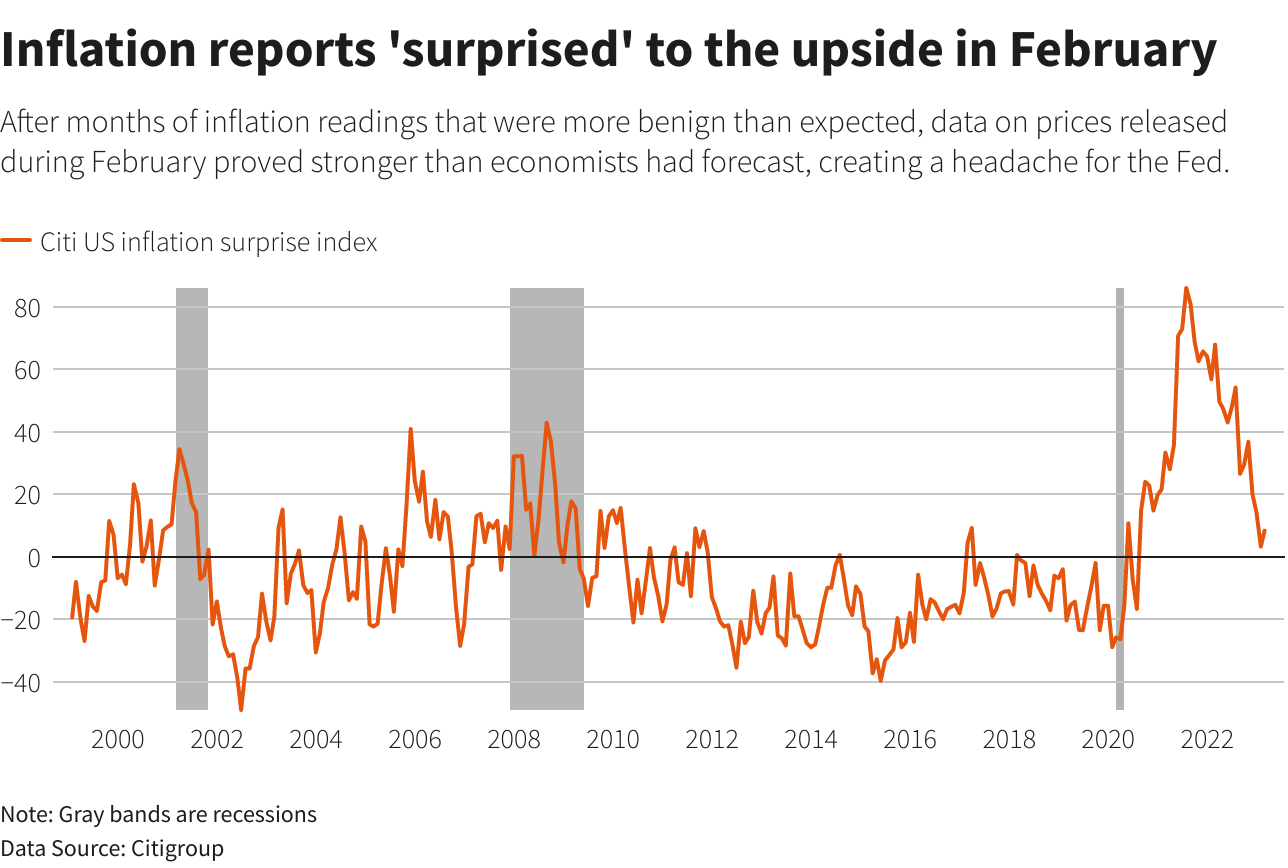
The comments were Powell's first since inflation unexpectedly jumped in January, and marked a stark acknowledgement that the "disinflationary process" he spoke of repeatedly in a Feb. 1 news conference was not unfolding smoothly.
Senators responded with a broad set of questions and pointed criticism around whether the Fed was diagnosing the inflation problem correctly and if price pressures could be tamed without significant damage to economic growth and the job market.
Democrats on the committee focused on the role high corporate profits may be playing in persistent inflation, with Senator Elizabeth Warren of Massachusetts charging that the Fed was "gambling with people's lives" through rate hikes that, by the central bank's most recent projections, would lead the unemployment rate to increase by more than a percentage point - a loss associated in the past with economic recessions.
"You claim there is only one solution: Lay off millions of workers," Warren said.
"Will working people be better off if we just walk away from our jobs and inflation rebounds?" Powell retorted.
"Raising interest rates certainly won't stop business from exploiting all these crises to jack up prices," said Senator Sherrod Brown, a Democrat from Ohio who chairs the committee.
Republicans focused on whether energy policy was restricting supply and keeping prices higher than needed, and whether restrained federal spending could help the Fed's cause.
"The only way to get this sticky inflation down is to attack it at the monetary side and the fiscal side. The more we help on the fiscal side, the fewer people you will have to throw out of work," said Senator John Kennedy, a Republican from Louisiana.
"It could work out that way," said Powell, who at a separate point in the hearing agreed with Democratic lawmakers' assertions that lower corporate profits could help lower inflation, and with Republicans' arguments that more energy production could help lower prices.
"It's not for us to point fingers," the Fed chief said.
'SURPRISINGLY HAWKISH'
Powell's remarks, virtually assuring that Fed officials will project a higher endpoint for the central bank's benchmark overnight interest rate at the upcoming March 21-22 meeting, sparked a quick repricing in bond markets as investors boosted bets that the Fed would approve a half-percentage-point rate hike when they meet in two weeks.
The Fed's policy rate is currently in the 4.50%-4.75% range. As of December, officials saw that rate rising to a peak of around 5.1%, a level investors expect may move at least half a percentage point higher now.
Equity markets added to initial losses and ended the day sharply lower, with the S&P 500 (.SPX) index dropping more than 1.5%. The U.S. dollar also rose, and yields on the 2-year Treasury climbed above 5% - the highest since 2007.
Powell's statement was "surprisingly hawkish," said Michael Brown, a market analyst with TraderX in London. With a 50-basis-point rate hike now in play, Brown said a strong monthly jobs report on Friday would likely lead to "calls for a 6% terminal rate," nearly a percentage point higher than Fed officials had projected as of December.
The March 10 release of the Labor Department's jobs report for February and an inflation report next week were cited by Powell as important in shaping what the Fed does at its next meeting.
Powell will testify again on Wednesday before the U.S. House of Representatives Financial Services Committee.
'LONG WAY TO GO'
The hearing and Powell's testimony honed in on an issue that is now at the center of the Fed's discussions as officials try to determine whether recent data will prove to be a "blip," or end up signaling that inflation remains stickier than thought and warrants a tougher response from the Fed.
In his testimony, Powell noted that much of the impact of the central bank's monetary policy may still be in the pipeline, with the labor market still sustaining a 3.4% unemployment rate not seen since 1969, and strong wage gains.
While Powell said he thought the Fed's 2% inflation target could still be met without dealing a major blow to the U.S. labor market, he acknowledged on Tuesday that "there will very likely be some softening in labor market conditions."
How much remains unclear, but Powell said the focus will remain more squarely on how inflation behaves.
Inflation has fallen since Powell's last appearances before Congress. After topping out at an annual rate of 9.1% in June, the Consumer Price Index dropped to 6.4% in January; the separate Personal Consumption Expenditures price index, which the Fed uses as the basis for its 2% target, peaked at 7% in June and had fallen to 5.4% as of January.
But that remains too high, Powell said.
"The process of getting inflation back down to 2% has a long way to go and is likely to be bumpy," Powell said, adding later in the hearing that "the social costs of failure are very, very high."











