

Mars, Nestlé and Hershey to face child slavery lawsuit in US
Eight children who claim they were used as slave labour on cocoa plantations in Ivory Coast have launched legal action against the world’s biggest chocolate companies. They accuse the corporations of aiding and abetting the illegal enslavement of “thousands” of children on cocoa farms in their supply chains.
Nestlé, Cargill, Barry Callebaut, Mars, Olam, Hershey and Mondelēz have been named as defendants in a lawsuit filed in Washington DC by the human rights firm International Rights Advocates (IRA), on behalf of eight former child slaves who say they were forced to work without pay on cocoa plantations in the west African country.
The plaintiffs, all of whom are originally from Mali and are now young adults, are seeking damages for forced labour and further compensation for unjust enrichment, negligent supervision and intentional infliction of emotional distress.
It is the first time that a class action of this kind has been filed against the cocoa industry in a US court. Citing research by the US state department, the International Labour Organization and Unicef, among others, the court documents allege that the plaintiffs’ experience of child slavery is mirrored by that of thousands of other minors.
Ivory Coast produces about 45% of the global supply of cocoa, a core ingredient in chocolate. The production of cocoa in west Africa has long been linked to human rights abuses, structural poverty, low pay and child labour.
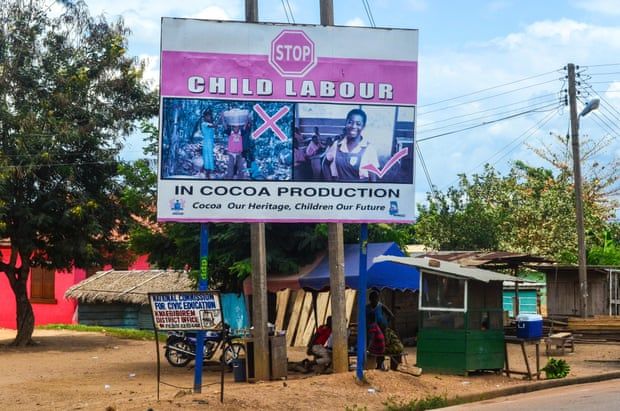 A sign warns against child labour in cocoa production in Ghana.
A central allegation of the lawsuit is that the defendants, despite not owning the cocoa farms in question, “knowingly profited” from the illegal work of children. According to the submissions, the defendants’ contracted suppliers were able to provide lower prices than if they had employed adult workers with proper protective equipment.
The lawsuit also accuses the companies of actively misleading the public in their 2001 promise to “phase out” child labour. The original deadline for achieving the commitment, made as part of the voluntary Harkin-Engel Protocol, was 2005. The World Cocoa Foundation, an industry body to which all the defendants belong, now aims to achieve the target by 2025.
In the claim, all eight plaintiffs describe being recruited in Mali through trickery and deception, before being trafficked across the border to cocoa farms in Ivory Coast. There, they were forced to work – often for several years or more – with no pay, no travel documents and no clear idea of where they were or how to get back to their families.
The court papers allege that the plaintiffs, all of whom were under 16 years old at the time of their recruitment, worked on farms in major cocoa-producing areas of the country. The defendants’ apparent influence in these markets is described as “dominant” by the plaintiffs’ counsel.
The lawsuit claims one plaintiff was only 11 years old when a local man in his home town of Kouroussandougou, Mali, promised him work in Ivory Coast for 25,000 CFA francs (£34) a month. The legal documents allege that the boy worked for two years without ever being paid, often applying pesticides and herbicides without protective clothing.
The documents claim another child named as a plaintiff in the suit had visible cuts on his hands and arms from machete accidents. Speaking of his experience of forced labour between 2009 and 2011, he recalls being constantly bitten by insects. As with most of the plaintiffs, he claims in the lawsuit that he was promised payment after the harvest, but it never came.
Many of the plaintiffs quoted in the court documents report being fed little and working long hours. Often, they claim they were kept alone or isolated from other child workers, who spoke different dialects.
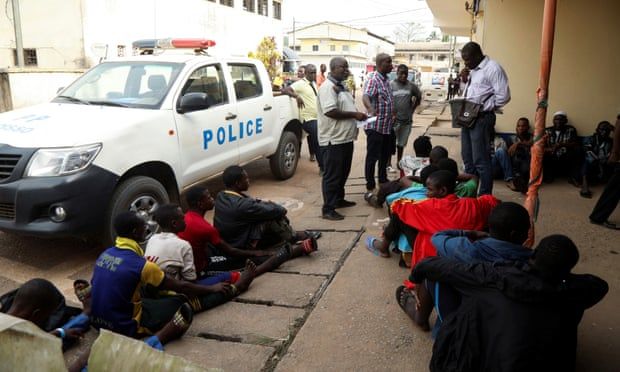 Police checks during an operation to rescue children from child traffickers in Aboisso, Ivory Coast.
During field work for this case, the plaintiffs’ legal team say that they routinely found children using machetes, applying chemicals and undertaking other hazardous tasks on cocoa plantations that were producing for one or more of the defendants.
As well as being morally repugnant, such abuses against children represent a “humanitarian disaster” as they contribute to Ivory Coast’s ongoing poverty, the court papers state. The widespread use of child slavery is also credited by the plaintiffs for causing “long-term mental and physical trauma”.
The case documentation maintains that the defendants are responsible for developing the entire cocoa production system of Ivory Coast. As key participants in this “venture”, it is claimed that they either knew or should have known about the “systematic” use of child labour.
The case is being brought under the Trafficking Victims Protection Reauthorization Act of 2017. IRA is currently involved in a separate complaint filed under the Alien Tort Statute against Nestlé and Cargill.
In a statement Cargill said: “We are aware of the filing and while we cannot comment on specifics of this case right now, [the company wants] to reinforce we have no tolerance for child labor in cocoa production. Children belong in school. They deserve safe living conditions and access to good nutrition.”
Nestlé said that the lawsuit “does not advance the shared goal of ending child labor in the cocoa industry” and added, “child labor is unacceptable and goes against everything we stand for. Nestlé has explicit policies against it and is unwavering in our dedication to ending it. We remain committed to combatting child labor within the cocoa supply chain and addressing its root causes as part of the Nestlé Cocoa Plan and through collaborative efforts.”
Responding to news of the lawsuit, a Mars spokesperson said: “We don’t comment on any possible pending litigation.”
Mondelēz said it did not wish to comment.
Barry Callebaut said it has committed to eradicating child labour from its supply chain by 2025. “Every year we publish the progress we have made against this target in our Forever Chocolate progress report,” it said.
An Olam spokesperson said that the company has a zero-tolerance policy for forced or slave labour in their supply chain. “If we were to identify any instances, we would immediately take action which includes notifying the appropriate authorities,” they said.
Hershey have been approached for comment.











