

Dominican Republic expelled hundreds of children to Haiti without their families this year
The United Nations Children’s Agency has received at least 1,800 unaccompanied children delivered by Dominican immigration authorities into Haiti since the year began, a spokesperson told CNN on Monday.
Many arrive without identity documents and are “shipped” into the country amid adult deportees, the spokesperson also said – raising the question of how Dominican authorities ascertained that they belonged in Haiti at all.
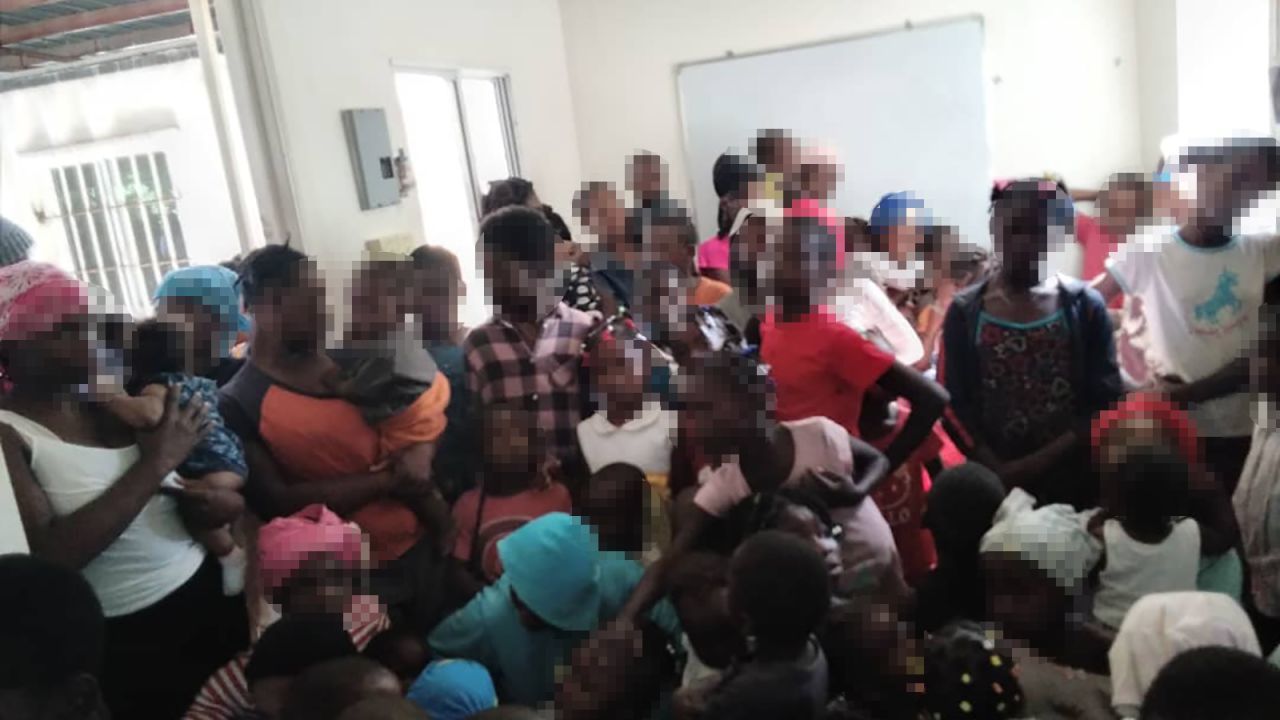 An image provided to CNN by the Haitian aid organization Groupe d'Appui
des Rapatriés et Réfugiés shows people deported from the Dominican
Republic on November 17 near the Malpasse border crossing. CNN obscured
parts of the image to preserve their privacy.
An image provided to CNN by the Haitian aid organization Groupe d'Appui
des Rapatriés et Réfugiés shows people deported from the Dominican
Republic on November 17 near the Malpasse border crossing. CNN obscured
parts of the image to preserve their privacy.“One woman had a diaper bag with her, but not the baby. [Immigration agents] had told her that she couldn’t carry her baby with her, and that they would bring it to the bus – but then they didn’t bring the baby to the bus,” said Yoana Kuzmova, a researcher at Dominican migration policy thinktank Center for Migratory Observation and Social Development in the Caribbean.
The Dominican Republic has long sought to reduce the Haitian population within its borders. But the latest wave of deportations this year is taking place with stunning speed and breadth, prompting critics to accuse the Caribbean nation’s government of racial profiling, chaotic execution, and a disregard for human rights and families as immigration agents hustle people out of the country.
The United States embassy in the Dominican Republic has warned Black and “darker-skinned Americans” that they risk “increased interaction” with Dominican authorities amid the immigration crackdown. In a statement released Saturday, the embassy described “reports of the unequal treatment” of US citizens based on skin color.
But Dominican Republic President Luis Abinader has rejected calls to stop the deportations, arguing that the country already supports neighboring Haiti more than any other country in the world.
The Dominican Republic’s migration directorate did not respond to CNN’s request for comment. But in a statement released after the publication of this article, the migration agency denied any cases of minors being separated from their parents since 2020. It quoted Venancio Alcántara, the migration agency’s director general, describing “specific procedures” for dealing with minors.
“Every time minors are accompanied by their parents, and when the parents have not been located, minors are referred to the Children and Teenagers National Counsel, which will take care of them,” he said.
Allegations of ‘degrading treatment’ and mistaken identities
In October alone, 14,801 people were sent to Haiti from the Dominican Republic, according to records by Haitian aid organization Groupe d’Appui des Rapatriés et Réfugiés – an average of 477 people each day.
Social media videos appearing to show Dominican immigration authorities conducting raids have caused panic among Haitians and people of Haitian origin in the Dominican Republic, with even some who are legal residents telling CNN that they are afraid to leave their homes.
Haiti’s Communications Ministry called on its neighbor to respect “human dignity” on Sunday, citing the “stunning images…that have drawn attention to inhumane and degrading treatment inflicted on Haitian citizens in the Dominican Republic.”
The immigration dragnet has swept up some people regardless of their nationality or legal status, according to former detainees and experts interviewed by CNN, as well as the US embassy statement.
One Haitian man, who lives and works legally in the Dominican Republic, told CNN that immigration agents broke into his home in the middle of the night and refused to listen to his arguments.
“I was sleeping in my house with my family. At 3 a.m. (local time), a group of immigration officers broke down my door and arrested me. They did not ask me for my papers or anything; they did not let me speak,” says one man of Haitian origin, whose legal work permit was in the process of being renewed when he was arrested.
“They just grabbed me and took me away; I told them I had papers and they did not even listen,” he added.
He was detained overnight in squalid conditions before being released the next day.
Video that he secretly filmed and shared with CNN showed a concrete building with cramped stalls piled with food and blackened with waste, and a narrow room with no beds, where at least 15 other detained men waited.
“They treat them like animals. Once they put them in jail, they leave them there to sleep on the floor without feeding them. They destroyed people’s documents and in some cases, people had no chance to show their papers,” said Sam Guillaume, a GARR spokesperson.
He added that his organization has received several Dominican citizens in Haiti who were erroneously seized and deported.
A years-long effort
The Dominican Republic’s effort to remove people of Haitian origin from the country goes back years.
In 2013, the country’s constitutional court controversially ruled that Dominicans born in the country to undocumented parents should be stripped of their citizenship – rendering tens of thousands of people stateless, with no other country to call home.
Known colloquially as “La Sentencia” or the Sentence, it “created a situation of statelessness of a magnitude never before seen in the Americas,” according to the Inter-American Commission on Human Rights.
Many Haitian migrants in the Dominican Republic rely on short-term residency permits to remain in the country legally through a “regularization plan.” But Kuzmova, the legal researcher, says she hears “over and over” that they risk being deported while they wait to renew those permits.
“When it comes to Haitian migrants, the residence permit is valid for a year, and they take a year to renew it. So the reality is that if this person who is eligible for a permit gets picked up on the street, they’re not going to have a valid document on them,” she says.
“What people are saying is that when you get picked up with an expired card, they destroy it. And that was basically the proof that you had of being in the regularization plan.”
A new presidential decree, issued last week to create a specialized law enforcement unit to combat squatting, could also be used to target people of Haitian origin living on historic sugar plantation villages known as bateyes, which once drew large numbers of migrant workers.
“The people living there now are largely retired old people who worked on the plantations, and they don’t have proof of title. So that could be another way to instrumentalize police to enforce deportations,” Kuzmova says.
As Haiti struggles to recover from interlinked political and security crises, the UN has repeatedly called on the Dominican Republic to stop sending people there.
“Unremitting armed violence and systematic human rights violations in Haiti do not currently allow for the safe, dignified and sustainable return of Haitians to the country. I reiterate my call to all countries in the region, including the Dominican Republic, to halt the deportation of Haitians,” said UN High Commissioner for Human Rights Volker Türk earlier this month.
Two days later, Dominican Republic President Luis Abinader responded with derision, describing Turk’s statement as “unacceptable and irresponsible” – and saying he would instead accelerate deportations.











