Gold and Cash Seizure Puts Indonesia’s Senior Anti-Corruption Prosecutor Under Investigation
Police found seventy-four kilograms of gold and hundreds of billions of rupiah during raids linked to Febrie Adriansyah, intensifying concern that rival law-enforcement institutions are using corruption cases against one another.
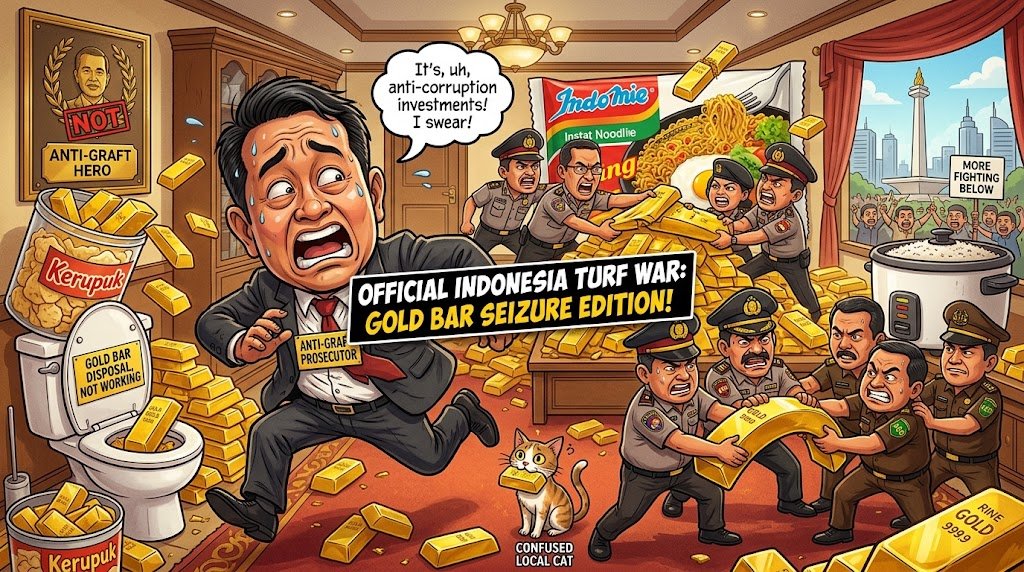
Indonesia’s National Police have placed one of the country’s most powerful anti-corruption prosecutors at the center of a criminal investigation after officers seized seventy-four kilograms of gold and approximately four hundred and seventy-six billion rupiah in cash from a residence linked to him.
Febrie Adriansyah, who led the Attorney General’s Office division responsible for major corruption cases, has resigned from that position and been named a suspect in three investigations.
He has not been detained, but authorities have prohibited him from leaving the country.
The raids have developed into more than a case about unexplained wealth.
They have exposed a widening struggle between the police and the Attorney General’s Office, two institutions with overlapping authority, competing investigative interests and a history of mutual suspicion.
Both agencies deny that they are engaged in a feud, yet the timing, targets and institutional response have reinforced the perception that corruption enforcement is becoming entangled with bureaucratic retaliation.
Police searched more than a dozen locations across the greater Jakarta area.
The properties included Adriansyah’s residence, a café, a neighboring currency-exchange business, an apartment and other sites connected to investigations involving state-owned electricity company Perusahaan Listrik Negara, military insurer and pension fund Asabri, and steel producer Krakatau Steel.
At Adriansyah’s home, investigators seized gold bars weighing seventy-four kilograms and cash in several currencies with a combined value reported at about four hundred and seventy-six billion rupiah, equivalent to roughly twenty-six and a half million United States dollars.
Adriansyah has said the assets can be accounted for, although he has not publicly established that he owns them or explained their origin in detail.
The presence of the property at his residence is evidence requiring investigation, not proof that the assets were obtained through corruption.
Police also searched the De’Clan Signature café in South Jakarta, where officers found about sixty billion rupiah in Indonesian, American and Singaporean currency inside a safe concealed behind a cupboard.
At an adjacent money changer, investigators confiscated seventy-one items of evidence and cash valued at approximately seven point two billion rupiah in sixteen currencies.
Police suspect the exchange business may have been used to launder money.
The café and currency business have been linked to businessman Don Ritto, who has also been named as a suspect.
His lawyer maintains that the seized money belonged to legitimate commercial operations and was unrelated to the corruption cases being investigated.
That explanation will now be tested against transaction records, beneficial-ownership documents, banking data and the movement of funds among the searched properties.
The investigation encompasses alleged wrongdoing connected to coal procurement, electricity supplies and state-owned enterprises.
Police have estimated that suspected irregularities in coal purchasing between twenty eighteen and twenty twenty-six caused about five trillion rupiah in state and broader economic losses.
The alleged scheme has also been linked to disruptions in electricity generation, although the precise responsibility of each suspect must be established through the evidentiary process.
Adriansyah’s position makes the case particularly consequential.
As deputy attorney-general for special crimes, he directed some of Indonesia’s most politically and economically sensitive prosecutions.
His division investigated alleged corruption surrounding President Prabowo Subianto’s free school meals program, state companies, mining interests and illegal forestry operations.
At least one senior police officer has been implicated in the school meals inquiry, giving the police investigation of Adriansyah an unavoidable institutional dimension.
The tension between the agencies predates the latest raids.
In twenty twenty-four, a member of the police counterterrorism unit was detained after allegedly following Adriansyah.
No complete public explanation was given for that episode.
The unresolved incident contributed to suspicion that elements within the police were monitoring a prosecutor involved in cases touching powerful commercial and law-enforcement interests.
The latest searches produced another extraordinary confrontation.
Witnesses described a standoff between police investigators and armed soldiers who initially attempted to prevent access to one of the businesses.
Military personnel were also seen guarding one of Adriansyah’s residences.
The armed forces said their presence had been requested by the prosecutor’s office, but civil-society groups warned that military protection around a criminal suspect could intimidate investigators and undermine the principle that all defendants are equal before the law.
After Adriansyah became a suspect, the Attorney General’s Office announced that it would assume control of parts of the investigation from the police.
That decision has deepened concern about institutional independence because the office would effectively be investigating a recently senior member of its own leadership.
Legal specialists and anti-corruption advocates have called for an autonomous body to supervise the inquiry, arguing that neither of the competing agencies can command full public confidence while investigating the other.
The Corruption Eradication Commission would ordinarily be a candidate for such a role, but its authority and independence have been weakened by legislative changes, leadership controversies and political pressure over recent years.
The present dispute therefore illustrates a structural problem in Indonesian governance: several institutions possess anti-corruption powers, but none is fully insulated from rivalry, political influence or conflicts of interest.
The government has said it will not interfere with judicial proceedings and has called for the investigation to be conducted transparently and in accordance with due process.
That posture preserves formal distance from the case, but it places responsibility on the police, prosecutors and courts to demonstrate that the evidence will be handled consistently rather than used as leverage in an institutional contest.
The allegations against Adriansyah have not been proven.
Investigators must establish ownership of the gold and cash, trace the assets to specific transactions and show a criminal connection to the three cases in which he has been named.
They must also distinguish personal property from funds belonging to businesses or third parties and explain how the assets came to be stored at the searched locations.
The consequences extend beyond one prosecutor.
A credible investigation could demonstrate that no official is beyond scrutiny, including those entrusted with prosecuting corruption.
A compromised or retaliatory process would produce the opposite result: evidence that Indonesia’s law-enforcement bodies are using their powers to protect institutional interests and neutralize rival investigations.
Adriansyah is now subject to a travel ban, the seized assets remain under police control, and investigators are tracing the money, gold and commercial relationships connected to the raids.
The next test is whether an institution independent of the competing police and prosecutorial hierarchies is given sufficient authority to establish ownership, criminal responsibility and the full origin of the seized wealth.
Febrie Adriansyah, who led the Attorney General’s Office division responsible for major corruption cases, has resigned from that position and been named a suspect in three investigations.
He has not been detained, but authorities have prohibited him from leaving the country.
The raids have developed into more than a case about unexplained wealth.
They have exposed a widening struggle between the police and the Attorney General’s Office, two institutions with overlapping authority, competing investigative interests and a history of mutual suspicion.
Both agencies deny that they are engaged in a feud, yet the timing, targets and institutional response have reinforced the perception that corruption enforcement is becoming entangled with bureaucratic retaliation.
Police searched more than a dozen locations across the greater Jakarta area.
The properties included Adriansyah’s residence, a café, a neighboring currency-exchange business, an apartment and other sites connected to investigations involving state-owned electricity company Perusahaan Listrik Negara, military insurer and pension fund Asabri, and steel producer Krakatau Steel.
At Adriansyah’s home, investigators seized gold bars weighing seventy-four kilograms and cash in several currencies with a combined value reported at about four hundred and seventy-six billion rupiah, equivalent to roughly twenty-six and a half million United States dollars.
Adriansyah has said the assets can be accounted for, although he has not publicly established that he owns them or explained their origin in detail.
The presence of the property at his residence is evidence requiring investigation, not proof that the assets were obtained through corruption.
Police also searched the De’Clan Signature café in South Jakarta, where officers found about sixty billion rupiah in Indonesian, American and Singaporean currency inside a safe concealed behind a cupboard.
At an adjacent money changer, investigators confiscated seventy-one items of evidence and cash valued at approximately seven point two billion rupiah in sixteen currencies.
Police suspect the exchange business may have been used to launder money.
The café and currency business have been linked to businessman Don Ritto, who has also been named as a suspect.
His lawyer maintains that the seized money belonged to legitimate commercial operations and was unrelated to the corruption cases being investigated.
That explanation will now be tested against transaction records, beneficial-ownership documents, banking data and the movement of funds among the searched properties.
The investigation encompasses alleged wrongdoing connected to coal procurement, electricity supplies and state-owned enterprises.
Police have estimated that suspected irregularities in coal purchasing between twenty eighteen and twenty twenty-six caused about five trillion rupiah in state and broader economic losses.
The alleged scheme has also been linked to disruptions in electricity generation, although the precise responsibility of each suspect must be established through the evidentiary process.
Adriansyah’s position makes the case particularly consequential.
As deputy attorney-general for special crimes, he directed some of Indonesia’s most politically and economically sensitive prosecutions.
His division investigated alleged corruption surrounding President Prabowo Subianto’s free school meals program, state companies, mining interests and illegal forestry operations.
At least one senior police officer has been implicated in the school meals inquiry, giving the police investigation of Adriansyah an unavoidable institutional dimension.
The tension between the agencies predates the latest raids.
In twenty twenty-four, a member of the police counterterrorism unit was detained after allegedly following Adriansyah.
No complete public explanation was given for that episode.
The unresolved incident contributed to suspicion that elements within the police were monitoring a prosecutor involved in cases touching powerful commercial and law-enforcement interests.
The latest searches produced another extraordinary confrontation.
Witnesses described a standoff between police investigators and armed soldiers who initially attempted to prevent access to one of the businesses.
Military personnel were also seen guarding one of Adriansyah’s residences.
The armed forces said their presence had been requested by the prosecutor’s office, but civil-society groups warned that military protection around a criminal suspect could intimidate investigators and undermine the principle that all defendants are equal before the law.
After Adriansyah became a suspect, the Attorney General’s Office announced that it would assume control of parts of the investigation from the police.
That decision has deepened concern about institutional independence because the office would effectively be investigating a recently senior member of its own leadership.
Legal specialists and anti-corruption advocates have called for an autonomous body to supervise the inquiry, arguing that neither of the competing agencies can command full public confidence while investigating the other.
The Corruption Eradication Commission would ordinarily be a candidate for such a role, but its authority and independence have been weakened by legislative changes, leadership controversies and political pressure over recent years.
The present dispute therefore illustrates a structural problem in Indonesian governance: several institutions possess anti-corruption powers, but none is fully insulated from rivalry, political influence or conflicts of interest.
The government has said it will not interfere with judicial proceedings and has called for the investigation to be conducted transparently and in accordance with due process.
That posture preserves formal distance from the case, but it places responsibility on the police, prosecutors and courts to demonstrate that the evidence will be handled consistently rather than used as leverage in an institutional contest.
The allegations against Adriansyah have not been proven.
Investigators must establish ownership of the gold and cash, trace the assets to specific transactions and show a criminal connection to the three cases in which he has been named.
They must also distinguish personal property from funds belonging to businesses or third parties and explain how the assets came to be stored at the searched locations.
The consequences extend beyond one prosecutor.
A credible investigation could demonstrate that no official is beyond scrutiny, including those entrusted with prosecuting corruption.
A compromised or retaliatory process would produce the opposite result: evidence that Indonesia’s law-enforcement bodies are using their powers to protect institutional interests and neutralize rival investigations.
Adriansyah is now subject to a travel ban, the seized assets remain under police control, and investigators are tracing the money, gold and commercial relationships connected to the raids.
The next test is whether an institution independent of the competing police and prosecutorial hierarchies is given sufficient authority to establish ownership, criminal responsibility and the full origin of the seized wealth.