

‘I was right to speak out about slavery money that built Bristol Old Vic’
Bristol Old Vic’s outgoing artistic director Tom Morris has defended his decision to publicly highlight the slave trade riches that financed the theatre’s construction and urged the city to face up to slavery’s legacy if it is to battle the scourge of racism today.
Morris, who is stepping down in the autumn after 12 years, said it had been vital – in order to engage with the city’s African-Caribbean community –to acknowledge the brutal
origins of the vast fortunes that paid for the theatre in the 18th century.
“Our theatre was built in 1766 when really the only source of income in the whole British economy was directly or indirectly related to the transatlantic slave trade – but it was undeniably so in Bristol,” he said. “That represents something important to [African-Caribbean] communities, and it is our duty to be honest about it. As soon as you start to be honest you are in a conversation, not a standoff.”
At least 15 of the 50 people who contributed £50 to found the celebrated Georgian theatre were merchants involved in the slave trade, with the others benefiting indirectly. In return, the founders were given specially minted silver tokens granting them seats to see all performances.
Morris, who is best known as the co-creator of the National Theatre’s hit show War Horse, revealed that he faced a backlash from some of the theatre’s donors who accused him of “dragging up history” unnecessarily. But he insisted it was the right course of action.
“The history of this theatre and this city can’t be buried, if we want to make social change now, partly because its burial is a denial of the very real legacy of damage, which it leaves on our fellow citizens,” said Morris. “But partly because there are lessons about how to make social change happen now.”
There are many in the city, he added, still seeking to diminish the horrors of a trade in human beings by suggesting the moral standards of today cannot be applied to a bygone era. “But accounts of the time show that almost everyone [in Bristol] thinks the trade is execrable – meaning extremely morally repugnant. The idea they didn’t know it is wrong is complete fiction. But they couldn’t seize the opportunity to change it because the economic and social cost was – they thought – too high.”
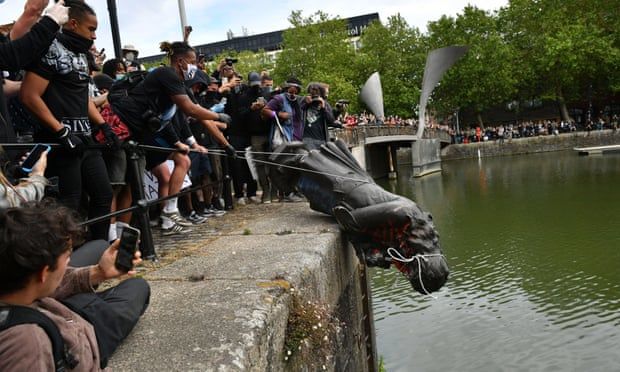 Protesters throwing a statue of the slave owner Edward Colston into Bristol harbour during a Black Lives Matter protest rally.
Morris also played a key role in encouraging the Bristol Post to offer an apology for a notorious front-page splash in 1996, which featured the mugshots of 16 black men, convicted of drugs offences, under the headline “Faces of Evil”. Morris brokered a meeting between the newspaper’s editor and the race equality campaigner Roger Griffith, which led to the apology in 2018.
The theatre’s new season, which will be Morris’s last, includes The Meaning of Zong, a play by the Olivier award-winning Hamilton actor, Giles Terera, about Olaudah Equiano, a former slave, who helped galvanise the abolition movement in Britain.
The 12 years of Morris’s tenure have been eventful. He has steered the theatre through austerity arts cuts and the pandemic, which is still affecting the arts sector.
The most perilous days, however, came during the early stages of the pandemic, before the government stepped in with a £1.57bn culture recovery fund in July 2020. “We got to the point of if something doesn’t happen in six to eight weeks, we’re going to have to mothball and dismantle the business in a way that would take decades to recover,” he said. “That was our worst-case scenario.”
The Old Vic, which is the oldest working theatre in the English-speaking world, found itself exposed because it had come to rely on ticket sales during the austerity era. The theatre was forced to make a third of its workforce redundant. “We’d gone from a situation where 40% of our turnover was commercially earned to the situation, after 10 years of austerity, where 75% of our income was trading income, essentially ticket sales and bar sales,” he said. “When we were suddenly forced to close, we lost 75% of our income. The job retention scheme stopped us from going bust. If the culture recovery fund had been quicker, we wouldn’t have made so many people redundant.”
Morris, who is credited with reviving the ailing theatre, is leaving in the autumn because he feels it needs fresh leadership and he wants to pursue other interests, including potentially making films and putting on a classical music prom.
Nevertheless, he is excited by his last season, which is seeking to provide an opportunity for people to think about the major themes emerging from the pandemic, including public health and racial justice. “Our main job is to entertain people, otherwise they won’t return – but at the same time it’s part of our civic role to hold the space for the big topics of our times.”











