
London Rally Sparks Security Concerns as Tommy Robinson Rallies Crowd with ‘Battle of Britain’ Language
Far-right activist addresses large demonstration in London, raising tensions over public order, political rhetoric and policing of mass protests
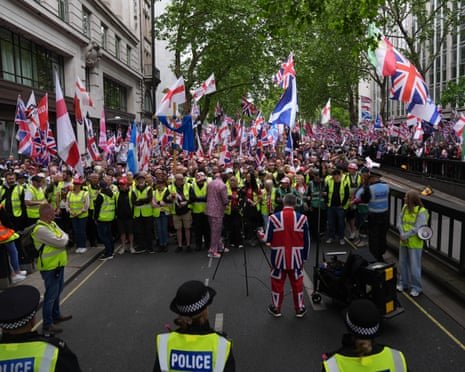
EVENT-DRIVEN public order tensions escalated in central London after far-right activist Tommy Robinson addressed a large rally in the capital, using language that urged supporters to prepare for what he described as a “battle of Britain.” The gathering brought together tens of thousands of attendees and triggered renewed scrutiny of political speech, protest dynamics and policing obligations in the United Kingdom.
What is confirmed is that a large demonstration took place in London featuring Tommy Robinson as a central speaker.
The event drew significant crowds and required a substantial policing presence to manage public safety, crowd movement and potential clashes with counter-protest groups.
Authorities deployed standard major-event policing protocols, including separation of groups and monitoring of flashpoints across central routes.
The key issue is not only the size of the rally but the framing of political messaging delivered from the stage.
Robinson’s use of escalatory language referencing a “battle of Britain” has intensified concerns among officials and civil liberties groups about the boundary between protected speech and rhetoric that could encourage disorder.
The phrase carries historical resonance in the UK, referring to the Second World War aerial campaign, and its use in a domestic protest context has been widely noted for its confrontational tone.
The demonstration sits within a broader pattern of increasingly polarised street politics in the UK, where migration, identity and policing have become central mobilising themes for competing protest movements.
Large-scale rallies have become more frequent, often involving opposing groups with sharply different political narratives, increasing the operational burden on police forces tasked with maintaining separation and preventing escalation.
The mechanism driving concern in this case is the interaction between mass mobilisation, digital coordination and politically charged messaging.
Modern protest movements can rapidly assemble large crowds through online platforms, while speeches delivered at rallies can amplify sentiment in real time to both physical and online audiences.
This creates a feedback loop in which rhetoric at the event can extend beyond the physical gathering and influence wider public discourse.
Policing implications are significant.
UK public order law requires authorities to balance the right to lawful assembly and free expression with the duty to prevent violence, intimidation or serious disruption.
When rhetoric becomes highly charged, police planning must account not only for crowd size but for the risk of spillover incidents, counter-mobilisation and isolated confrontations that can escalate quickly.
The stakes extend beyond a single demonstration.
Repeated high-profile rallies of this nature place pressure on institutional trust, particularly around perceptions of unequal policing or political bias.
They also raise questions about how democratic societies manage political speech that is provocative but not necessarily unlawful, and where the threshold lies for intervention.
For government and law enforcement, the immediate consequence is continued operational readiness for similar events, with ongoing assessment of risk levels tied to protest activity in major cities.
For political actors, the event reinforces the reality that street mobilisation remains a powerful force in UK politics, capable of shaping narratives and drawing national attention even outside formal electoral processes.
The rally concludes with heightened scrutiny of both the organisers and the policing response, as authorities continue to monitor the aftermath and prepare for potential follow-on demonstrations in the capital.
What is confirmed is that a large demonstration took place in London featuring Tommy Robinson as a central speaker.
The event drew significant crowds and required a substantial policing presence to manage public safety, crowd movement and potential clashes with counter-protest groups.
Authorities deployed standard major-event policing protocols, including separation of groups and monitoring of flashpoints across central routes.
The key issue is not only the size of the rally but the framing of political messaging delivered from the stage.
Robinson’s use of escalatory language referencing a “battle of Britain” has intensified concerns among officials and civil liberties groups about the boundary between protected speech and rhetoric that could encourage disorder.
The phrase carries historical resonance in the UK, referring to the Second World War aerial campaign, and its use in a domestic protest context has been widely noted for its confrontational tone.
The demonstration sits within a broader pattern of increasingly polarised street politics in the UK, where migration, identity and policing have become central mobilising themes for competing protest movements.
Large-scale rallies have become more frequent, often involving opposing groups with sharply different political narratives, increasing the operational burden on police forces tasked with maintaining separation and preventing escalation.
The mechanism driving concern in this case is the interaction between mass mobilisation, digital coordination and politically charged messaging.
Modern protest movements can rapidly assemble large crowds through online platforms, while speeches delivered at rallies can amplify sentiment in real time to both physical and online audiences.
This creates a feedback loop in which rhetoric at the event can extend beyond the physical gathering and influence wider public discourse.
Policing implications are significant.
UK public order law requires authorities to balance the right to lawful assembly and free expression with the duty to prevent violence, intimidation or serious disruption.
When rhetoric becomes highly charged, police planning must account not only for crowd size but for the risk of spillover incidents, counter-mobilisation and isolated confrontations that can escalate quickly.
The stakes extend beyond a single demonstration.
Repeated high-profile rallies of this nature place pressure on institutional trust, particularly around perceptions of unequal policing or political bias.
They also raise questions about how democratic societies manage political speech that is provocative but not necessarily unlawful, and where the threshold lies for intervention.
For government and law enforcement, the immediate consequence is continued operational readiness for similar events, with ongoing assessment of risk levels tied to protest activity in major cities.
For political actors, the event reinforces the reality that street mobilisation remains a powerful force in UK politics, capable of shaping narratives and drawing national attention even outside formal electoral processes.
The rally concludes with heightened scrutiny of both the organisers and the policing response, as authorities continue to monitor the aftermath and prepare for potential follow-on demonstrations in the capital.