

Phones and laptops could charge in five minutes thanks to battery breakthrough
Scientists at the University of Cambridge have peered into the inner workings of lithium-ion batteries to observe ions moving in real time.
The low-cost technique will allow researchers to identify the ‘speed limits’ for battery charging – which can then be used to lower charging times further.
The research, published in Nature, could turbocharge the development of next-gen batteries, which are essential for weaning humanity off of its addiction to fossil fuels.
‘We found that there are different speed limits for lithium-ion batteries, depending on whether it’s charging or discharging,’ said Dr Ashkay Rao from Cambridge’s Cavendish Laboratory, who led the research.
‘When charging, the speed depends on how fast the lithium ions can pass through the particles of active material.
‘When discharging, the speed depends on how fast the ions are inserted at the edges. If we can control these two mechanisms, it would enable lithium-ion batteries to charge much faster.’
Previous techniques to look into batteries were time-intensive and expensive, like electron microscopy and X-ray synchrotrons, but the Cambridge technique, using optical microscopy, offered better resolution at a lower price – and uses existing equipment.
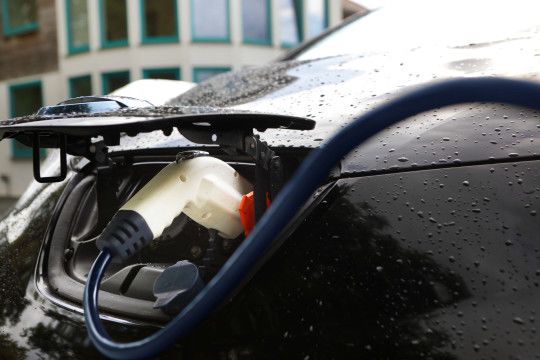 The technique could be vital for electric cars
‘This lab-based technique we’ve developed offers a huge change in technology speed so that we can keep up with the fast-moving inner workings of a battery,’ said co-author Dr Christoph Schnedermann from the Cavendish Laboratory.
‘The fact that we can actually see these phase boundaries charging in real time was really surprising. This technique could be an important piece of the puzzle in the development of next-generation batteries.’
Lithium-ion batteries are used in almost every electric device, from electric cars to smartphones – but high capacity and fast charging times are needed to be a competitor to the instantly-available and energy dense fossil fuels.
‘A better battery is one that can store a lot more energy or one that can charge much faster – ideally both, said Schnedermann.
‘But to make better batteries out of new materials, and to improve the batteries we’re already using, we need to understand what’s going on inside them.’
To improve lithium-ion batteries and make them charge faster, it’s necessary to look at what’s happening inside the batteries in real time.
PhD student and author Alice Merryweather said: ‘To really study what’s happening inside a battery, you essentially have to get the microscope to do two things at once: it needs to observe batteries charging and discharging over a period of several hours, but at the same time it needs to capture very fast processes happening inside the battery.’











