

Reparations could be ‘difference’ for unhoused Black Californians
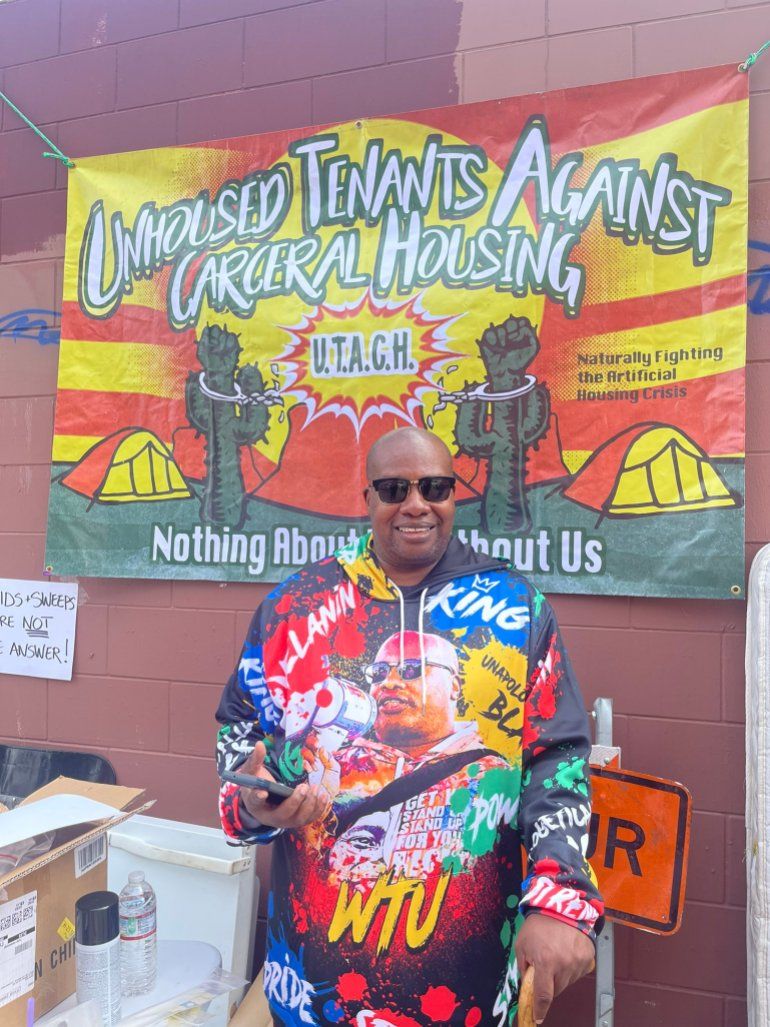
Theo Henderson, host and creator of the podcast We The Unhoused, was sitting in a park in Los Angeles when a nearby resident called police and around a dozen officers arrived.
Henderson, who was unhoused at the time, felt a mix of emotions: “My first thing was fear, because I’m a Black man and I’ve had negative experiences with the police, and knowing my life could be taken over just me raising my voice or doing something to upset them,” he told Al Jazeera.
“The second thing was anger, but I had to bottle my anger because of how disrespectful the cops were to me. And the third was humiliation and shame, because even though I didn’t do anything, you can’t help but feel ashamed for living in a displaced environment and not being at your best.”
Unhoused Black Americans are often targeted merely for being present in public spaces – viewed as a threat simply for existing, Henderson explained. Such experiences stem from a legacy of racist policies that can be traced back to the enslavement of African Americans, including in “free states” such as California, according to a new report by a state task force.
California’s task force on reparations – the first of its kind in the country – voted in March to grant reparations to the descendants of African Americans who were enslaved.
In a 500-page report (PDF) released this month, the task force called for the creation of a detailed reparations programme and urged the state to prevent banking and mortgage discrimination, as well as to end policies that contribute to the “vast overrepresentation” of African Americans among the unhoused population.
California has more people experiencing homelessness than any state in the country, the report found. Black people make up 6.5 percent of California residents, but nearly 40 percent of the state’s unhoused population.
Henderson, a former teacher, was renting when a medical emergency and the high cost of medication displaced him from his home. “It had to be a choice between medicine, food or a place to stay,” he said.
He can trace his lineage back to enslaved people in Alabama, and believes he would qualify for California reparations. “I would be eligible for that because I’ve been unhoused, I’m African American in this country, and I have no way to get back to my ancestral roots because of the disconnection that was created [by slavery],” he said.
White supremacist beliefs
Residential segregation in the United States is rooted in the same white supremacist beliefs that created and supported enslavement, the report found. After the Civil War ended in 1865, most African Americans lived in the south, on or near the land where they had been enslaved. In cities in both the north and south, African Americans lived in racially mixed neighbourhoods, the task force noted.
But that changed after 1890, when federal, state and municipal governments began forcing African Americans into urban ghettos, while helping white Americans buy homes in the suburbs.
As they migrated out of the south to escape violence and seek opportunities elsewhere, African Americans were excluded from white neighbourhoods by government policies, racist real estate rules, and white residents who targeted their homes and businesses.
 California has more people experiencing homelessness than any other US state
California enforced segregation through measures such as zoning ordinances and redlining, a discriminatory federal mortgage policy, the report noted. White residents set fire to the homes of Black residents who dared to live in white neighbourhoods, and California reportedly had more “sundown towns” – all-white neighbourhoods where Black people had to leave by sunset – than the entire US south.
In one podcast episode, Henderson draws a link between former sundown towns such as Hawthorne, California, and the over-policing of unhoused people in that city today: “Black people were barred from living there. If caught in town, they were thrown in jail, beaten or killed.”
In California today, Black residents are charged higher prices than white residents for identical housing, the report found, and homeowners in predominantly Black neighbourhoods are more likely to have subprime mortgages.
California homes owned by Black people are also valued lower: In one case cited by the task force, a white appraiser told a Black couple in Marin City that their home was valued at $995,000. They had it reappraised soon afterwards with a white friend pretending to be the homeowner, and the figure soared to nearly $1.5m.
Black Californians are also more likely to be renters than white Californians, and more likely to spend high percentages of their income on rent, according to the report.
‘Perfect storm of racism’
Darrell Owens grew up in an East Bay neighbourhood that has seen more than two-thirds of its Black population disappear over the last four decades, he said. The foreclosure crisis of the late aughts compounded existing inequality by turning Black homeowners into renters. “Now they’re being priced out on rent,” Owens, a policy analyst at the statewide advocacy group California YIMBY (Yes In My Backyard), told Al Jazeera. “It’s a perfect storm of racism, frankly.”
While he agreed with the report’s recommendations on housing, Owens said they were only half the puzzle: “Those are restorative processes that just stop the bleeding. I don’t want to just stop the bleeding; I want Black Californians to get what they are owed. That’s a debt that needs to be paid, more than just making sure fair housing enforcement is done.”
The task force is expected to issue another report by July 2023 that will detail the reparations that California owes.
But Brandon Greene, director of the racial and economic justice programme at the ACLU of Northern California, said he was sceptical of the ultimate outcome. Greene, who testified before the task force, told Al Jazeera that people who were forcibly removed deserve reparations large enough to provide generational wealth – and that may be quite a bit more than what’s eventually granted.
“It would likely be money that would be helpful, but I don’t know if it would be seismic in terms of shifting the Black wealth gap,” he said.
The task force has also urged California to create a cabinet-level position to oversee an agency tasked with implementing the report’s recommendations, and Greene believes this is an important step: “Then you have someone in the administration to carry on those conversations, as opposed to it just being outside agitation or people in the legislature pushing.”
Task force chair Kamilah Moore told Democracy Now! that she hopes the report sends a signal to the federal government. “Reparations for the African American community for the institution of slavery, the transatlantic slave trade, in the afterlife, is first and foremost a federal responsibility,” she said, adding that the task force is calling on the administration of US President Joe Biden to create its own reparations committee.
It’s not yet clear how much
California may pay in reparations, but Henderson believes the money will have an impact for unhoused people who qualify.
“It would make an immediate difference,” Henderson said of his own situation, noting that he recently found housing and could use the money to pay rent and avoid landing back on the street. He also wants to grow his podcast and create a bigger platform for unhoused people, with eventual dreams of owning a home and retiring.
“I don’t plan to be 100 years old, hobbling around doing the same thing,” he said. “I would like to make sure I’m secure in retirement.”











