Beautiful Virgin Islands

Sunday, Jul 12, 2026

Scientists believe they have discovered where asteroid which wiped out dinosaurs came from

Scientists believe they have discovered where asteroid which wiped out dinosaurs came from

A "sungrazed" comet may be responsible for the extinction event around 66 million years ago.

Scientists think they may be a step closer to understanding where the asteroid or comet that wiped out the dinosaurs came from.

The Chicxulub impactor smashed into the earth off the eastern shore of what is now Mexico, leaving a crater 100 miles across and 12 miles deep.

It ended the reign of the dinosaurs - taking out three quarters of plant and animal life with them - about 66 million years ago.

Three quarters of animal and plant life was taken out by the impact


Experts from Harvard University in the US believe they have figured out how such a large chunk of extra terrestrial rock ended up spelling death for the giant reptiles.

The gravity of the massive planet Jupiter draws comets from the icy outer edges of the solar system and hurtles them inwards, towards the sun.

As the comets slingshot around the sun, the gravitational power of the star breaks apart the cosmic missile.

The resulting shards fly across the solar system - increasing the chance of a collision with planets like Earth.

Undergraduate student Amir Siraj explained: "The solar system acts as a kind of pinball machine.

"Jupiter, the most massive planet, kicks incoming long-period comets into orbits that bring them very close to the sun."

Long-period comets take at least 200 years to orbit the sun, and come from a region of the solar system known as the Oort cloud.

The cloud is thought to exist between 2,000 and 100,000 astronomical units away from the sun - each astronomical unit is the average distance between the Earth and the sun, or about 93 million miles.

The shattering of the comets is known as "sungrazing".

Mr Siraj added: "In a sungrazing event, the portion of the comet closer to the sun feels a stronger gravitational pull than the part that is further, resulting in a tidal force across the object.

"You can get what's called a tidal disruption event, in which a large comet breaks up into many
smaller pieces.

"And crucially, on the journey back to the Oort cloud, there's an enhanced probability that one of these fragments hit the Earth."

Astronomer Avi Loeb said: "Our paper provides a basis for explaining the occurrence of this event.

"We are suggesting that, in fact, if you break up an object as it comes close to the sun, it could give rise to the appropriate event rate and also the kind of impact that killed the dinosaurs."
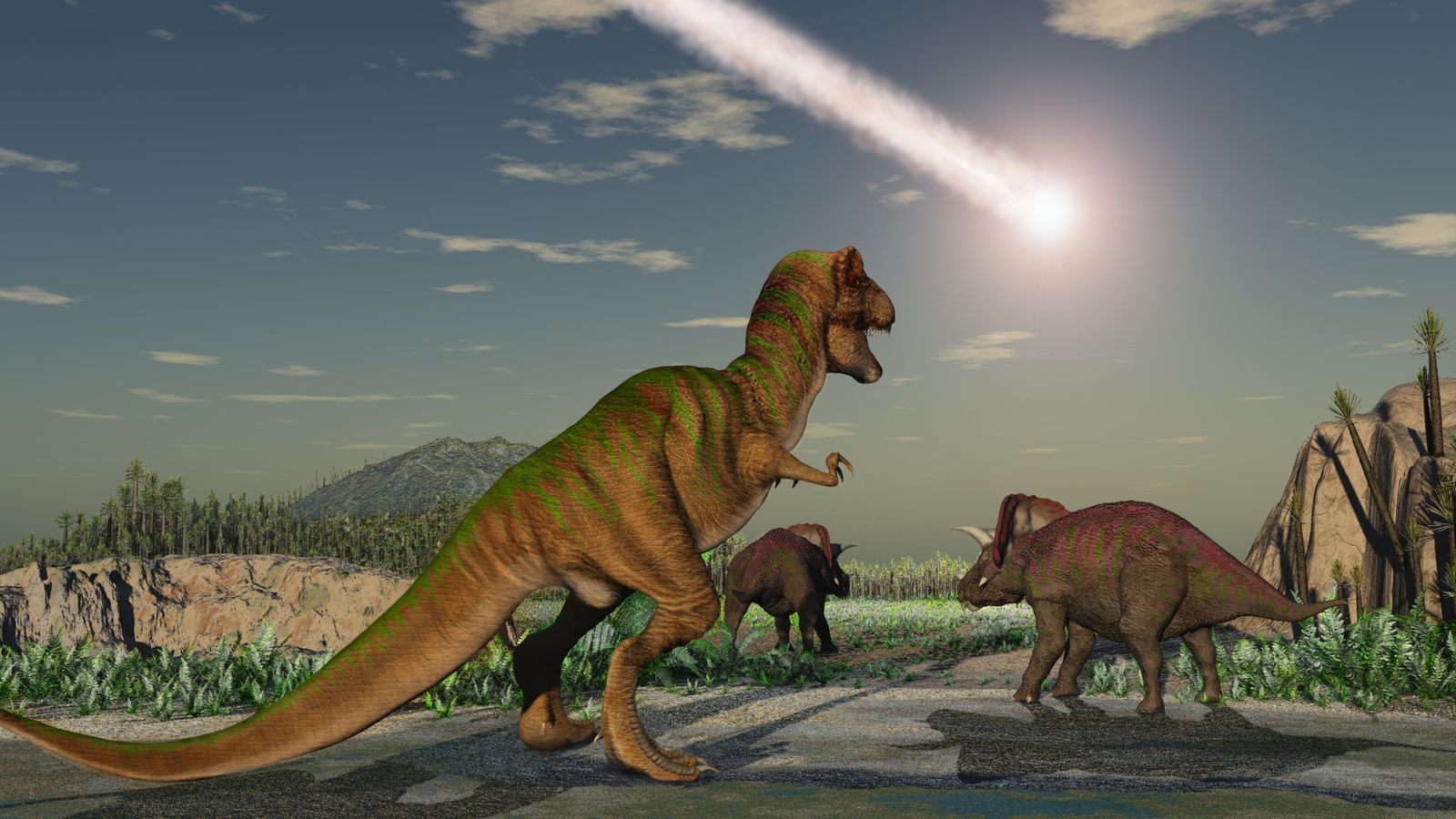
The comet struck around 66 million years ago


The paper, published in Nature's Scientific Reports, shows new calculations which increase the likelihood of a long-period comet striking the Earth by a factor of 10.

It also suggests that the carbonaceous chondrite material the dinosaur-killing comet was made of is more commonly found in the Oort cloud - something which the pair hope to study more.


Newsletter

Related Articles

Beautiful Virgin Islands
0:00
0:00
Close
World Cup Visitors Turn American Big-Box Stores Into Souvenir Stops
Netflix Weighs Always-On Channels, Bundles and Short-Form Video
Passenger Is Pulled Partly Outside Ryanair Jet After Window Fails Mid-Flight
The AI Invoice Shock: Layoffs Didn't Save Managers Money — They Cost Them More
Concern: Sexually Transmitted Bacterium Among Men Develops Antibiotic Resistance
Following Massive Investor Demand: SK Hynix Raises 26.5 Billion Dollars on Nasdaq
Passenger Partially Pulled Out of Ryanair Jet After Cabin Window Fails Mid-Flight
After Four Years, and Under a Heavy Veil of Secrecy: King Charles Meets His Grandchildren, Harry and Meghan's Children
Severe Heatwave Drives Dangerous Ground-Level Ozone Pollution Across Two Thirds of European Union
Westminster in Freefall as Farage's By-Election Gamble Triggers Broader Systemic Crises
Institutional Fractures and Political Volatility Reshape Britain's Domestic Landscape
Deadly Fire, Health Emergencies and Political Upheaval Shape a Volatile Global News Cycle
Flight Instructor Jumped to His Death — Student Landed the Plane: "You Know What You Need to Do"
The Physical and Electronic Barriers Disrupting Domestic Wireless Networks
France and Morocco Open World Cup Quarter-Finals as Collina Defends Refereeing
Prince Harry Suffers Major Court Defeat in Legal Battle Against Daily Mail Publisher
Bonnie Tyler, Welsh Singer Behind Total Eclipse of the Heart, Dies at 75
Tech Pulse: The Future of AI and Screen Culture
Global News Briefing: Escalating Geopolitical Tensions and Corporate Shakeups
Global News Brief: Escalating Conflicts, Public Health Crises, and World Cup Drama
Federal Financial Framework Shifts as Treasury Launches Universal Savings Program for Minors
French Court Allows Le Pen to Run for Presidency, but with an Electronic Tag: "I Will Appeal, and I Will Run"
$1.4 Trillion: The Lawsuit That Could Crush Meta
Europe's Growing Struggle with Extreme Heat and Air Conditioning
UK Daily Briefing: Legal Developments and Social Issues
Political Turmoil and Rising Costs
Anthropic Reengineers Agentic Architecture to Shift Autonomous Workplace Automation to the Cloud
Logic Flaw in Windows 11 Permission Architecture Silently Consumes Hundreds of Gigabytes of Local Storage
Apple Advances Late-Stage Operating Systems with Fourth Beta Deployments
Global Crisis Alert: Escalating Middle East Tensions and UK Political Upheaval
Deep Purple Has Released Its Best Album in Decades
Microsoft Lays Off 4,800 Employees and Xbox Suffers the Hardest Blow
Morocco and France Advance as 2026 FIFA World Cup Enters Quarterfinals.
Historic 2026 Tour de France Opens in Barcelona With Revamped Team Time Trial.
Global Mergers and Acquisitions Approach $4 Trillion Defying Geopolitical Tumult.
Negotiators Advance 20-Point Framework for Gaza Ceasefire and Demilitarization.
OECD Warns Middle East Conflict Will Depress Global Economic Growth.
Ukrainian Drones Strike Major Oil Terminal in St. Petersburg.
World Meteorological Organization Issues Urgent Alert Over Rapidly Intensifying El Niño.
United States Commemorates 250th Anniversary With Diplomatic Summits and Global Flotilla.
Iran Begins Days-Long Funeral for Supreme Leader Khamenei Amid Strait of Hormuz Standoff.
Technology giant reports surging carbon emissions driven by artificial intelligence infrastructure demands.
Artificial intelligence adoption accelerates workforce reductions across the technology and financial sectors.
Global technology and financial conglomerates collaborate to launch a new stablecoin standard.
United States regulators lift export restrictions on a major frontier artificial intelligence model.
Luxury bags take over the World Cup: style, status symbol, or just showing off?
×









