Swatch Store Closures Triggered After Frenzy Over Limited-Edition Watch Release
Retail shutdowns followed overcrowding and safety concerns as demand for a new Swatch collaboration led to long queues, resale speculation, and controlled distribution measures.
A SYSTEM-DRIVEN retail disruption involving Swiss watchmaker Swatch has led to temporary store closures in multiple locations after intense customer demand for a newly released limited-edition watch overwhelmed physical outlets and triggered safety concerns.
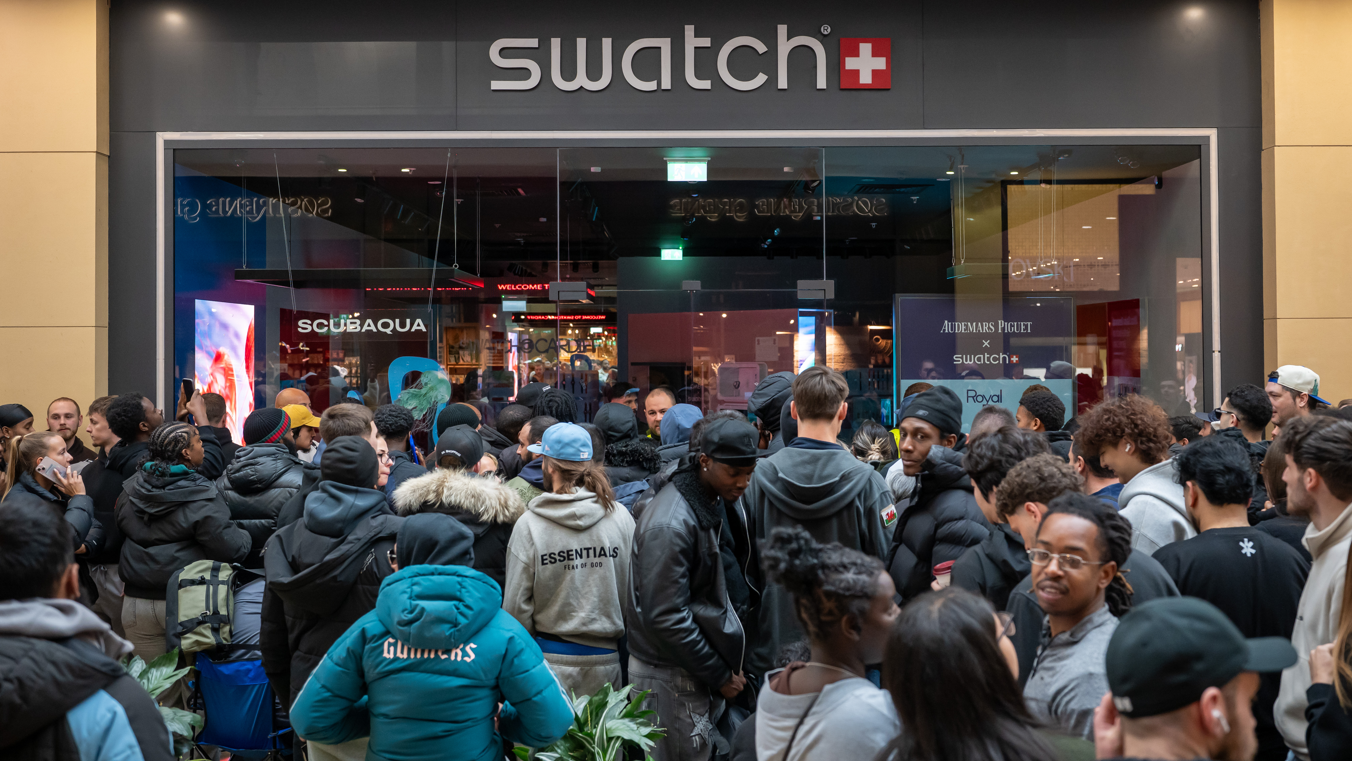
What is confirmed is that Swatch retail locations experienced large crowds forming outside stores following the launch of a new watch release tied to a limited or special-edition collection.
In several locations, queues grew rapidly, with some outlets unable to manage crowd control safely, prompting temporary shutdowns or restricted entry measures.
The surge reflects a recurring pattern in the global watch and collectibles market, where artificially limited supply combined with strong branding and social media amplification can generate sudden spikes in consumer demand.
In this case, the release quickly moved beyond normal retail expectations into a high-volume, high-pressure consumer event.
The key issue is not simply product popularity but the mechanics of scarcity marketing.
Swatch, like other watch brands, frequently uses limited drops, collaborations and region-specific releases to generate urgency.
These strategies rely on controlled supply to increase perceived value, but they also create conditions where physical retail spaces become choke points when demand exceeds capacity.
Crowd density at some locations became significant enough that staff reportedly restricted access or closed doors to prevent overcrowding.
In retail environments, such closures are typically implemented under health and safety obligations when foot traffic poses risks to customers or employees.
This can include fire code compliance limits, police guidance, or internal corporate safety policies.
The demand surge also reflects broader changes in consumer behaviour driven by online hype cycles.
Social media platforms amplify anticipation for limited releases, often encouraging early queuing or coordinated arrival at stores.
This can turn product launches into semi-organised events, even when companies do not officially market them as such.
Secondary market dynamics are also a contributing factor.
Limited-edition Swatch releases have previously appeared on resale platforms at significantly higher prices shortly after launch.
This resale potential incentivises early buyers and contributes to rapid stock depletion, intensifying competition at the point of sale.
Retail analysts note that while Swatch has long operated in the accessible luxury segment, its recent collaborations and themed releases have increasingly blurred the line between mass-market retail and collectible-driven scarcity economics.
That shift makes physical distribution more volatile, especially when launches are concentrated in short time windows.
For the company, store closures during a product launch present a reputational balancing act.
On one hand, high demand signals strong brand engagement and commercial success.
On the other, uncontrolled crowds risk safety incidents and operational disruption, potentially undermining the controlled exclusivity that drives demand in the first place.
For consumers, the outcome is increasingly familiar across global sneaker, gaming console and limited watch markets: demand is structurally engineered to exceed supply.
This creates a cycle in which access is determined less by traditional retail availability and more by timing, queue positioning and digital coordination.
The immediate consequence of the disruption is that affected stores have moved to restore normal trading conditions through staggered entry, purchase limits or temporary closures.
These measures are intended to stabilise operations while preserving product availability for subsequent sales windows.
What is confirmed is that Swatch retail locations experienced large crowds forming outside stores following the launch of a new watch release tied to a limited or special-edition collection.
In several locations, queues grew rapidly, with some outlets unable to manage crowd control safely, prompting temporary shutdowns or restricted entry measures.
The surge reflects a recurring pattern in the global watch and collectibles market, where artificially limited supply combined with strong branding and social media amplification can generate sudden spikes in consumer demand.
In this case, the release quickly moved beyond normal retail expectations into a high-volume, high-pressure consumer event.
The key issue is not simply product popularity but the mechanics of scarcity marketing.
Swatch, like other watch brands, frequently uses limited drops, collaborations and region-specific releases to generate urgency.
These strategies rely on controlled supply to increase perceived value, but they also create conditions where physical retail spaces become choke points when demand exceeds capacity.
Crowd density at some locations became significant enough that staff reportedly restricted access or closed doors to prevent overcrowding.
In retail environments, such closures are typically implemented under health and safety obligations when foot traffic poses risks to customers or employees.
This can include fire code compliance limits, police guidance, or internal corporate safety policies.
The demand surge also reflects broader changes in consumer behaviour driven by online hype cycles.
Social media platforms amplify anticipation for limited releases, often encouraging early queuing or coordinated arrival at stores.
This can turn product launches into semi-organised events, even when companies do not officially market them as such.
Secondary market dynamics are also a contributing factor.
Limited-edition Swatch releases have previously appeared on resale platforms at significantly higher prices shortly after launch.
This resale potential incentivises early buyers and contributes to rapid stock depletion, intensifying competition at the point of sale.
Retail analysts note that while Swatch has long operated in the accessible luxury segment, its recent collaborations and themed releases have increasingly blurred the line between mass-market retail and collectible-driven scarcity economics.
That shift makes physical distribution more volatile, especially when launches are concentrated in short time windows.
For the company, store closures during a product launch present a reputational balancing act.
On one hand, high demand signals strong brand engagement and commercial success.
On the other, uncontrolled crowds risk safety incidents and operational disruption, potentially undermining the controlled exclusivity that drives demand in the first place.
For consumers, the outcome is increasingly familiar across global sneaker, gaming console and limited watch markets: demand is structurally engineered to exceed supply.
This creates a cycle in which access is determined less by traditional retail availability and more by timing, queue positioning and digital coordination.
The immediate consequence of the disruption is that affected stores have moved to restore normal trading conditions through staggered entry, purchase limits or temporary closures.
These measures are intended to stabilise operations while preserving product availability for subsequent sales windows.