UK Confirms Third Suspected Hantavirus Case Linked to Cruise Ship Outbreak
Health authorities are tracking multiple infections tied to the MV Hondius cruise ship, as evacuation, isolation, and international monitoring efforts intensify across Europe, Africa, and remote Atlantic islands.
The United Kingdom’s public health response to a multinational infectious disease incident is now focused on a suspected hantavirus outbreak linked to the cruise ship MV Hondius, after officials confirmed a third British national with a suspected infection.
What is confirmed is that the UK Health Security Agency is actively monitoring British citizens connected to the outbreak, which has already involved evacuations, hospital treatment across multiple countries, and at least one confirmed death among infected passengers.
The third suspected British case involves an individual currently located on the remote island of Tristan da Cunha in the South Atlantic, one of the most isolated inhabited communities in the world.
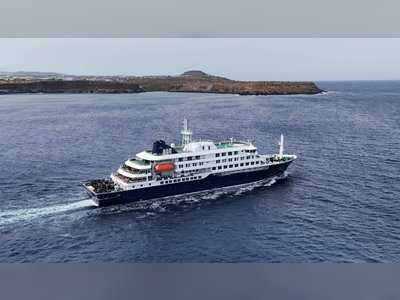
The outbreak originated aboard the MV Hondius, a cruise vessel that was operating in the Atlantic and Antarctic regions before reports of illness began emerging among passengers and crew.
The ship has since become the center of an international public health operation involving the World Health Organization and multiple national health agencies, including those in the United Kingdom, the Netherlands, and South Africa.
Medical authorities have confirmed that several individuals from the vessel have already been evacuated for treatment in Europe and Africa.
At least one British national is receiving specialist care in the Netherlands after evacuation, while another is in intensive care in South Africa.
The newly reported suspected case on Tristan da Cunha is being assessed in coordination with UK health authorities.
Hantavirus is a group of viruses typically carried by rodents such as rats and mice.
Human infection usually occurs through exposure to contaminated urine, droppings, or saliva.
In most documented outbreaks, human-to-human transmission is rare, although certain strains have shown limited transmissibility under close contact conditions.
The disease can range from flu-like symptoms to severe respiratory failure or kidney-related complications, with some forms carrying high fatality rates.
The current outbreak has raised concern not only because of confirmed and suspected cases across multiple continents, but also because of the logistical challenge of tracking passengers who disembarked at various ports during the voyage.
Health agencies are conducting contact tracing and monitoring individuals who may have been exposed, even in the absence of symptoms.
Authorities in the UK have begun arranging repatriation measures for British nationals associated with the ship.
Those returning are expected to undergo medical monitoring and isolation as a precautionary step, reflecting the uncertainty around incubation periods and symptom onset for hantavirus infections.
Despite the seriousness of the outbreak for those directly affected, public health officials continue to emphasize that the overall risk to the general population remains low.
The containment strategy relies on isolating known cases, monitoring contacts, and preventing further spread from identified exposure points rather than broader population-wide measures.
The situation remains under active investigation as international health bodies work to determine the precise chain of transmission aboard the vessel and assess whether any secondary spread has occurred beyond the ship and its immediate contact network.
What is confirmed is that the UK Health Security Agency is actively monitoring British citizens connected to the outbreak, which has already involved evacuations, hospital treatment across multiple countries, and at least one confirmed death among infected passengers.
The third suspected British case involves an individual currently located on the remote island of Tristan da Cunha in the South Atlantic, one of the most isolated inhabited communities in the world.
The outbreak originated aboard the MV Hondius, a cruise vessel that was operating in the Atlantic and Antarctic regions before reports of illness began emerging among passengers and crew.
The ship has since become the center of an international public health operation involving the World Health Organization and multiple national health agencies, including those in the United Kingdom, the Netherlands, and South Africa.
Medical authorities have confirmed that several individuals from the vessel have already been evacuated for treatment in Europe and Africa.
At least one British national is receiving specialist care in the Netherlands after evacuation, while another is in intensive care in South Africa.
The newly reported suspected case on Tristan da Cunha is being assessed in coordination with UK health authorities.
Hantavirus is a group of viruses typically carried by rodents such as rats and mice.
Human infection usually occurs through exposure to contaminated urine, droppings, or saliva.
In most documented outbreaks, human-to-human transmission is rare, although certain strains have shown limited transmissibility under close contact conditions.
The disease can range from flu-like symptoms to severe respiratory failure or kidney-related complications, with some forms carrying high fatality rates.
The current outbreak has raised concern not only because of confirmed and suspected cases across multiple continents, but also because of the logistical challenge of tracking passengers who disembarked at various ports during the voyage.
Health agencies are conducting contact tracing and monitoring individuals who may have been exposed, even in the absence of symptoms.
Authorities in the UK have begun arranging repatriation measures for British nationals associated with the ship.
Those returning are expected to undergo medical monitoring and isolation as a precautionary step, reflecting the uncertainty around incubation periods and symptom onset for hantavirus infections.
Despite the seriousness of the outbreak for those directly affected, public health officials continue to emphasize that the overall risk to the general population remains low.
The containment strategy relies on isolating known cases, monitoring contacts, and preventing further spread from identified exposure points rather than broader population-wide measures.
The situation remains under active investigation as international health bodies work to determine the precise chain of transmission aboard the vessel and assess whether any secondary spread has occurred beyond the ship and its immediate contact network.