
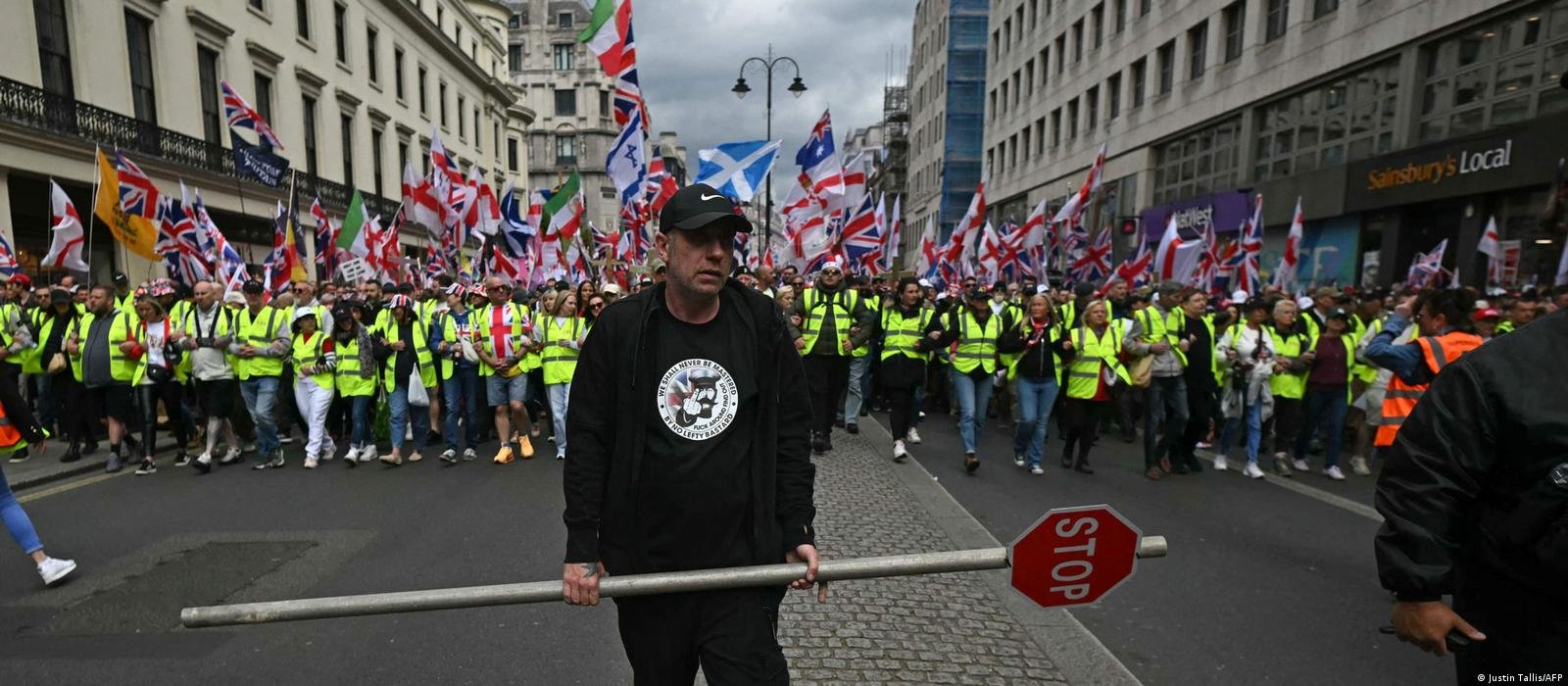
Far-Right Anti-Immigration Protest in London Tests UK Public Order Tensions
Demonstration highlights rising political friction over immigration policy, policing powers, and far-right mobilisation in the UK capital
SYSTEM-DRIVEN dynamics around immigration policy, public order policing, and far-right political mobilisation are shaping renewed tensions in London after an anti-immigration protest staged by a UK far-right group drew attention from authorities and counter-demonstrators.
The protest, held in central London, was organised by a far-right activist network that has repeatedly campaigned against immigration levels and asylum policy in the United Kingdom.
The demonstration formed part of a broader wave of protests and rallies in recent months in which immigration has become a central political flashpoint, particularly in urban centres where asylum housing and government migration policy have become highly contested.
What is confirmed is that the protest involved public assembly in a heavily policed area of London, with participants carrying banners and chanting slogans opposing immigration and government asylum policy.
Police deployed significant resources to manage the event, maintain separation between opposing groups, and prevent escalation into disorder.
Authorities have not reported major incidents of large-scale violence at the time of reporting, though the atmosphere was described as tense due to the presence of counter-protesters.
The political context for the demonstration is a broader increase in immigration as a defining issue in UK domestic politics.
Pressure on government services, housing shortages, and asylum processing backlogs have all contributed to heightened public debate.
Far-right groups have sought to capitalise on these pressures by framing immigration as a security and cultural issue, often using street demonstrations to amplify their message.
The UK government has responded to rising protest activity by strengthening its emphasis on public order policing and reviewing how law enforcement manages repeated demonstrations in sensitive urban areas.
Police forces in London have increasingly relied on pre-emptive containment strategies, including designated protest zones and rapid dispersal powers, to prevent clashes between opposing groups.
Counter-demonstrators, including anti-racism and pro-migrant advocacy groups, also gathered in response to the far-right mobilisation.
This pattern of parallel protests has become a recurring feature in UK cities, reflecting deepening polarisation over immigration policy and national identity.
While most events remain non-lethal and contained, the frequency of confrontational demonstrations has increased operational strain on policing resources.
The mechanism behind the escalation is not a single incident but a feedback loop: online mobilisation amplifies political messaging, offline demonstrations create media visibility, and heightened visibility further incentivises competing groups to organise counter-events.
This dynamic has been observed across multiple recent protest cycles in the UK and Europe.
For policymakers, the immediate challenge is maintaining freedom of assembly while preventing public order breakdowns.
For law enforcement, the operational issue is resource allocation across simultaneous demonstrations in densely populated urban environments.
For political leaders, the protests add pressure to address immigration policy in a way that reduces volatility without further inflaming divisions.
The London protest therefore sits within a wider pattern of contested public space in the UK, where immigration has become not only a policy debate but a recurring trigger for street-level political confrontation that continues to shape policing strategy and national political discourse.
The protest, held in central London, was organised by a far-right activist network that has repeatedly campaigned against immigration levels and asylum policy in the United Kingdom.
The demonstration formed part of a broader wave of protests and rallies in recent months in which immigration has become a central political flashpoint, particularly in urban centres where asylum housing and government migration policy have become highly contested.
What is confirmed is that the protest involved public assembly in a heavily policed area of London, with participants carrying banners and chanting slogans opposing immigration and government asylum policy.
Police deployed significant resources to manage the event, maintain separation between opposing groups, and prevent escalation into disorder.
Authorities have not reported major incidents of large-scale violence at the time of reporting, though the atmosphere was described as tense due to the presence of counter-protesters.
The political context for the demonstration is a broader increase in immigration as a defining issue in UK domestic politics.
Pressure on government services, housing shortages, and asylum processing backlogs have all contributed to heightened public debate.
Far-right groups have sought to capitalise on these pressures by framing immigration as a security and cultural issue, often using street demonstrations to amplify their message.
The UK government has responded to rising protest activity by strengthening its emphasis on public order policing and reviewing how law enforcement manages repeated demonstrations in sensitive urban areas.
Police forces in London have increasingly relied on pre-emptive containment strategies, including designated protest zones and rapid dispersal powers, to prevent clashes between opposing groups.
Counter-demonstrators, including anti-racism and pro-migrant advocacy groups, also gathered in response to the far-right mobilisation.
This pattern of parallel protests has become a recurring feature in UK cities, reflecting deepening polarisation over immigration policy and national identity.
While most events remain non-lethal and contained, the frequency of confrontational demonstrations has increased operational strain on policing resources.
The mechanism behind the escalation is not a single incident but a feedback loop: online mobilisation amplifies political messaging, offline demonstrations create media visibility, and heightened visibility further incentivises competing groups to organise counter-events.
This dynamic has been observed across multiple recent protest cycles in the UK and Europe.
For policymakers, the immediate challenge is maintaining freedom of assembly while preventing public order breakdowns.
For law enforcement, the operational issue is resource allocation across simultaneous demonstrations in densely populated urban environments.
For political leaders, the protests add pressure to address immigration policy in a way that reduces volatility without further inflaming divisions.
The London protest therefore sits within a wider pattern of contested public space in the UK, where immigration has become not only a policy debate but a recurring trigger for street-level political confrontation that continues to shape policing strategy and national political discourse.